Pearson Edexcel International GCSE in Physics · 4PH1 · Free · no account needed
The Life Cycle of Stars — exam questions
10 original Incandio exam-style questions on the Life Cycle of Stars, 24 marks, about 24 minutes of writing. Each one carries the command word, the tariff and the specification statement it assesses, exactly as a paper presents them. This is an original Incandio practice question, written to reflect the structure and demands of the qualification. It is not an official Pearson Edexcel past-paper question.
This is the practice set for The Life Cycle of Stars — the lesson that teaches it. Read the lesson first if the idea is new; come here when you want to find out whether you can turn it into marks. Completely free, no account needed to read.
What these questions ask of you
8 command words run through this set, and on Pearson Edexcel International GCSE Physics each one means something precise. Answering the wrong command is the commonest way a candidate who understands the lesson still loses the mark.
- Which (1 mark)
- one option chosen from the set given
- Name (1 mark)
- the correct quantity, unit or component
- Give (1–2 marks)
- a short factual answer
- Describe (2–4 marks)
- developed, linked statements of what happens — including a named direction where one exists
- Compare (2–4 marks)
- explicit comparison naming both cases
- Explain (2–4 marks)
- the physics that causes it, set out as a line of reasoning Misread as: describing the change without giving the physical reason for it
- Suggest (1–3 marks)
- a plausible answer applying taught physics to an unfamiliar arrangement
- Identify (1–2 marks)
- the correct item selected from what is shown
Assessed on Paper 1 (4PH1/1P) and Paper 2 (4PH1/2P), against AO1, AO2, AO3.
Where these sit in the specification
Pearson Edexcel International GCSE Physics (4PH1) — statements 8.9 · 8.10. Incandio is aligned to this specification; it is not published by, endorsed by or affiliated with Pearson, and it reproduces none of Pearson's wording.
The 10 questions
Answer them on paper, then open the lesson's exam practice to have them marked. The mark scheme, the accepted and rejected answers and the annotated model answer are in Incandio and are not printed here — an answer beside its question is not practice.
-
An astronomer summarised what is expected to become of three stars, all currently on the main sequence, based on the mass of each compared with the Sun.
Table 1 — three main-sequence stars Star Mass compared with the Sun Time on the main sequence / years Proxima Centauri 0.12 4 × 10¹² The Sun 1.0 1 × 10¹⁰ Rigel 21 1 × 10⁷ (a)
(1)Identify
Identify the star in Table 1 that will end its life as a supernova.
An astronomer summarised what is expected to become of three stars, all currently on the main sequence, based on the mass of each compared with the Sun.
Table 1 — three main-sequence stars Star Mass compared with the Sun Time on the main sequence / years Proxima Centauri 0.12 4 × 10¹² The Sun 1.0 1 × 10¹⁰ Rigel 21 1 × 10⁷ (b)
(2)Describe
Describe the relationship between mass and main-sequence lifetime shown by Table 1.
An astronomer summarised what is expected to become of three stars, all currently on the main sequence, based on the mass of each compared with the Sun.
Table 1 — three main-sequence stars Star Mass compared with the Sun Time on the main sequence / years Proxima Centauri 0.12 4 × 10¹² The Sun 1.0 1 × 10¹⁰ Rigel 21 1 × 10⁷ (c)
(4)Explain
Explain why the most massive star in Table 1 has the shortest main-sequence lifetime.
An astronomer summarised what is expected to become of three stars, all currently on the main sequence, based on the mass of each compared with the Sun.
Table 1 — three main-sequence stars Star Mass compared with the Sun Time on the main sequence / years Proxima Centauri 0.12 4 × 10¹² The Sun 1.0 1 × 10¹⁰ Rigel 21 1 × 10⁷ (Total for Question 1 = 7 marks)
-
(1)Which
Which is the final stage in the life of a star like the Sun?
Stage A a black hole B a neutron star C a white dwarf D a supernova (Total for Question 2 = 1 mark)
-
(1)Name
Name the cloud of dust and gas from which a star forms.
(Total for Question 3 = 1 mark)
-
(2)Give
Give the two possible remnants left behind after a supernova.
(Total for Question 4 = 2 marks)
-
(4)Describe
Describe the stages in the life of a star of similar mass to the Sun.
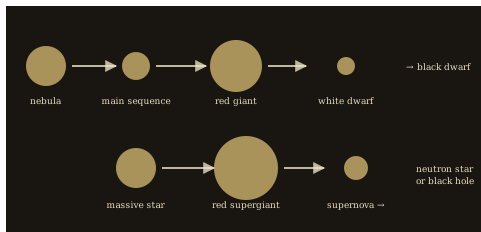
Figure 1 — the life cycles of stars (Total for Question 5 = 4 marks)
-
(3)Compare
Compare what happens at the end of the life of a star like the Sun with what happens to a much more massive star.
(Total for Question 6 = 3 marks)
-
(3)Explain
Explain why a main-sequence star remains stable for billions of years.
(Total for Question 7 = 3 marks)
-
(3)Suggest
Suggest why every atom of iron on Earth must once have been inside a star.
Where the elements come from — The early universe contained almost nothing but hydrogen and helium. Fusion in the core of a star builds progressively heavier nuclei from lighter ones. A supernova scatters the material of the exploding star across a wide region of space, where it can later be gathered into new stars and planets.
(Total for Question 8 = 3 marks)
Have them marked, then defend the answer
Practice tells you the mark; teaching it back tells you whether you understand it. On Incandio a topic counts as mastered only once you have taught it and defended it.
- Mark these questions — 10 questions, marked on Incandio against the authored scheme, with the mistake you actually made named.
- Teach it — explain the Life Cycle of Stars to Ember, an AI pupil who does not have it yet and asks the awkward question.
- Defend it — argue it against Arthur Eddington over three rounds, marked against descriptors you can read first.
Completely free. No subscriptions, no paywalls, no account needed to start.
Back to the lesson
- The Life Cycle of Stars — Two endings from one beginning — and the mass a star is born with decides which it gets.
- All of Incandio Physics · Incandio Exam Practice