Pearson Edexcel International GCSE in Physics · 4PH1 · Free · no account needed
The Life Cycle of Stars
Two endings from one beginning — and the mass a star is born with decides which it gets.
Topic 8 · Astrophysics — one of 7 lessons in this topic, and one of 65 in Physics.
This lesson ends with Arthur Eddington. Learn the Life Cycle of Stars, teach it, then defend it against Arthur Eddington.
The definition this lesson teaches, word for word — every Physics definition.
- Main sequence
- The long stable stage of a star's life during which hydrogen is fusing to helium in the core, and the outward push from fusion balances the inward pull of gravity.
What this lesson covers in the specification
Incandio is aligned to this specification. It is not published by, endorsed by or affiliated with Pearson, and it reproduces none of Pearson's wording — the statement numbers are given so you can check every lesson against your own copy.
- 8.9 — The evolution of stars of similar mass to the Sun
- 8.10 — The evolution of stars much more massive than the Sun
Specification section 8(c) Stellar evolution — also taught in The Hertzsprung–Russell Diagram, The Big Bang and its Evidence.
1 · Understand it
No exam language yet. The only question this section answers is: do I actually understand what is happening?
Every star begins in the same way. A vast cloud of dust and gas — a NEBULA, mostly hydrogen — is pulled together by gravity. As it contracts it gets hotter, because the material falling inwards gains kinetic energy. The hot, dense, collapsing ball at the centre — glowing but not yet fusing anything — is called a PROTOSTAR. When its core becomes hot and dense enough for hydrogen nuclei to overcome their mutual repulsion, fusion begins. The object is now a star, and it is on the MAIN SEQUENCE.
A main-sequence star is stable, and the reason is the balance from the fusion lesson: the outward push from fusion in the core exactly balances the inward pull of gravity. That balance can hold for billions of years, and the Sun has been on the main sequence for about 4.6 billion of them with roughly as long again to go. This is the longest and dullest phase of any star's life, and it is where the great majority of stars are found at any moment.
What ends it is running out of hydrogen in the core. With fusion no longer supplying the outward push, gravity wins for a while and the core contracts and heats further, which starts fusion in a shell around it, and that drives the outer layers outwards enormously. The star swells and its expanded surface cools, so it becomes RED — a RED GIANT for a Sun-like star, or a RED SUPERGIANT for a much more massive one.
Think of it like a fire and the weight of its own chimney
Picture a fire burning inside a heavy metal chimney that is trying to collapse onto it. While the fire burns fiercely, the hot gases rushing up hold the chimney apart, and the arrangement is stable for as long as the fuel lasts. When the fuel runs low the upward push weakens and the chimney begins to fall in — but as it falls it compresses what remains, which flares up hotter than before and blows the whole structure outwards. Everything on this page follows that pattern: a balance held by fuel, a collapse when the fuel fails, and a violent response to the collapse. The only thing that differs between a Sun-like star and a massive one is how much chimney there is to fall, and that difference is enough to produce two entirely different endings.
The life of a star like the Sun — statement 8.9
- NEBULA — a cloud of dust and gas is pulled together by gravity and heats as it contracts.
- PROTOSTAR — the hot, dense, contracting centre of the cloud, not yet hot enough for fusion.
- MAIN SEQUENCE STAR — fusion of hydrogen into helium begins, and the outward push balances gravity for billions of years.
- RED GIANT — the core hydrogen runs out, the core contracts, and the outer layers swell and cool.
- The outer layers are gently shed as a glowing shell of gas, exposing the hot core beneath.
- WHITE DWARF — that exposed core is a small, extremely dense, very hot object that produces no new energy.
- BLACK DWARF — over an enormous time it cools and fades until it emits no visible light at all. No black dwarf yet exists, because the universe is not old enough.
The life of a star much more massive than the Sun — statement 8.10
- NEBULA, PROTOSTAR and then MAIN SEQUENCE, exactly as before — but a massive star burns through its hydrogen far faster, in millions rather than billions of years.
- RED SUPERGIANT — much larger than a red giant, and it goes on to fuse heavier elements in successive shells.
- SUPERNOVA — the core collapses suddenly and the star explodes with enormous violence, briefly outshining an entire galaxy and scattering the elements it made into space.
- What is left depends on the mass. A NEUTRON STAR, extraordinarily dense, for the less massive of these.
- A BLACK HOLE, so dense that not even light can escape it, for the most massive.
- The elements heavier than iron are made in the supernova itself, so every such atom on Earth was produced in one.
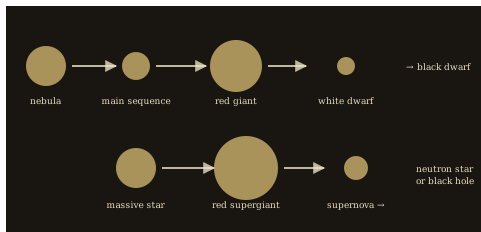
So MASS DECIDES EVERYTHING, and it is settled at birth. A more massive star has stronger gravity, so its core is hotter and denser, so fusion runs far faster — which means that despite having far more fuel it exhausts it much sooner. A star ten times the Sun's mass lives for perhaps twenty million years against the Sun's ten thousand million. The biggest stars have the shortest lives, which is the opposite of what one might expect.
One consequence is worth stating because it is genuinely striking. Fusion in stars built every element heavier than hydrogen and helium, and the elements heavier than iron were made in supernova explosions. The carbon in living things, the oxygen in the air, the iron in blood and the calcium in bones were all made inside stars that died before the Sun formed. That is a physical claim about where the atoms came from, not a metaphor.
2 · Grade 9 Notes
A different job from the section above. You have already understood it; this is the precise set of things to LEARN — definitions to reproduce word for word, processes in order, equations with units, and the answers that score full marks.
Two life cycles, decided by mass
| A star like the Sun | A star much more massive | |
|---|---|---|
| Start | Nebula, then protostar, then main sequence | Nebula, then protostar, then main sequence |
| Time on the main sequence | Billions of years | Millions of years — far shorter |
| Next stage | Red giant | Red supergiant |
| How it ends | Outer layers gently shed | SUPERNOVA — a violent explosion |
| What remains | White dwarf, then black dwarf | Neutron star, or a black hole if massive enough |
Statement 8.9 — a Sun-like star, in order
- Nebula — dust and gas pulled together by gravity, heating as it contracts.
- Protostar — the hot, dense, contracting centre, not yet fusing.
- Main sequence star — hydrogen fuses to helium; the outward push balances gravity for billions of years.
- Red giant — core hydrogen exhausted, core contracts, outer layers swell and cool.
- The outer layers are shed as a glowing shell of gas.
- White dwarf — the hot, dense, exposed core, producing no new energy.
- Black dwarf — the white dwarf cools and fades over an enormous time. None exists yet.
Statement 8.10 — a much more massive star, in order
- Nebula, protostar, then main sequence — but the fuel is used up in millions rather than billions of years.
- Red supergiant — much larger than a red giant, fusing heavier elements in shells.
- Supernova — the core collapses and the star explodes, briefly outshining a galaxy.
- Neutron star — the extremely dense remnant, for the less massive of these.
- Black hole — for the most massive, so dense that not even light escapes.
Learn this definition · Main sequence
The long stable stage of a star's life during which hydrogen is fusing to helium in the core, and the outward push from fusion balances the inward pull of gravity.
The stages, defined
- Nebula
- A cloud of dust and gas, mostly hydrogen, from which stars form.
- Protostar
- The hot, dense, contracting centre of a collapsing nebula, before fusion has started.
- Red giant / supergiant
- A star whose core hydrogen is exhausted, so the outer layers have swelled and cooled.
- White dwarf
- The hot dense exposed core left when a Sun-like star sheds its outer layers. It produces no new energy.
- Supernova
- The violent explosion of a massive star when its core collapses, scattering heavy elements into space.
- Neutron star / black hole
- The remnants of a supernova — extremely dense, and in the black hole's case dense enough that light cannot escape.
Model answer [5 marks]
Describe the stages in the life of a star with a similar mass to the Sun, from its formation to its final state. [5]
The star forms from a nebula, a cloud of dust and gas pulled together by gravity, which heats as it contracts to form a protostar. When the core is hot and dense enough, hydrogen fuses to helium and the star becomes a main sequence star, which remains stable for billions of years because the outward push from fusion balances the inward pull of gravity. When the hydrogen in the core is exhausted, the core contracts and the outer layers swell and cool, so the star becomes a red giant. The outer layers are then shed as a glowing shell of gas, leaving the hot dense core exposed as a white dwarf. Over an extremely long time the white dwarf cools and fades to become a black dwarf.
Model answer [3 marks]
Explain why a star much more massive than the Sun spends far less time on the main sequence, despite having much more fuel. [3]
A more massive star has a much stronger gravitational pull, which compresses its core to a higher pressure and temperature. Fusion proceeds far more rapidly at that higher temperature and pressure, so the star consumes its hydrogen at an enormously greater rate. Although it starts with far more fuel, it uses it so much faster that it exhausts its core hydrogen in millions of years rather than the billions a star like the Sun takes.
Not this: A bigger star lasts longer, because it has more fuel to burn.
This: The opposite. Greater mass means stronger gravity, a hotter denser core and far faster fusion, so the fuel is consumed enormously more quickly. The most massive stars live for a few million years; the Sun lives for about ten thousand million.
Mark-losing trap. The MASS at birth decides everything — which path, how long, and how it ends.
Mark-losing trap. Massive stars have SHORTER lives, not longer ones, despite having more fuel.
Mark-losing trap. A supernova is only for MASSIVE stars. A Sun-like star sheds its layers gently instead.
Mark-losing trap. No black dwarf exists yet — the universe is not old enough for one to have cooled.
3 · Prove it — the five questions
The five questions climb Grade 6 → Grade 7 → Grade 8 → Grade 9 → Grade 9 challenge, and are marked inside Incandio on your own device, by rule, with an authored diagnosis of the mistake you actually made. The mark schemes stay in the app so that the practice is worth doing; the questions themselves are here.
- Grade 6 · State [1 mark] — What is the name of the cloud of dust and gas from which a star forms?
- Grade 7 · State [2 marks] — A star much more massive than the Sun has reached the red supergiant stage. What happens next?
- Grade 8 · Explain [3 marks] — Explain why a main sequence star remains stable for billions of years.
- Grade 9 · Describe [6 marks] — Select every statement that belongs in a full-mark description of the life cycle of a star much more massive than the Sun.
- 9+ · Analyse [6 marks] — Analysis of the Sun shows it contains small quantities of elements much heavier than helium, including iron. A student says this proves the Sun must already have passed through a supergiant stage to have made them. Select every statement that belongs in a full-mark analysis.
The people behind this science
Two ways into the same idea — the one who worked out what happens at the very end, and the one whose equation sets the fuel bill for the whole life cycle. Inside Incandio each of them answers knowing exactly which lesson you have just finished.
Stephen Hawking — the one who worked out what happens at the very end
A black hole is where the massive-star path ends on this page, and it is stated as a fact with no explanation of how anything can be dense enough that light cannot leave. Hawking spent his career on exactly that object, and his most surprising result was that a black hole is not entirely black: quantum effects at the boundary let it radiate very faintly, so it slowly loses mass and, over an unimaginable time, evaporates. He is also the right figure for the honest admission that the centre of a black hole is where the physics on this page stops working and nobody yet knows what replaces it.
- “What actually happens at the edge of a black hole?”
- “How can something be so dense that light cannot escape?”
- “Is a black hole really black?”
- “What happens to matter that falls in?”
- “What do we still not know about them?”
Albert Einstein — the one whose equation sets the fuel bill for the whole life cycle
Every stage on this page is governed by how long the fuel lasts, and the fuel is mass converting into energy at the rate Einstein's relation sets. He is worth asking here rather than on the fusion page because the question is different: not where the energy comes from but how the accounting decides a star's LIFETIME. He is also the person to ask about black holes from the other side — his own theory predicts them, and he spent years arguing that they could not really exist in nature, which is a useful thing for a learner to hear about a prediction now taught as fact.
- “How does the mass of a star decide how long it lives?”
- “Why do the biggest stars burn out fastest?”
- “Did your theory predict black holes?”
- “Why did you argue that black holes could not be real?”
- “Where do the atoms in our bodies actually come from?”
Think you understand it?
Reading is the start. On Incandio a topic counts as mastered only once you have taught it and defended it — the two things a revision guide cannot ask of you.
Incandio this topic → Prove it. Teach it. Defend it. What does “Incandio it” mean?
- Prove it — five questions on the Life Cycle of Stars, marked on the spot, that tell you what was missing rather than just what was wrong.
- Teach it — Explain the Life Cycle of Stars in your own words to Ember, an AI pupil who does not have it yet and asks the awkward question. Understanding is credited; wording is not required.
- Defend it — Argue the Life Cycle of Stars against Arthur Eddington — three rounds, marked against descriptors you can read before you begin.
- Then the exam — read all 10 authored exam-style questions on this unit, each with its command word and its tariff, then have them marked on Incandio with the mistake you actually made named.
Completely free. No subscriptions, no paywalls, no account needed to start.
Carry on through the course
- Previous lesson: Star Colour and Temperature
- Next lesson: The Hertzsprung–Russell Diagram
- The Universe and Gravity — From a moon to the whole universe in five steps, and why your weight would change on the way.
- Orbits — Why anything in orbit is falling, why comets speed up as they arrive, and how to find an orbital speed.
- Star Colour and Temperature — Why blue stars are the hot ones, and how a colour tells you a temperature across the whole galaxy.
- The Hertzsprung–Russell Diagram — Plot every star by colour and true brightness and they do not scatter — they fall into groups.
- The Big Bang and its Evidence — Two observations that between them decided how the universe began.
- All of Physics · Physics key terms · required practicals · equations · Incandio Science · The 4PH1 specification