Pearson Edexcel International GCSE in Physics · 4PH1 · Free · no account needed
Series and Parallel Circuits
Two ways of joining components, and why every building in the world is wired one of them.
Topic 2 · Electricity — one of 9 lessons in this topic, and one of 65 in Physics.
This lesson ends with Gustav Kirchhoff. Learn Series and Parallel Circuits, teach it, then defend it against Gustav Kirchhoff.
The definition this lesson teaches, word for word — every Physics definition.
- Conservation of current at a junction
- The total current flowing into a junction equals the total current flowing out of it, because charge cannot be created, destroyed or accumulated there.
Its equation is on the Physics equations page with the other 37.
What this lesson covers in the specification
Incandio is aligned to this specification. It is not published by, endorsed by or affiliated with Pearson, and it reproduces none of Pearson's wording — the statement numbers are given so you can check every lesson against your own copy.
- 2.7 — Why a series or parallel circuit suits a particular application, including domestic lighting
- 2.17 — Why current is conserved at a junction
- 2.18 — The voltage across components in parallel is the same
- 2.19 — Calculate currents, voltages and resistances for two resistive components in series
Specification section 2(b) Mains electricity — also taught in Resistance and Ohm's Law, Current–Voltage Graphs, LDRs and Thermistors, Electrical Power and Energy, Mains Electricity and Safety.
1 · Understand it
No exam language yet. The only question this section answers is: do I actually understand what is happening?
There are exactly two ways to join two components to a supply. In SERIES they sit one after another on a single loop, so all the charge that goes through one must go through the other. In PARALLEL each sits on its own branch, so the charge divides between them and each branch is connected directly across the supply. Everything else about circuits follows from that one difference — one path or several.
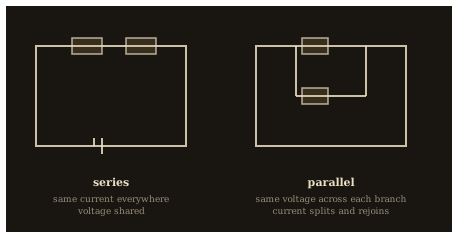
Series circuits — what follows from having one path
- The CURRENT is the same everywhere, because charge is conserved and there is nowhere for it to go except onwards.
- The VOLTAGES ADD UP: the voltages across the individual components add to the supply voltage, because each coulomb of charge gives up energy at each component in turn and the total given up must equal the total supplied.
- The RESISTANCES ADD UP: R_total = R₁ + R₂, because the charge has to be pushed through both in succession.
- So adding a component makes everything dimmer, and breaking the circuit anywhere stops all of it.
Parallel circuits — what follows from having several paths
- The VOLTAGE is the same across every branch, because each branch is connected directly across the supply — each coulomb passes through only one branch and gives up all its energy there.
- The CURRENTS ADD UP: the current from the supply divides at the junction and the branch currents add back to the total, because charge cannot accumulate at a junction or disappear into it.
- That is statement 2.17, and it is worth stating plainly: whatever flows into a junction each second must flow out of it each second.
- The TOTAL RESISTANCE FALLS as branches are added, because adding a branch adds another route for charge, so more current flows for the same voltage.
- Each branch can be switched independently, and a break in one branch leaves the others working.
Think of it like a road with a toll gate, or a road that splits
A series circuit is a single road with two toll gates on it. Every car passes through both, so the number of cars per minute is the same at each gate — that is the current being equal. Each car pays at both gates, and the two payments add up to what it had when it set off, which is the voltages adding to the supply voltage. A parallel circuit is a road that splits into two, each branch with its own gate, before rejoining. Now each car passes through only ONE gate and pays the full amount there — which is why the voltage across each branch is the full supply voltage rather than a share of it. And the cars per minute on the two branches must add up to the cars per minute on the main road, because none of them vanish at the fork.
The two most common errors on this topic are mirror images of each other, and the analogy fixes both. In series, learners often make the current divide — it does not, because there is no fork. In parallel, learners often make the voltage divide — it does not, because each coulomb only travels down one branch and gives up all its energy there. Current divides at a fork; voltage divides along a path.
Two resistors in series — statement 2.19 in full
A 12 V supply is connected in series with a 30 Ω resistor and a 20 Ω resistor. Find the current, and the voltage across each resistor.
- Total resistance: in series the resistances add, so R = 30 + 20 = 50 Ω.
- Current: I = V ÷ R = 12 ÷ 50 = 0.24 A. The same current flows through both.
- Voltage across the 30 Ω resistor: V = I × R = 0.24 × 30 = 7.2 V.
- Voltage across the 20 Ω resistor: V = 0.24 × 20 = 4.8 V.
- Check: 7.2 + 4.8 = 12 V, which is the supply voltage. If the two do not add up, something is wrong.
Answer: 0.24 A through both, with 7.2 V across the 30 Ω resistor and 4.8 V across the 20 Ω one.
Notice how the voltage divided: the larger resistance took the larger share, and in exactly the ratio of the resistances. That is worth remembering as a check, because it makes an implausible answer visible immediately — the bigger resistor always gets the bigger voltage when they are in series.
Now statement 2.7, which asks why one arrangement or the other is chosen. Household lighting is wired in PARALLEL, for three reasons that are all consequences of what parallel does. Every lamp gets the full mains voltage, so all of them are equally bright regardless of how many are switched on. Each can be switched on and off independently. And when one bulb fails the others keep working, because only that branch is broken. Wired in series, a house would go dark whenever any bulb failed, every lamp would be dim, and they could only be switched all together.
Series is not simply the worse option, though — it is chosen when you WANT everything to depend on everything. A safety interlock is wired in series so that opening any guard breaks the circuit and stops the machine. A single switch controlling a whole circuit is in series with it for the same reason. And a set of decorative lights wired in series can run each lamp at a low voltage from one high-voltage supply, which is cheap and is exactly why the whole string used to go out when one bulb blew.
2 · Grade 9 Notes
A different job from the section above. You have already understood it; this is the precise set of things to LEARN — definitions to reproduce word for word, processes in order, equations with units, and the answers that score full marks.
Series against parallel — the four differences to learn
| Series | Parallel | |
|---|---|---|
| Current | the same through every component | divides at a junction; the branch currents add to the total |
| Voltage | divides between components, adding to the supply voltage | the same across every branch, equal to the supply voltage |
| Total resistance | adds: R = R₁ + R₂, so adding a component reduces the current | falls as branches are added, so more current is drawn |
| If one component fails | the circuit is broken and nothing works | only that branch stops; the others carry on |
| Switching | one switch controls everything on the loop | each branch can be switched independently |
R_total = R₁ + R₂ (series)
R_total is the total resistance of two components in series, in ohms (Ω), and R₁ and R₂ are their individual resistances
Units: Ω. In series the resistances ADD. In parallel the total resistance is LESS than either branch on its own.
Learn this definition · Conservation of current at a junction
The total current flowing into a junction equals the total current flowing out of it, because charge cannot be created, destroyed or accumulated there.
Statement 2.19 — two resistive components in series, the routine
- Add the resistances to find the total: R = R₁ + R₂.
- Find the current from the supply voltage: I = V ÷ R. This current is the same through both components.
- Find the voltage across each component from V = I × R, using that component's own resistance.
- Check that the two voltages add up to the supply voltage.
Statement 2.7 — why domestic lighting is wired in parallel
- Every lamp receives the FULL mains voltage, so all are equally bright however many are switched on
- Each lamp can be switched ON AND OFF INDEPENDENTLY of the others
- If one lamp FAILS, only that branch is broken and the rest keep working
- In series, every lamp would be dim, all would go out together, and all would have to be switched at once
- SERIES is chosen where dependence is wanted: a safety interlock, or one switch for a whole circuit
What divides, and where
A. CURRENT divides at a JUNCTION — so it splits between parallel branches, and never within a series loop.
B. VOLTAGE divides along a PATH — so it splits between series components, and never between parallel branches.
Model answer [4 marks]
A 6.0 V supply is connected in series with a 15 Ω and a 25 Ω resistor. Calculate the voltage across the 25 Ω resistor. [4]
In series the resistances add, so the total resistance is 15 + 25 = 40 Ω. The current is therefore I = V ÷ R = 6.0 ÷ 40 = 0.15 A, and this same current flows through both resistors. The voltage across the 25 Ω resistor is V = I × R = 0.15 × 25 = 3.75 V.
Model answer [4 marks]
Explain why the lamps in a house are connected in parallel rather than in series. [4]
In a parallel circuit each lamp is connected directly across the supply, so every lamp receives the full mains voltage and is at its correct brightness however many are switched on. Each lamp is on its own branch, so it can be switched on and off independently of the others. If one lamp fails, only its own branch is broken and the current can still flow through the other branches, so the rest of the lights stay on. In series the lamps would share the supply voltage and all be dim, and a single failure would break the circuit and put out every light in the house.
Not this: In a parallel circuit the supply voltage is shared out between the branches.
This: Every branch has the FULL supply voltage across it. Each coulomb of charge travels down only one branch and gives up all its energy there, so there is nothing to share. It is the CURRENT that divides between branches.
Mark-losing trap. Current divides at a JUNCTION; voltage divides along a PATH. Get those the right way round.
Mark-losing trap. In series, always check your two voltages add up to the supply voltage.
Mark-losing trap. Adding a parallel branch LOWERS the total resistance, because it adds another route for charge.
Mark-losing trap. For 2.7, give a REASON tied to voltage, switching or failure — not just 'parallel is better'.
3 · Prove it — the five questions
The five questions climb Grade 6 → Grade 7 → Grade 8 → Grade 9 → Grade 9 challenge, and are marked inside Incandio on your own device, by rule, with an authored diagnosis of the mistake you actually made. The mark schemes stay in the app so that the practice is worth doing; the questions themselves are here.
- Grade 6 · State [1 mark] — Two lamps are connected in parallel across a 6.0 V supply. What is the voltage across each lamp?
- Grade 7 · Calculate [2 marks] — At a junction in a circuit, a current of 0.90 A flows in. Two branches leave the junction, and one of them carries 0.35 A. Calculate the current in the other branch.
- Grade 8 · Calculate [4 marks] — A 9.0 V supply is connected in series with a 20 Ω resistor and a 40 Ω resistor. Calculate the voltage across the 40 Ω resistor.
- Grade 9 · Explain [5 marks] — Select every statement that belongs in a full-mark explanation of why the lights in a house are wired in parallel rather than in series.
- 9+ · Analyse [6 marks] — A student connects two identical lamps in series to a 12 V battery and finds each is dim. They reconnect the same two lamps in parallel across the same battery, and both are bright. They conclude: 'Parallel is better in every way, so there is no reason ever to use series.' Select every statement that belongs in a full-mark analysis.
The people behind this science
Two ways into the same idea — the one who won the argument about how to wire the world, and the one who insisted on explaining it to people who were not scientists. Inside Incandio each of them answers knowing exactly which lesson you have just finished.
Nikola Tesla — the one who won the argument about how to wire the world
The question this page ends on — how do you actually wire a building — was settled by a public and vicious commercial fight in the 1880s, and Tesla was on one side of it. His alternating-current system, backed by Westinghouse, competed against Edison's direct current for the electrification of American cities, and the decision determined how every home has been wired since. He is the right person to ask why an engineering choice about circuits became a matter of demonstrations, publicity and reputation.
- “Why did it matter so much how a city's electricity was distributed?”
- “What advantages did your system have over the alternative?”
- “How do you win a technical argument that is being fought in the newspapers?”
- “What did you think of the way the dispute was conducted?”
- “Why must every lamp in a house receive the same voltage?”
Michael Faraday — the one who insisted on explaining it to people who were not scientists
Faraday gave the Christmas Lectures at the Royal Institution for nineteen years, and his Chemical History of a Candle is still one of the finest pieces of science teaching ever produced — an entire course built from one object on a table. He is the right figure for a page whose whole difficulty is not the mathematics but the picture, and whose commonest errors come from imagining current being used up or voltage being shared out. He spent his life arguing that if you cannot make the picture clear you do not yet understand it.
- “How would you explain a circuit to someone who has never seen electricity?”
- “Why do people so often think a current gets used up on the way round?”
- “What is the best demonstration for showing that a branch takes its own share?”
- “How do you teach something that cannot be seen at all?”
- “What makes an explanation genuinely clear rather than merely simple?”
Think you understand it?
Reading is the start. On Incandio a topic counts as mastered only once you have taught it and defended it — the two things a revision guide cannot ask of you.
Incandio this topic → Prove it. Teach it. Defend it. What does “Incandio it” mean?
- Prove it — five questions on Series and Parallel Circuits, marked on the spot, that tell you what was missing rather than just what was wrong.
- Teach it — Explain Series and Parallel Circuits in your own words to Ember, an AI pupil who does not have it yet and asks the awkward question. Understanding is credited; wording is not required.
- Defend it — Argue Series and Parallel Circuits against Gustav Kirchhoff — three rounds, marked against descriptors you can read before you begin.
- Then the exam — read all 10 authored exam-style questions on this unit, each with its command word and its tariff, then have them marked on Incandio with the mistake you actually made named.
Completely free. No subscriptions, no paywalls, no account needed to start.
Carry on through the course
- Previous lesson: Resistance and Ohm's Law
- Next lesson: Current–Voltage Graphs, LDRs and Thermistors
- Charge and Current — What is actually moving in a wire, how fast it is really going, and why the arrows on every circuit diagram point the wrong way.
- Resistance and Ohm's Law — What slows the electrons down, the one equation that ties the whole topic together, and when it stops being true.
- Current–Voltage Graphs, LDRs and Thermistors — The shapes four components make on a graph, and two resistors that deliberately refuse to stay the same.
- Voltage as Energy per Charge — What a volt actually is — and why knowing that turns three separate equations into one idea.
- Electrical Power and Energy — Why a wire carrying a current gets hot, how fast a device uses energy, and how to pick a fuse.
- All of Physics · Physics key terms · required practicals · equations · Incandio Science · The 4PH1 specification