Pearson Edexcel International GCSE in Physics · 4PH1 · Free · no account needed
Conduction, Convection and Radiation — exam questions
10 original Incandio exam-style questions on Conduction, Convection and Radiation, 25 marks, about 25 minutes of writing. Each one carries the command word, the tariff and the specification statement it assesses, exactly as a paper presents them. This is an original Incandio practice question, written to reflect the structure and demands of the qualification. It is not an official Pearson Edexcel past-paper question.
This is the practice set for Conduction, Convection and Radiation — the lesson that teaches it. Read the lesson first if the idea is new; come here when you want to find out whether you can turn it into marks. Completely free, no account needed to read.
What these questions ask of you
6 command words run through this set, and on Pearson Edexcel International GCSE Physics each one means something precise. Answering the wrong command is the commonest way a candidate who understands the lesson still loses the mark.
- Name (1 mark)
- the correct quantity, unit or component
- Which (1 mark)
- one option chosen from the set given
- Explain (2–4 marks)
- the physics that causes it, set out as a line of reasoning Misread as: describing the change without giving the physical reason for it
- Describe (2–4 marks)
- developed, linked statements of what happens — including a named direction where one exists
- Suggest (1–3 marks)
- a plausible answer applying taught physics to an unfamiliar arrangement
- Give (1–2 marks)
- a short factual answer
Assessed on Paper 1 (4PH1/1P) and Paper 2 (4PH1/2P), against AO1, AO2, AO3.
Where these sit in the specification
Pearson Edexcel International GCSE Physics (4PH1) — statements 4.6 · 4.8 · 4.7 · 4.9. Incandio is aligned to this specification; it is not published by, endorsed by or affiliated with Pearson, and it reproduces none of Pearson's wording.
The 10 questions
Answer them on paper, then open the lesson's exam practice to have them marked. The mark scheme, the accepted and rejected answers and the annotated model answer are in Incandio and are not printed here — an answer beside its question is not practice.
-
A student filled a metal cube with boiling water. Each of its four vertical faces had a different surface. She held an infrared detector the same distance from each face in turn and recorded the reading, then repeated the whole set of readings twice more and took a mean.
Table 1 — mean detector reading for each face, in arbitrary units Surface of the face Mean detector reading Matt black 8.4 Matt white 6.1 Dull grey metal 4.7 Shiny silver 1.8 (a)
(1)Give
Give the reading for the shiny silver face, using Table 1.
A student filled a metal cube with boiling water. Each of its four vertical faces had a different surface. She held an infrared detector the same distance from each face in turn and recorded the reading, then repeated the whole set of readings twice more and took a mean.
Table 1 — mean detector reading for each face, in arbitrary units Surface of the face Mean detector reading Matt black 8.4 Matt white 6.1 Dull grey metal 4.7 Shiny silver 1.8 reading = ............................
(b)
(2)Explain
Explain what Table 1 shows about the effect of surface on emission of radiation.
A student filled a metal cube with boiling water. Each of its four vertical faces had a different surface. She held an infrared detector the same distance from each face in turn and recorded the reading, then repeated the whole set of readings twice more and took a mean.
Table 1 — mean detector reading for each face, in arbitrary units Surface of the face Mean detector reading Matt black 8.4 Matt white 6.1 Dull grey metal 4.7 Shiny silver 1.8 (c)
(3)Suggest
Suggest what the readings would become if the cube were filled with iced water instead, and explain your prediction.
A student filled a metal cube with boiling water. Each of its four vertical faces had a different surface. She held an infrared detector the same distance from each face in turn and recorded the reading, then repeated the whole set of readings twice more and took a mean.
Table 1 — mean detector reading for each face, in arbitrary units Surface of the face Mean detector reading Matt black 8.4 Matt white 6.1 Dull grey metal 4.7 Shiny silver 1.8 (Total for Question 1 = 6 marks)
-
(1)Name
Name the process by which energy from the Sun reaches the Earth.
(Total for Question 2 = 1 mark)
-
(1)Which
Which surface is the best emitter of infrared radiation?
Surface A shiny silver B shiny white C matt black D matt white (Total for Question 3 = 1 mark)
-
(3)Explain
Explain why a metal spoon left in hot soup becomes hot along its whole length, while a wooden one does not.
(Total for Question 4 = 3 marks)
-
(4)Explain
A heater is placed at floor level in a cold room and after a while the whole room is warm. Explain how convection warms the air near the ceiling.
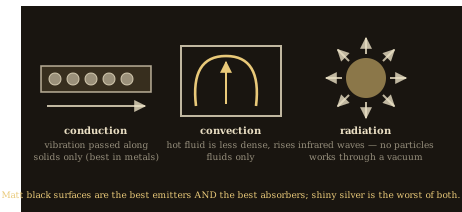
Figure 1 — the three ways thermal energy moves (Total for Question 5 = 4 marks)
-
(3)Describe
Describe how the colour and texture of a surface affect the infrared radiation it emits and absorbs.
(Total for Question 6 = 3 marks)
-
(4)Describe
Describe an investigation to compare how well two different surfaces absorb infrared radiation.
(Total for Question 7 = 4 marks)
-
(3)Suggest
Suggest how each feature of the flask reduces one of the three ways thermal energy is transferred.
A vacuum flask — A vacuum flask keeps a drink hot for hours. It is built as two glass walls with the air pumped out of the gap between them; both surfaces facing that gap are silvered; and the inner container is held in place by a few small plastic supports and closed with a plastic stopper.
(Total for Question 8 = 3 marks)
Have them marked, then defend the answer
Practice tells you the mark; teaching it back tells you whether you understand it. On Incandio a topic counts as mastered only once you have taught it and defended it.
- Mark these questions — 10 questions, marked on Incandio against the authored scheme, with the mistake you actually made named.
- Teach it — explain Conduction, Convection and Radiation to Ember, an AI pupil who does not have it yet and asks the awkward question.
- Defend it — argue it against Benjamin Franklin over three rounds, marked against descriptors you can read first.
Completely free. No subscriptions, no paywalls, no account needed to start.
Back to the lesson
- Conduction, Convection and Radiation — Three ways energy moves from hot to cold — and the one question that tells them apart.
- All of Incandio Physics · Incandio Exam Practice