Pearson Edexcel International GCSE in Physics · 4PH1 · Free · no account needed
The Kinetic Theory of Gases
One picture — fast random molecules bouncing off walls — that predicts everything a gas does.
Topic 5 · Solids, liquids and gases — one of 7 lessons in this topic, and one of 65 in Physics.
This lesson ends with James Clerk Maxwell. Learn the Kinetic Theory of Gases, teach it, then defend it against James Clerk Maxwell.
The 2 definitions this lesson teaches, word for word — every Physics definition.
- The kinetic theory of gases
- The model in which a gas is a very large number of small particles in rapid random motion, colliding elastically with the container walls and occupying a negligible fraction of its volume.
- Average molecular speed
- The mean speed of the molecules of a gas. The molecules have a wide range of speeds at any instant, and raising the temperature shifts the whole range upwards rather than changing every molecule equally.
What this lesson covers in the specification
Incandio is aligned to this specification. It is not published by, endorsed by or affiliated with Pearson, and it reproduces none of Pearson's wording — the statement numbers are given so you can check every lesson against your own copy.
- 5.18 — Why a rise in temperature increases the average speed of gas molecules
- 5.19 — Kelvin temperature is proportional to the average kinetic energy of the molecules
- 5.20 — The qualitative relationships between pressure and volume, and pressure and Kelvin temperature
1 · Understand it
No exam language yet. The only question this section answers is: do I actually understand what is happening?
The previous page established that gas pressure comes from molecules colliding with the walls. This page takes that single picture and gets everything else out of it — because once you know that pressure depends on how OFTEN the molecules strike and how HARD, every relationship in the topic follows by asking what a change does to those two things.
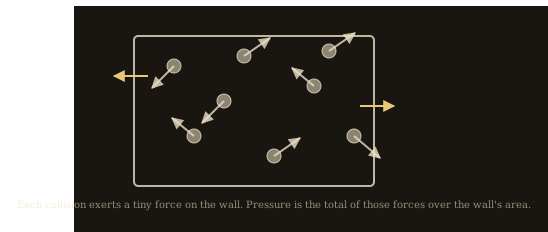
Start with statement 5.19, which is the most important sentence here: the KELVIN TEMPERATURE of a gas is PROPORTIONAL to the average kinetic energy of its molecules. Double the kelvin temperature and you double the average kinetic energy. That is what temperature IS on this account — not a separate property, but a measure of molecular motion, which is why the scale has to start where the motion stops.
Statement 5.18 — why heating speeds the molecules up
- Heating the gas transfers energy to it, and that energy goes into the kinetic store of the molecules.
- The average KINETIC ENERGY of the molecules therefore increases.
- Kinetic energy is ½mv², and the mass of each molecule is unchanged, so an increase in kinetic energy must be an increase in SPEED.
- The average speed of the molecules therefore rises.
- Because kinetic energy depends on the SQUARE of the speed, doubling the kelvin temperature doubles the average kinetic energy but multiplies the average speed by only about 1.4.
One important qualification, because the word 'average' is doing real work. The molecules do not all travel at the same speed — at any instant there is a wide spread, with some barely moving and a few going extraordinarily fast. Raising the temperature shifts the whole distribution upwards rather than giving every molecule the same push. This is why evaporation can happen well below boiling point: even in cool water, a few molecules at the top of the range have enough energy to escape.
Statement 5.20 — the two relationships, derived rather than memorised
- PRESSURE AND TEMPERATURE at constant volume. Heating raises the average speed, so molecules strike the walls MORE OFTEN and each collision produces a LARGER momentum change. Both increase the force on the walls, so the PRESSURE RISES — in direct proportion to the kelvin temperature.
- PRESSURE AND VOLUME at constant temperature. Reduce the volume and the molecules have less distance to travel between walls, so they strike them MORE OFTEN. Their speed is unchanged, since the temperature is unchanged, so each collision is just as hard as before.
- More frequent collisions of the same strength mean a greater force on each unit of area, so the PRESSURE RISES as the volume falls.
- That relationship is INVERSE: halve the volume and the pressure doubles, because the collisions become twice as frequent.
- Notice which quantity is doing the work in each case. Temperature changes how HARD and how OFTEN; volume changes only how OFTEN.
Think of it like squash players in a court that can shrink
Picture a court with a few dozen players hitting balls at the walls at random. The thump you hear from outside depends on two things: how often a ball lands and how hard each one arrives. Now make the players hit harder — that is raising the temperature — and both go up at once, because the balls travel faster AND get back to the wall sooner. Instead, make the court smaller without changing how hard anyone hits: the balls arrive more often simply because the walls are closer, but each impact is exactly as hard as before. Both changes increase the thumping, and they do it by different routes. That is the whole difference between the two gas laws, and it is why the pressure–temperature relation involves molecular speed and the pressure–volume one does not.
It is worth appreciating how much this model gets right from very little. It assumes only that a gas is a large number of small particles in rapid random motion, colliding elastically with the walls and occupying a negligible fraction of the volume. From that alone come gas pressure, both gas laws, the existence of absolute zero, the fact that pressure acts equally in all directions, why gases are easily compressed and why they diffuse. Very few models in physics pay for themselves so completely.
And it is worth knowing where it stops working, because every model has an edge. The assumptions fail when a gas is compressed so much that the molecules occupy a significant share of the volume, or cooled so far that the attractions between them stop being negligible — which is exactly when a real gas starts to depart from the gas laws and eventually liquefies. The model does not break down mysteriously; it breaks down precisely where its own assumptions do.
2 · Grade 9 Notes
A different job from the section above. You have already understood it; this is the precise set of things to LEARN — definitions to reproduce word for word, processes in order, equations with units, and the answers that score full marks.
Learn this definition · The kinetic theory of gases
The model in which a gas is a very large number of small particles in rapid random motion, colliding elastically with the container walls and occupying a negligible fraction of its volume.
Statement 5.19 — temperature and molecular energy
- The KELVIN temperature is PROPORTIONAL to the average kinetic energy of the molecules
- Double the kelvin temperature and the average kinetic energy doubles
- Because KE = ½mv², doubling the kinetic energy multiplies the average SPEED by only about 1.4
- At 0 K the kinetic energy would be zero, which is why the scale starts there
- The molecules have a RANGE of speeds; heating shifts the whole spread upwards
Learn this definition · Average molecular speed
The mean speed of the molecules of a gas. The molecules have a wide range of speeds at any instant, and raising the temperature shifts the whole range upwards rather than changing every molecule equally.
Statement 5.20 — the two relationships, and the mechanism for each
| Pressure and temperature (constant volume) | Pressure and volume (constant temperature) | |
|---|---|---|
| What is changed | the gas is heated | the container is made smaller |
| Effect on molecular speed | speed INCREASES | speed UNCHANGED — the temperature is the same |
| How often they hit the walls | more often, because they move faster | more often, because the walls are closer |
| How hard each collision is | harder — a larger momentum change | the same as before |
| Result | pressure rises in DIRECT proportion to kelvin temperature | pressure rises INVERSELY as the volume falls |
Explaining any gas relationship from the model
- State what has changed and whether the temperature is constant.
- Say what happens to the average SPEED of the molecules — it changes only if the temperature does.
- Say what happens to how OFTEN the molecules strike the walls.
- Say what happens to how HARD each collision is, in terms of momentum change.
- Combine both to say what happens to the total force, and therefore to the pressure.
The two ways to raise the pressure — same result, different mechanism
A. HEATING at constant volume raises both how OFTEN and how HARD the molecules strike, because they are moving faster.
B. COMPRESSING at constant temperature raises only how OFTEN, because the walls are closer. The speed, and so the force of each impact, is unchanged.
Model answer [5 marks]
Explain, using the kinetic theory, why the pressure of a fixed mass of gas increases when it is heated at constant volume. [5]
Heating the gas increases the average kinetic energy of its molecules, and since the kelvin temperature is proportional to that average kinetic energy, the molecules move faster on average. Because they are moving faster, they reach the walls of the container more often, so there are more collisions each second. Each collision also involves a larger change of momentum, because the molecules arrive faster, so each one exerts a greater force on the wall. Both effects increase the total force on the walls, and since the volume and therefore the area are unchanged, the pressure increases.
Model answer [4 marks]
Explain, using the kinetic theory, why reducing the volume of a gas at constant temperature increases its pressure. [4]
Because the temperature is unchanged, the average kinetic energy and therefore the average speed of the molecules stays the same, so each collision with a wall produces the same change of momentum as before. Reducing the volume means the molecules have a shorter distance to travel between the walls, so they collide with the walls more frequently. More collisions each second, each exerting the same force, means a greater total force on the walls. The area of the walls has also decreased, and both effects together mean the pressure increases.
Not this: Compressing a gas makes its molecules move faster, which is why the pressure rises.
This: At constant temperature the molecules move at exactly the same average speed. The pressure rises only because they strike the walls MORE OFTEN, having less distance to travel. Speed changes only when the temperature changes.
Mark-losing trap. Temperature changes how HARD and how OFTEN. Volume changes only how OFTEN.
Mark-losing trap. It is the KELVIN temperature that is proportional to average kinetic energy, never the Celsius one.
Mark-losing trap. Say 'average' — the molecules have a RANGE of speeds, and that range is why evaporation happens.
Mark-losing trap. Explain by collisions per second AND momentum change per collision. Both are marks.
3 · Prove it — the five questions
The five questions climb Grade 6 → Grade 7 → Grade 8 → Grade 9 → Grade 9 challenge, and are marked inside Incandio on your own device, by rule, with an authored diagnosis of the mistake you actually made. The mark schemes stay in the app so that the practice is worth doing; the questions themselves are here.
- Grade 6 · State [1 mark] — What happens to the average speed of the molecules of a gas when it is heated?
- Grade 7 · State [2 marks] — A gas is compressed into a smaller volume at constant temperature. What happens to the average speed of its molecules?
- Grade 8 · State [2 marks] — The kelvin temperature of a gas is doubled. What happens to the average kinetic energy of its molecules?
- Grade 9 · Explain [5 marks] — Select every statement that belongs in a full-mark explanation, using the kinetic theory, of why heating a fixed mass of gas at constant volume increases its pressure.
- 9+ · Analyse [6 marks] — A student explains both gas laws the same way: 'Whenever the pressure of a gas increases, it is because the molecules are moving faster.' Select every statement that belongs in a full-mark analysis.
The people behind this science
Two ways into the same idea — the one who described the molecules statistically rather than individually, and the one who found a way to see the molecules doing it. Inside Incandio each of them answers knowing exactly which lesson you have just finished.
James Clerk Maxwell — the one who described the molecules statistically rather than individually
Maxwell built the kinetic theory this page uses, and his decisive move was to give up on the individual molecules. There are far too many to follow, and their collisions are far too numerous — so instead he worked out the DISTRIBUTION of their speeds, showing how many are moving at each speed at a given temperature. That distribution still carries his name, and it is why the word 'average' has to appear in every statement on this page. It was also one of the first times a physical law was expressed as a statistical statement rather than a mechanical one.
- “How can you describe molecules you could never hope to track?”
- “Why do the molecules have a range of speeds rather than one speed?”
- “What made you willing to use probability in physics?”
- “What does temperature actually mean, on your account?”
- “How much can a model get right while ignoring so much detail?”
Albert Einstein — the one who found a way to see the molecules doing it
The kinetic theory assumes rapid random molecular motion, and for decades that was an assumption nobody could check — the molecules are far too small to see. Einstein's 1905 paper on Brownian motion supplied the test. A particle small enough is bombarded unevenly by the molecules around it and will visibly jitter, and he predicted precisely how far such a particle should wander in a given time. Perrin measured it, the prediction held, and the random motion on this page stopped being a modelling assumption and became an observation.
- “How does a jiggling speck of pollen show that molecules are moving?”
- “What exactly did you predict that could be measured?”
- “Why is the motion of the speck irregular rather than steady?”
- “What did this settle that argument alone could not?”
- “Would the effect work with a larger particle?”
Think you understand it?
Reading is the start. On Incandio a topic counts as mastered only once you have taught it and defended it — the two things a revision guide cannot ask of you.
Incandio this topic → Prove it. Teach it. Defend it. What does “Incandio it” mean?
- Prove it — five questions on the Kinetic Theory of Gases, marked on the spot, that tell you what was missing rather than just what was wrong.
- Teach it — Explain the Kinetic Theory of Gases in your own words to Ember, an AI pupil who does not have it yet and asks the awkward question. Understanding is credited; wording is not required.
- Defend it — Argue the Kinetic Theory of Gases against James Clerk Maxwell — three rounds, marked against descriptors you can read before you begin.
- Then the exam — read all 10 authored exam-style questions on this unit, each with its command word and its tariff, then have them marked on Incandio with the mistake you actually made named.
Completely free. No subscriptions, no paywalls, no account needed to start.
Carry on through the course
- Previous lesson: Gas Pressure and Absolute Zero
- Next lesson: The Gas Laws
- Density — Not how heavy something is, but how much of it is packed into the space it occupies.
- Pressure, and Pressure in Liquids — Why a drawing pin works, why pressure at a point pushes every way at once, and why depth is the only thing that matters underwater.
- Particles and Changes of State — What the particles are doing in each state — and why a boiling pan stays at 100 °C however hard you heat it.
- Specific Heat Capacity — Why the sand burns your feet and the sea is freezing on the same afternoon.
- Gas Pressure and Absolute Zero — Where the pressure of a gas actually comes from, and why the temperature scale has to start somewhere else.
- All of Physics · Physics key terms · required practicals · equations · Incandio Science · The 4PH1 specification