Explore Their Life · Pearson Edexcel International GCSE revision on Incandio
William Harvey: A Life in Five Chapters
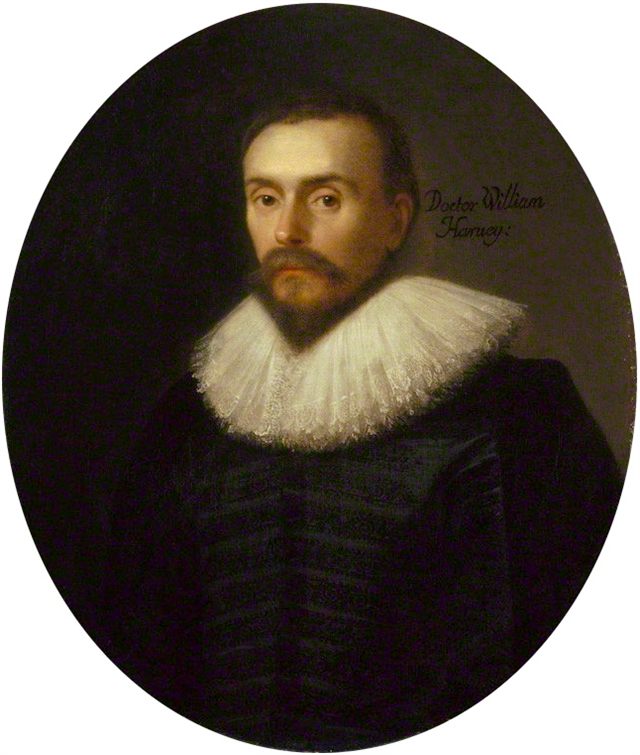
1578–1657
The royal physician who destroyed fourteen hundred years of medical authority with a piece of arithmetic — and then spent twenty-five years being called a quack for it.
Harvey proved that blood circulates by working out how much of it the heart moves in an hour, and showing that no organ could possibly make that much. He could not see the vessels that completed the loop and said so. These five chapters follow a calculation, its cost, and the four years between his death and its confirmation.
The five chapters
- Padua, and a Teacher Who Missed It — The valves described without their purpose
- The Arithmetic That Settled It — How much blood can a liver make in a day?
- The Vessels He Could Not See — Inferring what no lens would show
- Circulator — A quarter-century being called a quack
- Out of Everything, an Egg — Embryology, a lost library, and a childless marriage
Chapter 1 · Padua, and a Teacher Who Missed It
The valves described without their purpose
1578 – 1602 · Folkestone · Cambridge · Padua
William Harvey was born at Folkestone in 1578, the eldest son of a prosperous Kentish merchant family. He took his degree at Caius College, Cambridge, and then went to Padua — the best medical school in Europe, and the one place where anatomy was taught by dissection at the centre of the room rather than read aloud from Galen while a servant cut.
His teacher was Hieronymus Fabricius, who in 1603 published a description of the small membranous flaps inside the veins. Fabricius saw them clearly, drew them accurately, and got their purpose entirely wrong: he thought they slowed the blood down so that the limbs were not flooded.
They are one-way valves. They permit flow toward the heart and block it in the other direction. Harvey worked this out later, and the point that mattered was not the anatomy but the direction: the veins are built to carry blood *inward*, always, everywhere. That is not what a system of ebb and flow would look like.
He returned to London, joined the College of Physicians, married Elizabeth Browne — daughter of the royal physician — and in 1609 became physician to St Bartholomew's Hospital, where he treated the poor of London for the rest of his working life.
He was later physician to James I and then to Charles I, which gave him something unusual: access to the royal deer parks, and therefore a supply of animals for dissection that no other anatomist in England had.
Why this matters
Fabricius saw the venous valves and misread them; Harvey read the same structures correctly, which shows that observation without the right question yields nothing.
You have the valves seen and misunderstood. What would you ask him?
Ask Harvey
- “Your teacher saw the valves — why did he not see what they were for?”
- “What was different about learning anatomy at Padua?”
- “How much did the royal deer parks matter to your research?”
- “What did Galen say the blood did?”
- “What was St Bartholomew's like to work in?”
Chapter 2 · The Arithmetic That Settled It
How much blood can a liver make in a day?
c. 1615 – 1628 · London
Galen's account, believed for fourteen hundred years, was that blood is continuously manufactured in the liver from digested food, carried outward, and consumed by the tissues. It ebbs and flows in the vessels like a tide.
Harvey killed it with a sum.
Measure how much blood the left ventricle holds. Even on a deliberately cautious estimate — assume it expels only a fraction of its contents at each beat — multiply by the number of beats in half an hour. The figure comes out at many pounds of blood: on his own reckoning, more than the entire weight of a man, produced in a fraction of a day.
No liver could do that. There is not enough food in the world to supply it. Therefore the blood is not being consumed and remade. It must be the same blood, going round and coming back.
This is worth pausing on. Nobody had used a *quantity* to settle a question in medicine before. The argument does not depend on seeing anything new; it depends on multiplying two numbers and noticing that the answer is absurd. Harvey did not need better instruments than his opponents. He needed to ask how much.
He confirmed the direction of flow directly. Tie a ligature tightly round an arm and the arteries below are blocked; loosen it and the arm swells with blood arriving by artery and unable to leave by the compressed veins. Press a vein empty with a finger and it refills only from the far end.
“I profess to learn and teach anatomy not from books but from dissections.”
— William Harvey, De Motu Cordis (1628), dedication
Why this matters
Harvey introduced quantitative reasoning into medicine: the decisive step was not a new observation but a calculation whose answer was impossible.
You have the sum that broke Galen. What is your question?
Ask Harvey
- “Take me through the calculation that convinced you.”
- “Why had nobody thought to ask how much blood before?”
- “What does the ligature experiment on an arm actually show?”
- “Could a careful Galenist have answered your arithmetic?”
- “Is the heart a pump, or something more than that?”
Chapter 3 · The Vessels He Could Not See
Inferring what no lens would show
1628 · London · Frankfurt
*Exercitatio Anatomica de Motu Cordis et Sanguinis in Animalibus* — on the motion of the heart and blood in animals — was published at Frankfurt in 1628. It is seventy-two pages, badly printed on poor paper, and it is one of the foundational texts of physiology.
It contains an admitted gap. Blood leaves the heart by the arteries and returns by the veins. Harvey could trace arteries until they became too fine to follow, and veins likewise. He could not see what joined them.
He did not pretend otherwise, and he did not invent a mechanism. He argued that connections must exist which are too small to be observed, because the circulation requires them and everything else about it is demonstrated. He also showed that blood forced into an artery in a dead animal emerges from the corresponding vein, so a passage exists whether or not anybody can see it.
That is an inference from necessity, and it is honest. He states what he has shown, states what he has not, and says why the unobserved thing must be there.
Marcello Malpighi saw those capillaries in a frog's lung in 1661, using a microscope, four years after Harvey's death. He did not live to see the loop closed.
He also never knew what the blood carried. Oxygen was not identified until the 1770s. Harvey knew that blood moves and why it must; he had no idea what the movement was *for*.
Why this matters
Harvey inferred the capillaries from necessity, stated plainly that he could not see them, and was vindicated thirty-three years later.
You have the gap he refused to paper over. What would you ask?
Ask Harvey
- “How can you assert vessels exist that nobody has ever seen?”
- “Why admit the gap rather than propose a mechanism?”
- “What did you think the blood was carrying?”
- “Why publish so short a book, and abroad?”
- “What would you have given for a microscope?”
Chapter 4 · Circulator
A quarter-century being called a quack
1628 – 1650s · London · Paris
The reception was hostile and it lasted. Harvey wrote that after the book appeared his medical practice fell away, and that many held him to be crack-brained.
The insult his opponents used was *circulator* — which in Latin means a wandering mountebank, a market-square quack, as well as one who makes things go round. The pun was deliberate and it stuck for years.
Jean Riolan the younger, the leading anatomist in Paris and the most formidable of the opponents, rejected the circulation and proposed a compromise in which a limited circulation existed alongside Galenic ebb and flow. Harvey answered him at length and courteously, in two published letters, and did not give an inch on the substance.
The resistance was not simple stupidity. Galenic medicine was an entire system — of diagnosis, of prognosis, and above all of treatment. Bloodletting from particular veins for particular complaints made sense only within it. If the blood simply goes round, the reasoning behind where and when to bleed a patient collapses. Accepting Harvey meant abandoning the theory behind most of what physicians actually did.
Harvey's own view was that a true finding can wait. He lived long enough to see the circulation generally accepted in England by the 1650s — and to see almost nothing change in medical practice, because knowing that blood circulates does not, by itself, tell you how to treat anybody.
Why this matters
The resistance to Harvey was rational as well as stubborn: accepting the circulation invalidated the reasoning behind most contemporary treatment.
You have twenty-five years of being called a mountebank. What is your question?
Ask Harvey
- “What did it cost you to publish?”
- “Why did physicians resist so hard, beyond mere stubbornness?”
- “How did you answer Riolan without losing your temper?”
- “Did knowing about the circulation help a single patient in your lifetime?”
- “Would you publish again knowing what it would cost?”
Chapter 5 · Out of Everything, an Egg
Embryology, a lost library, and a childless marriage
1642 – 1657 · Oxford · Edgehill · London
Harvey stayed with Charles I when the Civil War came. He was present at Edgehill in 1642 and, according to John Aubrey, spent the battle under a hedge reading a book, until a shot came too near.
His lodgings at Whitehall were ransacked by Parliamentary troops, and he lost papers, notes and specimens — including, he said, his records on the generation of insects, which he never reconstructed. He followed the King to Oxford, was made Warden of Merton, and lost the position when the city surrendered.
In 1651, aged seventy-three, he published *De Generatione Animalium*, on the development of animals — the fruit of decades of observation of deer, chicks and other embryos. He argued against the prevailing view that the embryo is preformed and merely enlarges, holding instead that structures appear in sequence out of undifferentiated material. He could not see enough to prove it, and the frontispiece carries his summary: *ex ovo omnia* — everything from an egg.
His marriage to Elizabeth was childless, and she predeceased him. He suffered badly from gout in old age. He died on 3 June 1657, aged seventy-nine, of a stroke, and left money to the College of Physicians to build a library.
He never knew that Malpighi would see his capillaries four years later, or that his method — measure it, and let the number decide — would matter more in the end than his result.
Why this matters
Harvey's embryology argued that structures form in sequence rather than being preformed — an argument he could not settle with the instruments he had.
You have the lost papers and the egg. What would you ask him?
Ask Harvey
- “What did you lose when your lodgings were ransacked?”
- “What do you mean by 'everything from an egg'?”
- “Were you really reading under a hedge at Edgehill?”
- “How much did serving the King cost you when he lost?”
- “Which mattered more — the circulation, or how you proved it?”
What Harvey changed
Harvey founded physiology as an experimental science. The circulation of the blood underlies everything later understood about the heart, the lungs and transport in the body, and his method — measure the thing and let the number decide — changed how medicine argues. He inferred the capillaries he could not see; Malpighi found them four years after his death.
A debate that continues
How far Harvey's own thinking remained shaped by Aristotelian ideas of the heart's primacy, rather than being purely mechanical, is still discussed, as is the extent of his debt to Realdo Colombo's earlier account of the pulmonary transit.
Keep exploring — ask Harvey
- “What would you measure next if you had another lifetime?”
- “Is an inference from necessity as good as an observation?”
- “Which of your opponents argued best against you?”
Related lives
- Marcello Malpighi — Founder of Microscopic Anatomy
- Antonie van Leeuwenhoek — Who Found A World In A Drop Of Water
- Claude Bernard — Father of Experimental Medicine
- Robert Hooke — Who Named the Cell and Weighed the Spring
Related themes
The circulatory system · Transport in animals · Evidence and proof in biology
Where Harvey appears in your course
William Harvey has a genuine claim on 5 lessons of the Pearson Edexcel International GCSE science course built into Incandio:
- Blood — Biology: Before Harvey, blood was thought to be manufactured in the liver and used up by the body. If that were true, blood could not be a transport medium at all — it would be a supply. He proved by measuring the heart's output that the same blood must return and be reused, which is precisely what allows plasma to collect carbon dioxide here and deliver it there, and to carry heat from a warm organ to a cold one.
- The Heart, and What Goes Wrong With It — Biology: Everything on this page depends on the heart being a pump driving blood round a circuit, and that was established by Harvey in 1628 against the settled opinion of every physician in Europe. His decisive argument was not a dissection but a calculation: multiply what the heart holds by the beats in an hour, and the liver would have to manufacture many times a man's own weight in blood each day.
- Blood Vessels and the Circulation — Biology: Harvey proved blood travels out through arteries and back through veins, which requires something joining the two — and no lens available to him would show it. He argued the connections must exist and be too small to see, and was mocked for it. Marcello Malpighi saw the capillaries under a microscope in 1661, four years after Harvey died.
- The Kidney and the Nephron — Biology: Filtration in the glomerulus is driven by blood pressure, and blood only has pressure because a muscular heart generates it and drives blood round a closed circuit. Before Harvey, blood was thought to seep and ebb rather than be pumped — and a kidney could not have worked this way at all in that picture. His circulation is what makes the mechanism on this page possible.
- ADH and the Water Balance of the Blood — Biology: ADH is made in one organ and acts on another, several handspans away, with nothing connecting them but blood. That only works if blood genuinely travels in a circuit reaching every organ and returning — which is Harvey's discovery. In a body where blood ebbed and seeped as the ancients believed, chemical messaging of this kind would be impossible.
Continue on Incandio
- Talk to Harvey — every question on this page is one tap from being asked, and the same page carries the Historical Brief, the achievements and the timeline
- All 280 figures · Incandio — learn every idea, teach it, then defend it