Explore Their Life · Pearson Edexcel International GCSE revision on Incandio
Dwight D. Eisenhower: A Life in Five Chapters
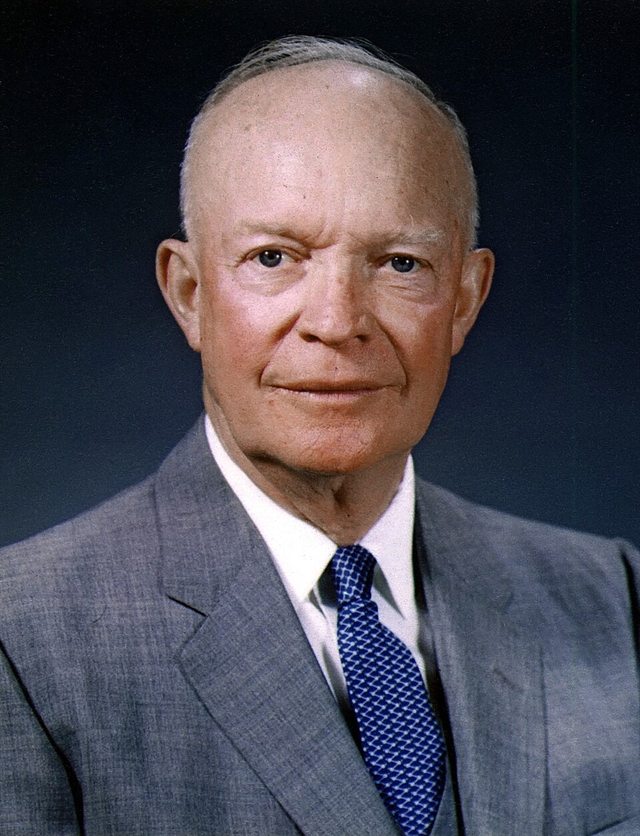
1890–1969
A Kansas boy who reached fifty as a lieutenant colonel, commanded the largest invasion in history with a note in his pocket taking the blame if it failed, and left the presidency warning America about the arms industry he had built.
Eisenhower spent twenty-five years being overlooked and then four commanding the Western war. These five chapters follow the long anonymity, the coalition command, the presidency that ended the Korean War and refused several others, the paratroopers at Little Rock, and a farewell address nobody expected.
The five chapters
- Twenty-Five Quiet Years — The class the stars fell on, and a man who missed the war
- The Note in His Pocket — Supreme Command, and what it actually consisted of
- The Wars He Did Not Fight — A general president who kept saying no
- Little Rock — A president who disagreed with the ruling and enforced it anyway
- The Farewell Address — A warning from the man who had built the thing he warned about
Chapter 1 · Twenty-Five Quiet Years
The class the stars fell on, and a man who missed the war
1890 – 1941 · Abilene · West Point · Panama · The Philippines
Dwight Eisenhower was born in 1890 and raised in Abilene, Kansas, in a family with very little money and a pacifist religious background his career did not much resemble. He went to West Point because it was free, and graduated in 1915 in a class that produced so many generals it became known as the class the stars fell on.
He missed the First World War. He trained tank crews in Pennsylvania, applied repeatedly for a posting to France, and was refused every time; the orders finally came for a date after the armistice. He regarded it at the time as a personal catastrophe.
What followed was two decades of staff work: Panama, the Army Industrial College, seven years working for Douglas MacArthur in Washington and then the Philippines. He learned the drafting of plans, the handling of difficult superiors, and the politics of coalitions, and he was still a lieutenant colonel at the age of fifty.
When war came, Marshall brought him to Washington to the War Plans Division and promoted him with extraordinary speed. In June 1942 he was sent to London to command American forces in Europe, over the heads of a great many senior men. He had never commanded troops in battle and never would.
Why this matters
The Supreme Commander of the invasion of Europe had never led men under fire, and what he was chosen for was the ability to hold an alliance together.
A lieutenant colonel at fifty. What would you ask him?
Ask Eisenhower
- “What did missing the First World War do to you?”
- “What did seven years working for MacArthur teach you?”
- “Did you expect to end your career as a colonel?”
- “Why do you think Marshall picked you?”
- “How does someone with no combat command lead soldiers who have fought?”
Chapter 2 · The Note in His Pocket
Supreme Command, and what it actually consisted of
1942 – 1945 · London · North Africa · Normandy · Reims
Eisenhower commanded the landings in North Africa in 1942, then Sicily and Italy, and in December 1943 was appointed Supreme Commander of the invasion of France.
The job was not principally military. It was the management of an alliance in which Montgomery was insubordinate, Patton was uncontrollable, de Gaulle would not be commanded by anybody, the British and American staffs distrusted each other's plans, and every one of them had a government behind them. What Eisenhower supplied was the ability to keep them all in the same operation, and he was ruthless about it — he sacked officers for anti-British or anti-American remarks, on the grounds that the alliance was the weapon.
On the night before D-Day he wrote a short statement to be released if the landings failed. It said the troops had done everything bravery could do, and that if any blame attached to the attempt it was his alone. He put it in his wallet and forgot about it; it was found weeks later. He had post-dated it wrongly, to July, which tells you something about the state he wrote it in.
The landings succeeded, France was liberated, and the German surrender was signed in his headquarters at Reims in May 1945. He came home the most popular man in America and both parties tried to make him their presidential candidate.
Why this matters
Supreme Command was a political job, and the note in the wallet is the clearest surviving evidence of how a commander thought about responsibility.
A note accepting the blame, written the night before. What would you ask him?
Ask Eisenhower
- “Why write the failure message before you knew?”
- “How did you actually keep Montgomery and Patton in the same war?”
- “Why sack officers for insulting an ally?”
- “What was the hardest decision of the invasion?”
- “Did you want the presidency when you came home?”
Chapter 3 · The Wars He Did Not Fight
A general president who kept saying no
1953 – 1961 · Washington · Korea · Indochina · Suez
Eisenhower was elected in 1952 and ended the Korean War within six months of taking office. What followed is a presidency defined more by refusals than by actions.
In 1954 the French were surrounded at Dien Bien Phu and asked for American air support. Some of his advisers pressed for it and the use of nuclear weapons was discussed. He refused, on the grounds that he would not commit American forces to a ground war in Asia without allies and without congressional authority.
In 1956 Britain, France and Israel attacked Egypt over the Suez Canal without telling him. He was extremely angry and applied financial pressure on the pound that forced a British withdrawal within days. It is the clearest demonstration in the whole period of where power in the Western alliance now lay.
He held military spending down against continuous pressure to raise it, using the doctrine of massive retaliation partly because nuclear weapons were cheaper than armies. He absorbed the political damage of Sputnik in 1957 without panicking, and refused to build the missile force the alarm demanded.
Against that: the CIA under his presidency overthrew the government of Iran in 1953 and of Guatemala in 1954, and the U2 flight shot down over the Soviet Union in May 1960 destroyed the Paris summit and the détente he had spent his last year building.
Why this matters
A president who had commanded the largest army in Western history spent eight years declining to use force, which is the least expected thing about him.
A general who kept refusing wars. What would you ask him?
Ask Eisenhower
- “Why refuse to help the French at Dien Bien Phu?”
- “What did you do to the pound during Suez, and why?”
- “Was massive retaliation a strategy or a way of saving money?”
- “Were the coups in Iran and Guatemala worth what they cost?”
- “What did the U2 shoot-down cost you personally?”
Chapter 4 · Little Rock
A president who disagreed with the ruling and enforced it anyway
September 1957 · Little Rock · Washington
Eisenhower did not welcome Brown v Board of Education. He thought desegregation could not be imposed by law faster than opinion would accept it, he declined to endorse the ruling publicly, and he later said that appointing Earl Warren as Chief Justice was among his worst mistakes.
In September 1957 the Governor of Arkansas used the state National Guard to prevent nine black students entering Central High School in Little Rock. A federal court had ordered their admission. When a mob surrounded the school and the local police could not hold it, Eisenhower federalised the Arkansas National Guard — taking it out of the Governor's hands — and sent a battalion of the 101st Airborne Division.
The soldiers escorted the students into the school and stayed for the year. It was the first use of federal troops to enforce civil rights in the South since Reconstruction.
His reasoning was not about civil rights. He said so: the issue was that a federal court order had been defied by a state governor, and if that stood there was no federal law. The students got their year at Central High, and they got it because a president who disagreed with the ruling would not tolerate a state nullifying a court.
Both halves of that belong in any honest account. He was slow, reluctant and privately unsympathetic, and when the moment came he sent the 101st Airborne.
Why this matters
Little Rock shows a president enforcing a decision he disliked because the alternative was the end of federal authority — a distinction worth understanding precisely.
Paratroopers escorting nine students to school. What would you ask him?
Ask Eisenhower
- “Why would you not say publicly that Brown was right?”
- “What decided you to send the 101st Airborne?”
- “Was federalising the Arkansas Guard the point of the whole operation?”
- “Did you think about the nine students themselves?”
- “Would you have acted if no court order had been defied?”
Chapter 5 · The Farewell Address
A warning from the man who had built the thing he warned about
January 1961 · Washington · Gettysburg
Three days before leaving office, Eisenhower gave a televised address that nobody expected to be memorable. In it he described a permanent armaments industry of vast size, new in American experience, and the combination of that industry with a large military establishment. He warned that its total influence — economic, political, even spiritual — was felt in every city and every statehouse, and that the nation must guard against the acquisition of unwarranted influence by what he called the military-industrial complex.
The words were his own position, worked over for months with his speechwriters, and the striking thing about them is who was saying them: the man who had commanded the invasion of Europe, run NATO, and presided over eight years of nuclear build-up. He was describing something he had helped create and could see he had not been able to control.
He retired to a farm at Gettysburg, beside the battlefield, and died in 1969.
His reputation followed a path like Truman's. He left office regarded as a genial figure who had presided rather than governed. The opening of his papers changed that: the letters and diaries show a president who took the decisions himself, kept his own counsel deliberately, and used apparent vagueness in press conferences as a technique. The phrase historians now use is the hidden-hand presidency, and the farewell address is the clearest evidence for it.
Why this matters
The warning about the military-industrial complex carries its weight because of who gave it, and because he did not exempt himself.
A warning from the man who built it. What would you ask him?
Ask Eisenhower
- “Why give that warning at the end rather than act on it in office?”
- “What could a president actually do about an armaments industry?”
- “Was seeming vague in press conferences deliberate?”
- “Which of your eight years do you think was the most dangerous?”
- “Do you think you governed as much as you presided?”
What Eisenhower changed
Eisenhower commanded the invasion of Europe and then spent eight years as president declining to fight: he ended Korea, refused Indochina, stopped Suez by squeezing the pound, and held military spending down against constant pressure. He also authorised the coups in Iran and Guatemala, and he left office warning America against the armaments industry he had done as much as anyone to build. The reappraisal of him rests on his own papers, which show a far more deliberate president than the one his contemporaries thought they had.
A debate that continues
Was Eisenhower a passive president who let his cabinet govern, or a highly controlled one who concealed how much he decided? The hidden-hand reading now dominates, but how far it can be pushed is still argued.
Keep exploring — ask Eisenhower
- “Should a leader enforce a law they believe is being applied too fast?”
- “Can a president control an industry the country depends on?”
- “What is a general president likely to see that a civilian one is not?”
Related lives
- George Marshall — He Gave The Command Away And Never Said What It Cost
- Harry S. Truman — Eighty-Two Days, And Nobody Told Him Anything
- Martin Luther King Jr. — Reverend · Nobel Laureate · Prophet
Related themes
The Cold War in the 1950s · Civil rights and federal power · The military-industrial complex
Continue on Incandio
- Talk to Eisenhower — every question on this page is one tap from being asked, and the same page carries the Historical Brief, the achievements and the timeline
- All 280 figures · Incandio — learn every idea, teach it, then defend it