Explore Their Life · Pearson Edexcel International GCSE revision on Incandio
Harry S. Truman: A Life in Five Chapters
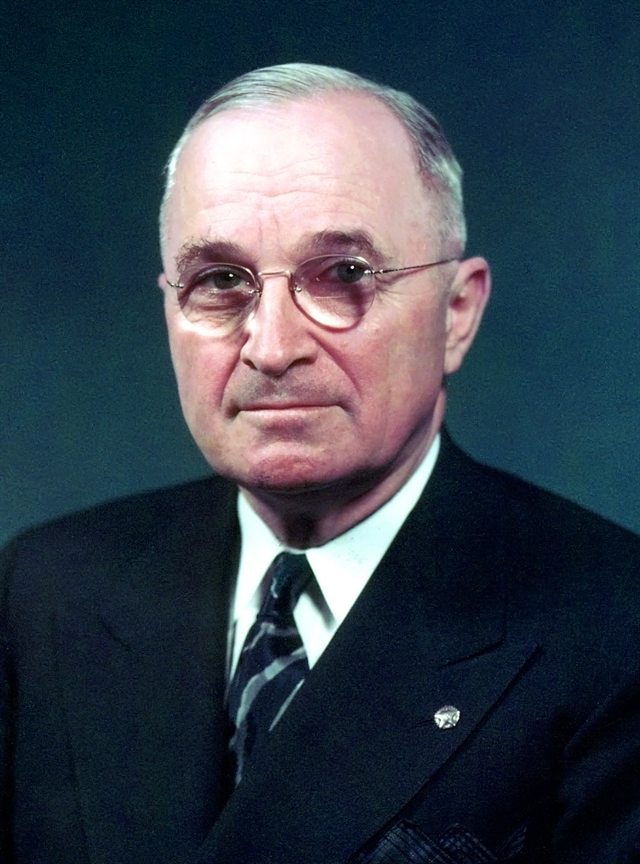
1884–1972
A failed shopkeeper from Missouri who was vice-president for eighty-two days, was not told the atomic bomb existed until he was president, and then made almost every decision that set the shape of the Cold War.
Truman took office knowing less about the war he was running than any incoming president in American history, and left it having built the institutions the West used for forty years. These five chapters follow the farm, the failed shop, the eighty-two days, the year that made the Cold War, and a reputation that rose long after he had gone.
The five chapters
- The Farm, the Guns and the Shop That Failed — The last president who never went to college
- Eighty-Two Days — A vice-president who was told nothing
- The Year the Cold War Was Built — A doctrine, a plan, and a loyalty programme
- Korea, and the General He Sacked — Civilian control, at the cost of everything else
- The Reputation That Arrived Late — Out at the bottom, and up ever since
Chapter 1 · The Farm, the Guns and the Shop That Failed
The last president who never went to college
1884 – 1934 · Lamar · Independence · The Western Front · Kansas City
Harry Truman was born in Missouri in 1884 and grew up on a farm. His eyesight was too poor for West Point and there was no money for college, so he farmed until he was thirty-three — which makes him the only twentieth-century American president with no university degree.
In 1917 he went to France as an artillery officer and commanded Battery D, a unit of Irish-American Kansas City men with a reputation for eating their commanders. He was not physically imposing and he wore spectacles, and he held them, and they stayed loyal to him for the rest of his life. He always said the army was where he found out he could lead.
He came home and opened a men's outfitters in Kansas City with an army friend. It failed in the recession of the early 1920s and left him in debt for years; he refused to declare bankruptcy and paid it off slowly.
What rescued him was the Pendergast machine, the Democratic organisation that ran Kansas City. It made him a county judge — an administrative post rather than a judicial one — and in 1934 it sent him to the United States Senate. He arrived with the label the Senator from Pendergast, and it stuck for years.
None of this is the biography of a man expected to matter. It is the biography of a competent, unglamorous, personally straight machine politician.
Why this matters
Truman's political base was a big-city machine, and the ordinariness of his career is what made his 1945 inheritance so extraordinary.
A failed shop and a machine seat. What would you ask him?
Ask Truman
- “What did commanding Battery D teach you that farming had not?”
- “Why did you refuse to declare bankruptcy when the shop failed?”
- “What did you owe the Pendergast machine, and what did it cost you?”
- “Did not having a degree hold you back in Washington?”
- “How did the Truman Committee change how the Senate saw you?”
Chapter 2 · Eighty-Two Days
A vice-president who was told nothing
January – August 1945 · Washington · Potsdam · Hiroshima
Truman was made vice-president in January 1945 because he was acceptable to everybody and objectionable to nobody: the party bosses would not have Henry Wallace, the South would not have James Byrnes, and Roosevelt did not much care. In eighty-two days as vice-president he met the President twice on business.
Roosevelt died on 12 April 1945. Truman was sworn in that evening. He had not been briefed on the Manhattan Project — he learned that an atomic weapon existed from the Secretary of War after he became president — and he had not been shown the war plans, the state of the alliance, or what had been agreed at Yalta.
Within four months he had ended the war in Europe, gone to Potsdam to negotiate with Stalin and Churchill, and authorised the use of two atomic bombs on Japanese cities.
The decision on the bomb has been argued about ever since, and the argument is real. The case made at the time was that it would end the war without an invasion of the Japanese home islands, whose casualty estimates were very high and are themselves disputed. The case against runs from the position of Japan by August 1945, to the Soviet declaration of war on 8 August, to the question of whether the second bomb on Nagasaki was necessary at all, to the question of what message was being sent to Moscow. Truman never publicly expressed doubt about it.
Why this matters
The most consequential decision of the century was taken by a man who had known the weapon existed for less than four months.
Eighty-two days, and then everything. What would you ask him?
Ask Truman
- “What were you told about the war on the day Roosevelt died?”
- “How did you first learn that an atomic bomb existed?”
- “At Potsdam, what did you make of Stalin?”
- “Was the second bomb, on Nagasaki, necessary?”
- “Did you ever have second thoughts about August 1945?”
Chapter 3 · The Year the Cold War Was Built
A doctrine, a plan, and a loyalty programme
1947 – 1949 · Washington · Greece · Berlin
In February 1947 Britain informed Washington that it could no longer afford to support Greece and Turkey. Truman went to Congress in March and asked for the money, and framed the request in terms that went far beyond Greece: that it must be the policy of the United States to support free peoples resisting subjugation. That is the Truman Doctrine, and it committed the United States to a global posture it had never held in peacetime.
What followed in three years is the architecture of the West. The Marshall Plan, announced by his Secretary of State in June 1947 and eventually worth around thirteen billion dollars. The National Security Act of 1947, which created the CIA, the Department of Defense and the National Security Council. The Berlin Airlift from June 1948, which supplied a city of two million by air for nearly a year rather than force a corridor. NATO in April 1949 — the first peacetime military alliance in American history.
The same years produced the other thing. In March 1947, days after the Doctrine speech, Truman signed Executive Order 9835 establishing a loyalty programme for federal employees. It was intended partly to protect his foreign policy from the charge of softness, and it built the administrative machinery — loyalty boards, security files, dismissal without an accuser — that McCarthy later used and that ruined a great many people who had done nothing.
He also desegregated the armed forces by executive order in 1948, against furious opposition from his own party's Southern wing, in an election year he was expected to lose.
Why this matters
The years that built containment also built the loyalty apparatus of the Red Scare, and the same president signed both.
Containment and the loyalty boards in the same spring. What would you ask him?
Ask Truman
- “Why frame a request about Greece as a doctrine for the whole world?”
- “Why supply Berlin by air rather than force the road?”
- “Did the loyalty programme protect the country or arm McCarthy?”
- “You desegregated the armed forces in an election year you expected to lose. Why then?”
- “Was the Marshall Plan generosity or self-interest?”
Chapter 4 · Korea, and the General He Sacked
Civilian control, at the cost of everything else
1950 – 1953 · Washington · Korea · Wake Island
North Korean forces crossed the 38th parallel in June 1950. Truman committed American troops within days, through the United Nations, and without asking Congress for a declaration of war — a precedent with a very long life. The intervention saved South Korea from being overrun and then went further: after the landing at Inchon, UN forces crossed into the north and drove towards the Chinese border, and China entered the war in November.
The war settled into a stalemate near where it had started, and it consumed Truman's presidency. Douglas MacArthur, the UN commander, wanted to widen it — bombing across the Chinese border, and possibly the use of atomic weapons — and said so publicly, in letters and statements that contradicted the policy of the government he served.
In April 1951 Truman sacked him. MacArthur was the most famous soldier in America; he came home to ticker-tape parades and addressed a joint session of Congress, and Truman's approval ratings collapsed to around a fifth of the country. He never recovered them.
He was entirely clear about why he had done it. A general who makes his own foreign policy in public is not a general, whatever he has won. It is the single most important assertion of civilian control over the military in American history, and it cost the man who made it his presidency.
Why this matters
Sacking MacArthur was politically ruinous and constitutionally decisive, and Truman knew both when he did it.
The most popular soldier in America, dismissed. What would you ask him?
Ask Truman
- “Why commit troops to Korea without asking Congress to declare war?”
- “Was crossing the 38th parallel a mistake?”
- “What made MacArthur's public statements unacceptable?”
- “Did you expect the country to turn on you for it?”
- “Was atomic use in Korea ever seriously considered?”
Chapter 5 · The Reputation That Arrived Late
Out at the bottom, and up ever since
1953 – now · Independence · Washington
Truman left office in January 1953 as one of the least popular presidents ever measured. Korea was unresolved, McCarthy was at his height, corruption cases had reached people close to him, and he was widely regarded as a small man who had been given a large job.
He went home to Independence, Missouri, to a house that belonged to his wife's family, and took no corporate directorships and no consultancies. There was no presidential pension at the time; Congress created one partly because his circumstances were embarrassing. He wrote his memoirs, walked in the mornings, and answered his own front door.
His reputation began to rise in the 1960s and has gone on rising. Historians now routinely place him in the upper group of American presidents, and the reason is the 1947–49 record: the Doctrine, the Marshall Plan, the airlift and NATO are the structure the West used until 1989, and all four were built in three years by a man nobody had thought capable of it.
The things that will not go away are the loyalty programme, which supplied the machinery of the Red Scare, and the bomb, which is not a settled question and should not be taught as one. Both belong in any account of him, and neither cancels the other. He is the strongest case in modern history for the proposition that competence and decisiveness in an ordinary person can matter more than brilliance in a remarkable one.
Why this matters
Truman is the clearest example of a presidential reputation made by decisions rather than by popularity, and remade decades after the man had gone.
Out at the bottom, and rising ever since. What would you ask him?
Ask Truman
- “Why did you refuse to take money for your name after leaving office?”
- “Which of your decisions do you expect to be judged worst?”
- “Did you understand in 1947 that you were building something permanent?”
- “What should a president do when the country is against them and they are right?”
- “How much of what you did was really Marshall and Acheson?”
What Truman changed
In under four years Truman authorised the use of atomic weapons, committed the United States to containing the Soviet Union everywhere, funded the reconstruction of western Europe, supplied Berlin by air for eleven months, founded NATO, desegregated the armed forces and dismissed the most famous general in America for insubordination. The institutions of that period outlasted the Cold War itself. So did the loyalty apparatus he signed into being, and so did the argument about Hiroshima.
A debate that continues
Was the atomic bombing of Japan necessary to end the war, or was it partly a message to the Soviet Union? Historians have argued the point since the 1960s and the archival evidence supports more than one reading.
Keep exploring — ask Truman
- “Can a decision be right at the time and wrong in retrospect?”
- “What does a democracy owe a general who disagrees with it in public?”
- “Should the same president be judged for containment and for the loyalty boards together?”
Related lives
- George Marshall — He Gave The Command Away And Never Said What It Cost
- Dwight D. Eisenhower — He Sent Troops To Little Rock For The Court, Not The Cause
- Franklin D. Roosevelt — Try It, And If It Fails Admit It Frankly
Related themes
The origins of the Cold War · Nuclear weapons and their use · Containment
Continue on Incandio
- Talk to Truman — every question on this page is one tap from being asked, and the same page carries the Historical Brief, the achievements and the timeline
- All 280 figures · Incandio — learn every idea, teach it, then defend it