Explore Their Life · Pearson Edexcel International GCSE revision on Incandio
George Marshall: A Life in Five Chapters
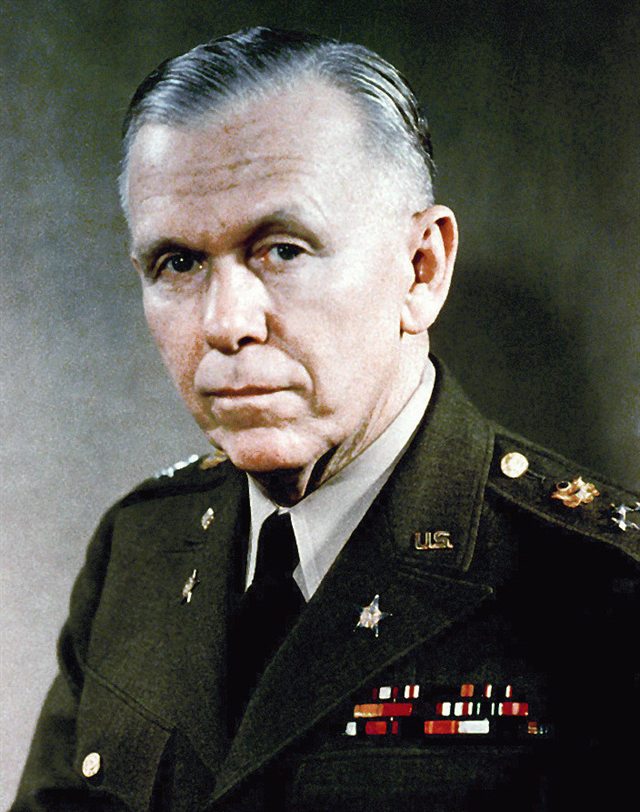
1880–1959
The soldier who built an eight-million-man army, gave away the command he had spent his life earning, rebuilt Europe with a speech at a graduation ceremony, and was called a traitor on the floor of the Senate.
Marshall is the least famous of the Americans who shaped the century, largely by choice. These five chapters follow the cadet nobody expected much of, the Chief of Staff who built an army from almost nothing, the command he did not take, the plan that carries his name, and the smear that came at the end of it.
The five chapters
- The Cadet Nobody Expected Much Of — Virginia Military Institute, and a war spent on paper
- Building an Army From Nothing — Chief of Staff on the day the war began
- The Command He Gave Away — Overlord, and the man who did not ask for it
- Fifteen Minutes at a Graduation — The plan, and the year in China before it
- The Smear, and the Silence That Followed It — A Nobel Prize, and an accusation nobody answered
Chapter 1 · The Cadet Nobody Expected Much Of
Virginia Military Institute, and a war spent on paper
1880 – 1919 · Uniontown · Lexington · France
George Marshall was born in Pennsylvania in 1880 and went to the Virginia Military Institute rather than West Point, which in the American army of the period was a distinct disadvantage. He was an unremarkable student who worked extremely hard and was noticed for organisation rather than dash.
In the First World War he never commanded troops in battle. He was a staff officer, and he turned out to be one of the best in the army: he planned the movement of six hundred thousand men and their supplies into position for the Meuse–Argonne offensive in 1918, a logistical operation of a size the American army had never attempted, executed largely at night to conceal it.
That is the shape of his whole career. He was a planner, not a battlefield commander, in an army that promoted battlefield commanders — and he had a reputation for saying what he thought to superiors who did not want to hear it, which cost him for twenty years and eventually made him.
Between the wars he served in China, taught, and ran the Infantry School at Fort Benning, where he rewrote the training and kept a notebook of officers he thought capable. Many of the American generals of the Second World War are in that notebook, and Marshall took them out of it when the time came.
Why this matters
The man who ran the American war effort had never commanded a unit in combat, which is why he judged commanders the way he did.
A staff officer with a notebook of names. What would you ask him?
Ask Marshall
- “What did moving six hundred thousand men teach you about war?”
- “Did never commanding in battle hold you back?”
- “What were you looking for when you wrote a name in the notebook?”
- “Why did you tell superiors things they did not want to hear?”
- “How much did going to VMI rather than West Point matter?”
Chapter 2 · Building an Army From Nothing
Chief of Staff on the day the war began
1939 – 1941 · Washington
Marshall was sworn in as Army Chief of Staff on 1 September 1939, the day Germany invaded Poland. The army he inherited was smaller than Portugal's. It had a few hundred thousand men, obsolete equipment, and a Congress that had no intention of paying for more.
What he did over the next six years is the least glamorous and possibly the most consequential American achievement of the war. The army grew to over eight million. He rebuilt the training system, retired a large number of senior officers who were too old or too slow, and promoted young men over the heads of their seniors on the strength of what he had seen. He testified before Congress constantly, and he was believed, because he never overstated and never asked for more than he could justify.
He also took the position, before Pearl Harbor, that Germany had to be defeated first even though Japan had attacked — a strategic judgement that shaped the whole war and was politically very hard to hold.
He had a rule about the President that everybody around him noticed: Roosevelt called almost everyone by their first name and never called Marshall anything but General Marshall, because Marshall would not permit the familiarity. He believed it would compromise his ability to tell the President things the President did not want to hear.
Why this matters
The scale of American mobilisation was an administrative achievement before it was a military one, and it belonged to one man.
An army the size of Portugal's, on the day Poland was invaded. What would you ask him?
Ask Marshall
- “How do you retire hundreds of senior officers without breaking an army?”
- “Why insist that Germany be defeated before Japan?”
- “Why would you not let the President call you by your first name?”
- “How did you persuade a Congress that did not want to pay?”
- “Who did you promote that nobody else would have?”
Chapter 3 · The Command He Gave Away
Overlord, and the man who did not ask for it
1943 · Washington · Cairo · Tehran
By 1943 the invasion of France was being planned and the command of it was the most desirable appointment in the Western world. Everybody assumed it was Marshall's — Roosevelt assumed it, Churchill assumed it, Stimson pressed for it, and it was the culmination of everything he had built.
Roosevelt asked him what he wanted. Marshall refused to say. He took the position that the President should decide on the basis of what served the country, and that for the Chief of Staff to express a preference about his own advancement was improper.
Roosevelt kept him in Washington. The reason he gave was that he could not sleep at night with Marshall out of the country, which was a compliment and a sentence of disappointment. The command went to Dwight Eisenhower, a man Marshall had promoted from lieutenant colonel four years earlier.
He accepted it without visible complaint and went on running the war from a desk. It is the most-cited example of his character and it is also a piece of evidence about how the American war was run: the officer with the best claim to the most famous command in history would not ask for it, and did not get it.
Why this matters
Refusing to state a preference about his own future is the decision that defines Marshall, and it cost him the command of D-Day.
The command of Overlord, and a man who would not ask. What would you ask him?
Ask Marshall
- “Why would you not tell Roosevelt that you wanted Overlord?”
- “Did you mind that Eisenhower took it?”
- “Was staying in Washington the right decision for the war?”
- “What is an officer allowed to want for themselves?”
- “Did you ever regret it?”
Chapter 4 · Fifteen Minutes at a Graduation
The plan, and the year in China before it
1945 – 1949 · China · Washington · Cambridge, Massachusetts
Marshall retired in November 1945 and was in his driveway when the White House telephoned. Truman sent him to China as special envoy, to try to broker a settlement between the Nationalists and the Communists. He spent a year at it, and failed, and always regarded it as the failure of his life. Whether anybody could have succeeded is genuinely doubtful.
He became Secretary of State in January 1947, and on 5 June that year he gave a short address at the Harvard commencement. He offered American help to rebuild Europe, on the condition that the Europeans agreed among themselves what was needed and asked for it jointly. He did not use the word plan. It was fifteen minutes long, and most American newspapers barely reported it; the British Foreign Secretary heard it on the radio and acted within a day.
What followed was around thirteen billion dollars over four years, the Organisation for European Economic Cooperation, and the beginning of the habit of western European states negotiating economically as a group. The offer was formally extended to the Soviet Union and eastern Europe; Moscow refused it and required its satellites to refuse it too, which is the point at which the division of Europe became economic as well as political.
He insisted the programme was directed against hunger and chaos rather than against any country. Almost nobody believed that then and few historians believe it now, but the reconstruction was real whatever the motive.
Why this matters
The Marshall Plan was offered to the whole of Europe and refused by half of it, which is when the continent's division became permanent.
Fifteen minutes at a graduation ceremony. What would you ask him?
Ask Marshall
- “Why insist that Europeans decide together what they needed?”
- “Did you expect the Soviet Union to refuse?”
- “What went wrong in China, and could anything have gone right?”
- “Was the plan charity, strategy, or a market for American goods?”
- “Why give the most important speech of your life at a graduation?”
Chapter 5 · The Smear, and the Silence That Followed It
A Nobel Prize, and an accusation nobody answered
1950 – 1959 · Washington · Wisconsin · Oslo
Truman brought Marshall back a third time, as Secretary of Defense, when the Korean War began. He was seventy. He served for a year, oversaw the rearmament the war required, and supported the dismissal of MacArthur.
In June 1951 Joseph McCarthy delivered a speech in the Senate — later published as a book — accusing Marshall of participation in a conspiracy so immense as to dwarf any in human history. The charge was that Marshall's decisions had deliberately handed China and eastern Europe to Communism. It was an accusation of treason against the man who had built the American army, made against him on the floor of the Senate, and it was not seriously believed by anyone in Washington.
The following year Eisenhower, campaigning for the presidency and needing McCarthy's supporters in Wisconsin, had a passage defending Marshall in a draft speech. He removed it before delivering it. Marshall had promoted Eisenhower over dozens of more senior men and had made his career. He never publicly complained about it, and Eisenhower's biographers have treated it as the worst thing he ever did.
In 1953 Marshall was awarded the Nobel Peace Prize — the only professional soldier ever to receive it. He died in 1959 and, at his own insistence, was buried at Arlington without a state funeral, without lying in state, and with no eulogies.
Why this matters
That an accusation of treason against Marshall could be made and go unanswered is the sharpest single measure of what McCarthyism did to American politics.
A Nobel Prize and a charge of treason in the same decade. What would you ask him?
Ask Marshall
- “What did you make of being accused of treason in the Senate?”
- “Did it matter that Eisenhower cut the passage defending you?”
- “Why did you leave instructions against a state funeral and any eulogy?”
- “What did the Nobel Prize mean to a soldier?”
- “Should a public servant answer a slander or ignore it?”
What Marshall changed
Marshall built the army that fought the Second World War, chose the men who commanded it, declined the command he had earned, and then designed the reconstruction of western Europe and put his own name reluctantly on it. He is the only professional soldier to have won the Nobel Peace Prize. He is also the clearest case of what McCarthyism could do: the man with the least assailable record in American public life was called a traitor in the Senate, and the general he had made did not defend him.
A debate that continues
Was the Marshall Plan a programme of reconstruction, a market-building exercise for American industry, or an instrument of containment? The three readings are not exclusive and historians weigh them differently.
Keep exploring — ask Marshall
- “Should the most qualified person for a job say that they want it?”
- “Can aid be generous and self-interested at the same time?”
- “What does it cost a democracy when a slander goes unanswered?”
Related lives
- Harry S. Truman — Eighty-Two Days, And Nobody Told Him Anything
- Dwight D. Eisenhower — He Sent Troops To Little Rock For The Court, Not The Cause
- Franklin D. Roosevelt — Try It, And If It Fails Admit It Frankly
Related themes
The Marshall Plan and European recovery · Civil–military relations · McCarthyism
Continue on Incandio
- Talk to Marshall — every question on this page is one tap from being asked, and the same page carries the Historical Brief, the achievements and the timeline
- All 280 figures · Incandio — learn every idea, teach it, then defend it