Antoine Lavoisier
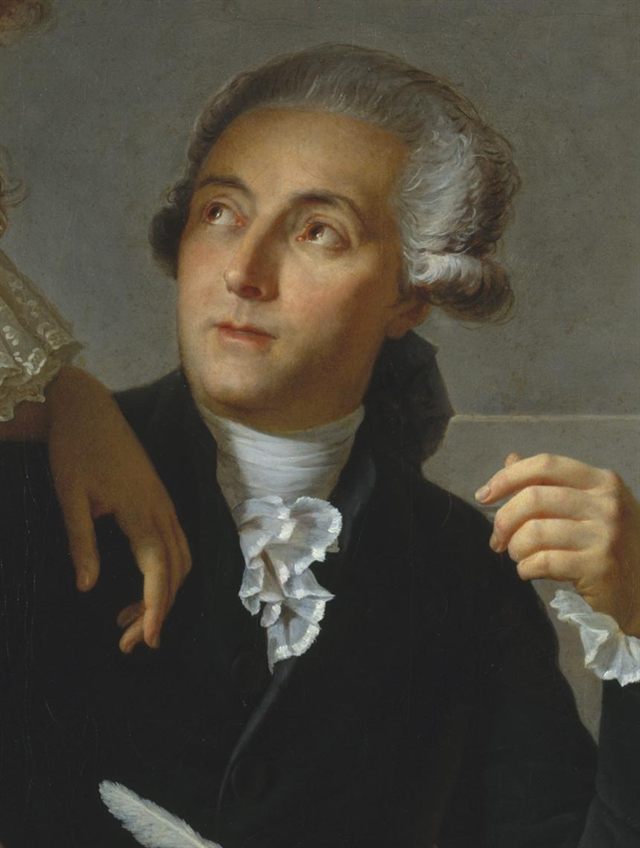
Father of Modern Chemistry · Chemist · 1743–1794
The chemist who made the balance the instrument of proof — establishing that mass is conserved, overturning phlogiston, naming oxygen, and showing that respiration is a slow combustion.
Who was Lavoisier?
Antoine Lavoisier was born to wealth in Paris and trained in law before turning to chemistry. His method was to weigh everything, in sealed vessels, before and after — and from that came his central principle: in a chemical change the total mass never alters. Applying it, he destroyed the phlogiston theory, showing that a metal heated in air GAINS mass because it combines with part of the air rather than losing a fire-substance. Priestley and Scheele had prepared that gas first, but Lavoisier understood it and gave it the name oxygen. With Laplace he built an ice calorimeter and measured the heat produced by a living guinea pig, finding that it consumed oxygen and gave out fixed air and warmth in the same proportions as a candle — respiration was a slow combustion. He also rebuilt the language of chemistry so that a substance's name would state its composition, and published the Traité élémentaire de chimie in 1789. He was also a fermier général, a collector of the King's taxes, and in 1794 the Revolutionary Tribunal sent him to the guillotine.
Major achievements
- Established the law of conservation of mass in chemical reactions
- Overturned the phlogiston theory of combustion
- Named oxygen and hydrogen, and explained combustion as combination with oxygen
- Showed with Laplace that respiration is a slow form of combustion
- Created the systematic chemical nomenclature still used today
Life in brief
- 1743 — Born in Paris: Into a wealthy family; trained first in law.
- 1768 — Joins the Ferme générale: The private tax-collecting company that made his fortune.
- 1772 — Burning experiments: Finds that burning substances gain mass from the air.
- 1774 — Meets Priestley: Learns of the new air Priestley has prepared.
- 1777 — Names oxygen: Interprets the gas correctly and explains combustion.
- 1783 — Respiration measured: With Laplace, shows a living animal respires like a candle burns.
- 1787 — New nomenclature: Reforms chemical naming so a name states a composition.
- 1789 — Traité élémentaire de chimie: States conservation of mass and founds modern chemistry.
Explore the life of Lavoisier — five chapters
- The Tax Farmer — Where the money came from, and what it bought
- Weigh Everything, Sealed — The method, and the law that came out of it
- Naming Oxygen — Understanding what two other men had already made
- Marie-Anne — The translator, illustrator and laboratory partner
- A New Language, and Eight Minutes — The Traité of 1789, and 8 May 1794
Read the five-chapter life of Antoine Lavoisier →
Where Lavoisier appears in your course
Antoine Lavoisier has a genuine claim on 24 lessons of the Pearson Edexcel International GCSE science course built into Incandio. Six of them:
- Absorption and the Energy in Food — Biology: Burning a crisp under a tube of water is a crude version of an experiment Lavoisier did properly in the 1780s: he enclosed an animal in a jacket of ice and weighed the meltwater, turning warmth into a measurement. He also understood better than anyone how much heat escapes such an apparatus — which is precisely the difficulty that makes the practical on this page underestimate every time.
- Respiration and ATP — Biology: With Laplace, Lavoisier sealed a guinea pig inside a jacket of ice and weighed the water its warmth melted, while measuring the oxygen it consumed and the fixed air it gave out. The proportions matched a burning candle exactly. That experiment is where this lesson's equation comes from, and it is the moment respiration stopped being a mystery of life and became chemistry.
- Alveoli, Exercise and Smoking — Biology: Before Lavoisier, air was thought to be a single substance, and there was no way to say what breathing did to it. He showed that only one component is consumed and another is given back — which is why an alveolus needs two gradients running in opposite directions at once, and why ventilation has to keep replacing the air rather than simply filling the lungs.
- Blood — Biology: Lavoisier established that only one component of air is consumed by a living body, and that blood changes colour as it takes it up — dark blood becoming bright as it passes through the lungs. He could not know about haemoglobin, but he identified what the red cells of this lesson are built entirely around, and he did it by chemistry rather than by dissection.
- Homeostasis and the Control of Body Temperature — Biology: Temperature regulation is a balance between heat gained and heat lost, and Lavoisier established the source of the gain. Working with Laplace, he put a guinea pig inside a chamber packed with ice, measured the water that melted, and compared it with the heat released when charcoal was burned to produce the same carbon dioxide. The figures matched closely: the warmth of an animal comes from a slow combustion inside it. That is respiration, and it is the reason the body has heat to lose in the first place.
- Gas Exchange in Plants, Day and Night — Biology: This page is entirely about two gases moving in opposite directions, and Lavoisier is the reason they can be named at all. He established that the air is a mixture, identified the part that supports burning and named it oxygen, and showed that respiration consumes it and produces fixed air — carbon dioxide — which is one half of every equation on this page. Before that work, 'good air' and 'spoiled air' were the only available descriptions, and no exchange could be measured because nobody knew what was being exchanged.
Begin
- Start a conversation with Lavoisier — a dramatised, historically grounded AI portrayal
- Read the Historical Brief
- Explore the life of Lavoisier — five chapters
- Find your exam topics · Meet all 208 figures