Pearson Edexcel International GCSE in Biology · 4BI1 · Free · no account needed
Absorption and the Energy in Food
How a tube half a square metre in area absorbs an entire diet — and how to measure the energy a food actually contains.
Topic 2 · Structures and functions in living organisms — one of 34 lessons in this topic, and one of 68 in Biology.
This lesson ends with William Beaumont. Learn Absorption and the Energy in Food, teach it, then defend it against William Beaumont.
The definition this lesson teaches, word for word — every Biology definition.
- Villus (plural: villi)
- A finger-like projection of the lining of the small intestine, one cell thick, containing a blood capillary and a lacteal, which greatly increases the surface area for absorption.
One of the 16 Biology required practicals.
What this lesson covers in the specification
Incandio is aligned to this specification. It is not published by, endorsed by or affiliated with Pearson, and it reproduces none of Pearson's wording — the statement numbers are given so you can check every lesson against your own copy.
- 2.32 — How the small intestine is adapted for absorption, including the structure of a villus
- 2.33 — Practical: investigate the energy content of a food sample (bold B statement — Paper 2 only) (required practical)
Specification section 2(e) Nutrition — also taught in Photosynthesis, What Limits Photosynthesis, The Leaf: Structure and Gas Exchange, A Balanced Diet.
1 · Understand it
No exam language yet. The only question this section answers is: do I actually understand what is happening?
A smooth tube six metres long and three centimetres across offers about half a square metre of lining — roughly the area of a large towel. Everything you have ever eaten had to cross a surface, and half a square metre is nowhere near enough to absorb a whole diet before the food is pushed onwards and lost. The small intestine's entire structure is a response to that problem, and it solves it by the same trick three times over, at three different scales.
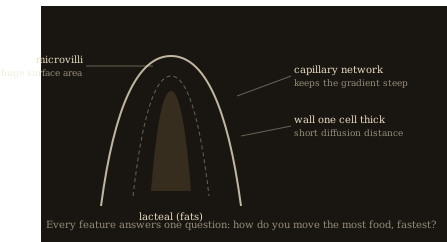
Folding, three times, on top of itself
- The lining of the tube is thrown into large circular FOLDS, which roughly triples the area straight away.
- Every fold is covered in VILLI — finger-like projections about a millimetre long, packed side by side. This multiplies the area again, by something like ten times.
- Every cell on a villus has its own surface folded into MICROVILLI, a brush border far too small to see. This multiplies the area a further twenty times or so.
- Each stage multiplies rather than adds, and multiplying three large factors together turns half a square metre into a surface measured in hundreds. That is the whole reason the structure looks the way it does.
But surface area on its own would not be enough, and this is where the villus becomes genuinely elegant. Absorption happens largely by diffusion, and the rate of diffusion depends on three things: how much surface there is, how far the molecules must travel, and how steep the concentration gradient is. The villus improves all three at once. Its wall is a single cell thick, so the distance from the food to the blood is about as short as living tissue can be made. And a capillary runs right up inside it, carrying absorbed glucose and amino acids away the moment they arrive — which keeps the concentration inside low, so the gradient from the gut contents inwards never gets the chance to flatten out.
Where each product of digestion actually goes
- Glucose and amino acids are small and water-soluble, so they pass through the villus wall into the CAPILLARY, and travel away in the blood.
- Fatty acids and glycerol are not water-soluble, so they take a different route: into the LACTEAL, the lymph vessel running up the centre of the villus.
- Some absorption is by diffusion, down the gradient. But when the concentration in the gut falls below that in the blood, diffusion would run backwards — so the last of the glucose is taken up by active transport, using energy from respiration.
- That is why the cells lining a villus are packed with mitochondria: they are paying for the final part of the absorption.
The second half of this page is a measurement rather than a structure. Food contains stored chemical energy, and there is a direct way to find out how much: burn it, and use the heat to warm a known mass of water. Water needs 4.2 joules to raise one gram of it by one degree, so if you know the mass of water and how far its temperature rose, you know how much energy went into it — and if you divide that by the mass of food burnt, you have the energy per gram. It is a crude method and it always underestimates, for reasons worth understanding rather than memorising: a great deal of the heat goes into the air and the glass rather than the water, and food rarely burns completely.
2 · Grade 9 Notes
A different job from the section above. You have already understood it; this is the precise set of things to LEARN — definitions to reproduce word for word, processes in order, equations with units, and the answers that score full marks.
Learn this definition · Villus (plural: villi)
A finger-like projection of the lining of the small intestine, one cell thick, containing a blood capillary and a lacteal, which greatly increases the surface area for absorption.
The adaptations of a villus — each with the factor it improves
- Villi and microvilli
- increase the surface area enormously, so more molecules can be absorbed at the same time
- Wall one cell thick
- gives a very short diffusion distance between the gut contents and the blood
- Dense capillary network
- carries absorbed glucose and amino acids away, keeping the concentration gradient steep
- Lacteal
- absorbs the fatty acids and glycerol, which are not water-soluble and so cannot enter the blood directly
- Many mitochondria
- release the energy needed for active transport of the last glucose against its gradient
The two absorption routes — which product goes where
| Into the blood capillary | Into the lacteal | |
|---|---|---|
| What is absorbed | glucose and amino acids | fatty acids and glycerol |
| Why that route | small and water-soluble, so they dissolve in blood plasma | not water-soluble, so they cannot travel in plasma directly |
| Where it goes next | to the liver in the hepatic portal vein | into the lymphatic system, and later into the blood |
energy transferred (J) = mass of water (g) × 4.2 × temperature rise (°C)
4.2 J/g/°C is the energy needed to raise 1 g of water by 1 °C; divide the result by the mass of food burnt to get energy per gram
Units: J, g, °C. Energy per gram is in J/g.
Required practical 2.33 — the energy content of a food sample
- Measure a fixed volume of water into a boiling tube — 25 cm³ has a mass of 25 g — and clamp the tube.
- Record the mass of the food sample and the starting temperature of the water.
- Set light to the food and immediately hold it under the boiling tube, relighting it if it goes out before it is fully burnt.
- Stir the water and record the highest temperature reached.
- Energy transferred = mass of water × 4.2 × temperature rise. Divide by the mass of food to get the energy per gram.
Variables
Independent (changed) — the type of food burnt
Dependent (measured) — temperature rise of the water, used to calculate energy per gram
| Control variable | Why it must be held constant |
|---|---|
| Volume of water | more water rises less for the same energy |
| Distance from flame to tube | further away means more heat lost to the air |
| Starting temperature | a hotter start loses heat faster to the room |
| Same thermometer | two thermometers may read slightly differently |
Sources of error
| Type | What goes wrong | What to do |
|---|---|---|
| Systematic | Much of the heat goes into the air, the glass and the clamp. | Shield the apparatus with a draught screen and insulate the tube. |
| Systematic | The food does not burn completely, so not all its energy is released. | Relight until the sample will no longer catch at all. |
| Judgement | Deciding the highest temperature as the reading drifts. | Stir continuously and record the maximum steady value. |
| Random | Food samples differ from one piece to the next. | Repeat with several samples of each food and take a mean. |
Model answer [4 marks]
Explain how the structure of a villus increases the rate at which glucose is absorbed. [4]
The villi and the microvilli on their cells give a very large surface area, so more glucose can be absorbed at the same time. The wall is one cell thick, so the diffusion distance into the blood is short. A dense capillary network carries absorbed glucose away, keeping its concentration inside the villus low so the concentration gradient stays steep. Mitochondria in the epithelial cells release energy for the active transport of glucose once the gradient has been used up.
Model answer [3 marks]
Explain why the energy content measured by burning a food sample is always lower than the true value. [3]
Much of the heat released is transferred to the surrounding air, the glass of the tube and the apparatus rather than to the water, so the water's temperature rise is smaller than it should be. The food also often fails to burn completely, so some of its stored energy is never released at all. Both effects lose energy, so both make the calculated value too low.
Mark-losing trap. Say what each adaptation DOES. 'Villi increase surface area' scores; 'the small intestine has villi' on its own does not.
Mark-losing trap. Glucose and amino acids go into the blood capillary; fatty acids and glycerol go into the lacteal. This split is examined constantly.
Mark-losing trap. Absorption is not diffusion alone. The last of the glucose is taken up by active transport, which is why the cells are full of mitochondria.
Mark-losing trap. The burning-food method always UNDERestimates. Heat lost and incomplete burning both reduce the measured value — neither can raise it.
3 · Prove it — the five questions
The five questions climb Grade 6 → Grade 7 → Grade 8 → Grade 9 → Grade 9 challenge, and are marked inside Incandio on your own device, by rule, with an authored diagnosis of the mistake you actually made. The mark schemes stay in the app so that the practice is worth doing; the questions themselves are here.
- Grade 6 · Identify [1 mark] — Which structure inside a villus absorbs the products of lipid digestion?
- Grade 7 · Explain [2 marks] — The wall of a villus is only one cell thick. Explain how this helps absorption.
- Grade 8 · Explain [4 marks] — Explain how the small intestine is adapted to absorb the products of digestion rapidly. Select every statement that belongs in a full-mark explanation.
- Grade 9 · Calculate [4 marks] — 0.40 g of a food sample is burnt beneath a boiling tube containing 25.0 g of water. The water's temperature rises by 18.0 °C. Taking 4.2 J/g/°C for water, calculate the energy content of the food in J/g.
- 9+ · Evaluate [5 marks] — A student measures the energy content of a peanut as 12 000 J/g. The value printed on the packet, measured industrially, is 24 000 J/g. The student repeats her experiment five times and gets almost exactly the same answer each time. She concludes that her method is reliable and that the packet must be wrong. Select every statement that belongs in a full-mark response.
The people behind this science
Three ways into the same idea — the one who recorded every departure and never saw an arrival, and the one who explained why a bigger surface means a faster crossing, and the one who first put a number on the energy a body releases. Inside Incandio each of them answers knowing exactly which lesson you have just finished.
William Beaumont — the one who recorded every departure and never saw an arrival
Beaumont's famous timetables recorded dinners dissolving in a living stomach hour by hour — the most exact record of digestion ever made from life — yet his window opened on the stomach, which absorbs almost nothing, so he never once saw the meal actually enter the body. His era pictured dissolved food simply soaking in where it lay. The villus this lesson describes is the answer to the question his ledger could never close: where the dinner arrives.
- “Your tables record every dinner's departure — where did you believe the food went?”
- “What did your era think absorption was?”
- “Why did the meals you watched diminish if the stomach absorbs almost nothing?”
- “What would you have made of an organ folded into hundreds of square metres?”
- “What measurement would have convinced you the crossing happens beyond the stomach?”
Albert Einstein — the one who explained why a bigger surface means a faster crossing
Every adaptation on this page — the folds, the villi, the microvilli, the single-cell wall, the capillary keeping the gradient steep — is an attempt to speed up diffusion, and diffusion is the random walking of particles that Einstein put on a mathematical footing in 1905. The villus is that mathematics turned into an organ.
- “Why does random movement cross a large surface faster than a small one?”
- “What decides how long a molecule takes to travel a given distance by diffusion?”
- “Why does carrying molecules away speed up the arrival of the next ones?”
- “Is there a limit to how fast diffusion can ever deliver something?”
Antoine Lavoisier — the one who first put a number on the energy a body releases
Burning a crisp under a tube of water is a crude version of an experiment Lavoisier did properly in the 1780s: he enclosed an animal in a jacket of ice and weighed the meltwater, turning warmth into a measurement. He also understood better than anyone how much heat escapes such an apparatus — which is precisely the difficulty that makes the practical on this page underestimate every time.
- “How much of the heat escaped before you could measure any of it?”
- “Why did you choose melting ice as the way to measure warmth?”
- “How would you check whether your apparatus was losing energy?”
- “Can the energy stored in a food be compared with the energy in a fuel?”
Think you understand it?
Reading is the start. On Incandio a topic counts as mastered only once you have taught it and defended it — the two things a revision guide cannot ask of you.
Incandio this topic → Prove it. Teach it. Defend it. What does “Incandio it” mean?
- Prove it — five questions on Absorption and the Energy in Food, marked on the spot, that tell you what was missing rather than just what was wrong.
- Teach it — Explain Absorption and the Energy in Food in your own words to Ember, an AI pupil who does not have it yet and asks the awkward question. Understanding is credited; wording is not required.
- Defend it — Argue Absorption and the Energy in Food against William Beaumont — three rounds, marked against descriptors you can read before you begin.
- Then the exam — read all 10 authored exam-style questions on this unit, each with its command word and its tariff, then have them marked on Incandio with the mistake you actually made named.
Completely free. No subscriptions, no paywalls, no account needed to start.
Carry on through the course
- Previous lesson: Digestive Enzymes and Bile
- Next lesson: Respiration and ATP
- Levels of Organisation — From organelle to organism — the five-step ladder that every later topic in biology is built on.
- Comparing Cells, and Stem Cells — What plant and animal cells share and where they differ — then why a cell specialising is one of the most powerful ideas in biology.
- Carbohydrates, Proteins and Lipids — The three big food molecules — what they are made of, what they are built from, and how to test for them.
- Enzymes: Catalysts With a Shape — Why a protein with a hole in it speeds up a reaction, and why heat destroys that ability permanently.
- Enzymes and pH — Why acid ruins one enzyme and is the only condition another will work in — and how to find an enzyme's best pH by experiment.
- All of Biology · Biology key terms · required practicals · Incandio Science · The 4BI1 specification