Pearson Edexcel International GCSE in Biology · 4BI1 · Free · no account needed
Homeostasis and the Control of Body Temperature
Why the inside of you barely changes while the outside changes constantly — and exactly what the skin does about heat.
On the specification this is role of the skin in temperature regulation — 4BI1 statements 2.80 · 2.81 · 2.82 · 2.93.
Topic 2 · Structures and functions in living organisms — one of 34 lessons in this topic, and one of 68 in Biology.
This lesson ends with Antoine Lavoisier. Learn Homeostasis and the Control of Body Temperature, teach it, then defend it against Antoine Lavoisier.
The 2 definitions this lesson teaches, word for word — every Biology definition.
- Homeostasis
- The maintenance of a constant internal environment, within narrow limits, despite changes in the external environment and in the organism's own activity.
- Negative feedback
- A control mechanism in which a change away from the normal level triggers a response that reverses that change and returns the condition towards normal. Taught in full in ADH and the Water Balance of the Blood.
What this lesson covers in the specification
Incandio is aligned to this specification. It is not published by, endorsed by or affiliated with Pearson, and it reproduces none of Pearson's wording — the statement numbers are given so you can check every lesson against your own copy.
- 2.80 — How organisms respond to changes in their environment
- 2.81 — Homeostasis as the maintenance of a constant internal environment
- 2.82 — A co-ordinated response requires a stimulus, a receptor and an effector
- 2.93 — The role of the skin in temperature regulation: sweating, vasoconstriction, vasodilation
Specification section 2(j) Co-ordination and response — also taught in ADH and the Water Balance of the Blood, Plant Responses, Tropisms and Auxin, The Nervous System, and the Two Ways a Body Sends a Message, Synapses and the Reflex Arc.
1 · Understand it
No exam language yet. The only question this section answers is: do I actually understand what is happening?
Walk out of a warm house into freezing air. The temperature outside your skin has just dropped by thirty degrees. The temperature deep inside you drops by a fraction of one degree, and within minutes it is back where it was. That is not because the cold failed to reach you. It is because something detected the change and did work to undo it, continuously, without you deciding anything.
The same is true of far more than temperature. The amount of water in your blood, the amount of glucose in it, its pH, its carbon dioxide — all of them are held inside narrow limits while the world outside you, and your own activity, keep trying to shift them. Keeping those internal conditions steady is called HOMEOSTASIS, and it is one of the things a living organism does that a stone does not.
It is worth being clear about WHY constancy matters so much, because the reason is the same reason in every case: enzymes. Every reaction inside you is controlled by an enzyme, and every enzyme works properly only in a narrow range of temperature and pH. Too cold and the reactions run too slowly to keep you alive; too hot and the enzyme's shape is changed permanently and it stops working at all. Homeostasis is not tidiness. It is the maintenance of the exact conditions your chemistry requires.
Think of it like a house with a thermostat
A thermostat does not know what temperature the house should be, and the boiler certainly does not. The thermostat measures one thing — the air in the hallway — and the boiler responds to one signal. Set it at 20 °C and the house stays near 20 °C in July and in January, because whenever the hallway drifts below, the heating comes on, and whenever it drifts above, the heating goes off. Two things are worth noticing. First, nobody is deciding: the correction is built into the wiring. Second, the thermostat measures INSIDE the house, not outside it — it does not care what the weather is doing, only what has happened to the room. Your body is wired the same way, and the room it measures is your blood.
The pathway behind every response — learn this shape, it recurs all term
- STIMULUS — a change. The air turns cold; the light dims; a hand touches something hot.
- RECEPTOR — a cell or organ that detects that particular change. Temperature receptors in the skin and in the hypothalamus; light receptors in the retina; pain receptors in the skin.
- CO-ORDINATOR — the part that receives the information and decides what should happen. Usually the brain or spinal cord, and for temperature it is the hypothalamus.
- EFFECTOR — the part that carries the response out. Only ever a MUSCLE, which contracts, or a GLAND, which secretes something.
- RESPONSE — what the effector actually does: sweat produced, an arteriole (a small artery feeding the capillaries) narrowed, a hand pulled away.
A response is called CO-ORDINATED when those parts work as one sequence rather than independently — detection in one place producing action in another, connected by nerves or by chemicals in the blood. That is why the specification insists on naming all three: an answer that says 'the body gets cold so it shivers' has skipped both the receptor and the effector, and skipped the marks with them.
Not every response is internal chemistry. An organism can also respond by BEHAVIOUR — moving into the shade, curling up, putting on a coat, or in a lizard's case lying on a hot rock in the morning because it cannot generate much heat of its own. Behaviour is often the first and cheapest response; the physiological machinery below is what takes over when behaviour is not enough or not possible.
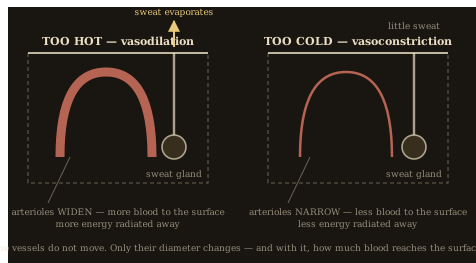
Too hot — what the skin actually does
- Temperature receptors in the skin, and receptors in the hypothalamus monitoring the blood, detect that the temperature has risen above about 37 °C.
- The hypothalamus co-ordinates the response and sends impulses along nerves to the skin.
- SWEAT GLANDS (the effectors) secrete more sweat onto the surface of the skin.
- The sweat evaporates. Evaporation takes energy from the skin to convert liquid water into vapour, so the skin — and the blood flowing through it — cools.
- At the same time the arterioles supplying the surface capillaries WIDEN. This is vasodilation, and it is done by muscle in the arteriole wall relaxing.
- More blood therefore flows through the capillaries close to the surface, so more energy is transferred from the blood to the surroundings by radiation. The skin looks flushed.
- The core temperature falls back towards 37 °C — which removes the stimulus, so the response is scaled back.
Too cold — the same machinery, run the other way
- The receptors detect that the temperature has fallen below about 37 °C.
- The hypothalamus co-ordinates the response.
- Sweat production is reduced almost to nothing, so almost no energy is lost by evaporation.
- Muscle in the walls of the arterioles supplying the surface capillaries CONTRACTS, narrowing them. This is vasoconstriction.
- Much less blood flows through the capillaries near the surface, so much less energy is radiated away. The skin looks pale.
- Shivering begins: skeletal muscles contract and relax rapidly, and respiration in those muscles releases energy as heat — so the body generates extra heat rather than merely conserving it.
- The core temperature rises back towards 37 °C, and the corrections are scaled back.
There is one very common misunderstanding here that is worth destroying now. Blood vessels do not move. You will sometimes hear that the capillaries 'move closer to the surface' when you are hot and 'sink deeper' when you are cold — they do not, and cannot; they are fixed in the tissue. What changes is the DIAMETER of the small arteries feeding them, and therefore the volume of blood that reaches the surface each second. Widen the pipe and more blood arrives to give up its heat; narrow it and the blood is kept in deeper vessels where the heat stays inside you.
It is also worth being precise about sweating, because sweat itself does not cool you. Producing sweat does nothing at all; only EVAPORATING it removes energy. The fastest-moving water molecules escape from the liquid first, and the energy they carry away comes from the skin they leave behind. That has a consequence you can feel: on a humid day the air is already nearly saturated with water vapour, so the concentration gradient for water vapour between your skin and the air is shallow and evaporation is slow. You sweat just as hard, lose just as much water — and cool far less. It is why heat with humidity is dangerous in a way that dry heat of the same temperature is not.
Notice the shape of both chains. A rise in temperature triggers changes that lower it; a fall triggers changes that raise it. The response always opposes the change that produced it, and fades as normal is restored. That is NEGATIVE FEEDBACK, and it is how every homeostatic system on this course works — temperature, blood water, blood glucose. Once you can see the shape, each new example is the same idea with different parts.
2 · Grade 9 Notes
A different job from the section above. You have already understood it; this is the precise set of things to LEARN — definitions to reproduce word for word, processes in order, equations with units, and the answers that score full marks.
Learn this definition · Homeostasis
The maintenance of a constant internal environment, within narrow limits, despite changes in the external environment and in the organism's own activity.
Learn this definition · Negative feedback
A control mechanism in which a change away from the normal level triggers a response that reverses that change and returns the condition towards normal.
Taught in full in ADH and the Water Balance of the Blood.
Statement 2.82 — the four words a co-ordinated response answer must contain
- Stimulus
- A detectable change in the internal or external environment — a rise in temperature, a fall in light intensity, a touch.
- Receptor
- A cell or organ that detects a stimulus. Temperature receptors in the skin and hypothalamus; light receptors in the retina.
- Co-ordinator
- The part that receives the information and determines the response — the brain or spinal cord. For temperature, the hypothalamus.
- Effector
- The part that carries out the response. ONLY a muscle (which contracts) or a gland (which secretes). Naming anything else loses the mark.
The co-ordinated response pathway — write it in this order every time
- Stimulus: state the change, and its direction.
- Receptor: name where it is detected.
- Co-ordinator: name the brain, spinal cord or hypothalamus.
- Effector: name a muscle or a gland.
- Response: state what the effector does, and the effect on the condition being controlled.
The internal conditions kept constant — and the reason each one matters
- Temperature (about 37 °C)
- Enzymes work fastest near 37 °C; much colder and reactions are too slow, much hotter and enzymes are denatured and cannot be recovered.
- Water content of the blood
- Cells lose or gain water by osmosis if the blood's concentration changes, and either shrivels or bursts them.
- Blood glucose concentration
- Glucose is the respiratory substrate; too little starves the cells of energy, and too much draws water out of them by osmosis.
- pH of the blood
- Enzymes have an optimum pH and are denatured outside a narrow range around it.
- Carbon dioxide concentration
- Dissolved carbon dioxide makes the blood more acidic, so removing it is part of holding the pH steady.
The skin, too hot against too cold — the table to be able to write out
| Core temperature too HIGH | Core temperature too LOW | |
|---|---|---|
| Detected by | temperature receptors in the skin and in the hypothalamus | temperature receptors in the skin and in the hypothalamus |
| Co-ordinated by | the hypothalamus | the hypothalamus |
| Sweat glands | secrete more sweat; evaporation removes energy from the skin | secrete much less sweat; almost no energy lost by evaporation |
| Arterioles supplying surface capillaries | muscle in the wall relaxes — VASODILATION, so they widen | muscle in the wall contracts — VASOCONSTRICTION, so they narrow |
| Blood flow near the skin surface | increases, so more energy is radiated away; the skin flushes | decreases, so less energy is radiated away; the skin pales |
| Skeletal muscle | no shivering | shivering — rapid contraction, and respiration in the muscle releases energy as heat |
| Net effect | energy lost exceeds energy gained, so core temperature falls to normal | energy is conserved and generated, so core temperature rises to normal |
Vasodilation — the exact sequence, and the order marks are given in
- Core temperature rises above normal.
- Receptors in the hypothalamus and the skin detect the rise.
- Muscle in the walls of the arterioles supplying the surface capillaries relaxes.
- Those arterioles widen, so a greater volume of blood flows through the capillaries near the skin surface.
- More energy is transferred from the blood to the surroundings by radiation.
- Core temperature falls back towards normal.
Sweating — the sequence, with the step most answers leave out
- Core temperature rises above normal, and is detected.
- Sweat glands secrete sweat onto the surface of the skin.
- The sweat EVAPORATES — this is the step that does the cooling; producing sweat on its own removes nothing.
- Evaporation requires energy, which is taken from the skin and from the blood flowing through it.
- The skin and blood cool, so the core temperature falls back towards normal.
What actually changes at the skin surface
A. TRUE: the diameter of the arterioles supplying the surface capillaries changes, so the volume of blood arriving at the surface changes.
B. FALSE: the capillaries themselves move up or down through the skin. They are fixed in position and have no muscle in their walls.
Not this: Sweat cools you as it is produced, so a person sweating heavily must be cooling efficiently.
This: Only evaporation removes energy. If the surrounding air is humid, sweat is produced and lost as liquid without evaporating, so the body loses water without being cooled.
Not this: Homeostasis means the internal conditions never change.
This: They change constantly and are constantly corrected. Homeostasis holds them within narrow limits around a normal level; it does not freeze them.
Model answer [5 marks]
Explain how the skin helps to reduce the body temperature of a person who has become too hot. [5]
Temperature receptors in the skin and hypothalamus detect the rise in temperature, and the hypothalamus co-ordinates the response. Sweat glands secrete more sweat onto the skin surface, and as this sweat evaporates it takes energy from the skin, cooling it. Muscle in the walls of the arterioles supplying the surface capillaries relaxes, so the arterioles dilate and more blood flows near the surface. More energy is therefore transferred to the surroundings by radiation, and the core temperature falls back towards normal.
Model answer [4 marks]
A person steps outside into cold air. Describe the co-ordinated response that follows, using the terms stimulus, receptor, co-ordinator and effector. [4]
The stimulus is the fall in temperature. The receptors are the temperature receptors in the skin and in the hypothalamus, which detect it. The co-ordinator is the hypothalamus, which sends impulses along nerves to the skin. The effectors are the muscles in the arteriole walls, which contract to cause vasoconstriction, and the sweat glands, which reduce secretion — so less energy is lost and the core temperature is maintained.
Model answer [3 marks]
Explain why homeostasis is necessary for an organism to survive. [3]
The reactions of metabolism are controlled by enzymes, and enzymes function only within narrow ranges of temperature and pH. Outside those ranges reactions become too slow, or the enzymes are denatured and stop working altogether. Homeostasis maintains the conditions in which those enzymes work, so that metabolism continues whatever the external environment does.
Mark-losing trap. An effector is a MUSCLE or a GLAND. The skin, the brain and 'the body' are not effectors and score nothing.
Mark-losing trap. Write vasodilation and vasoconstriction as changes in the DIAMETER of arterioles. Vessels never move up or down through the skin.
Mark-losing trap. It is the EVAPORATION of sweat that cools, not its production. Say the word evaporate.
Mark-losing trap. Blood loses energy to the surroundings by RADIATION at the skin surface — not by 'the cold getting in'.
Mark-losing trap. Name the hypothalamus as the co-ordinator for temperature. 'The brain' is vague and often not credited on a two-mark point.
Mark-losing trap. Homeostasis keeps conditions within narrow LIMITS. Saying it keeps them 'exactly the same' contradicts the negative feedback you have just described.
3 · Prove it — the five questions
The five questions climb Grade 6 → Grade 7 → Grade 8 → Grade 9 → Grade 9 challenge, and are marked inside Incandio on your own device, by rule, with an authored diagnosis of the mistake you actually made. The mark schemes stay in the app so that the practice is worth doing; the questions themselves are here.
- Grade 6 · Define [1 mark] — What does the term homeostasis mean?
- Grade 7 · Identify [1 mark] — A person steps out of a warm building into cold air. Their skin becomes pale. In this response, which structure is the effector?
- Grade 8 · Explain [5 marks] — A student finishes a hard training session indoors and is uncomfortably hot. Explain how their skin brings their body temperature back down. Select every statement that belongs in a full-mark explanation.
- Grade 9 · Calculate [4 marks] — During one hour of running, an athlete's body releases 4200 kJ of energy as heat and they produce 1.5 dm³ of sweat. Evaporating 1 cm³ of sweat from the skin removes 2.4 kJ of energy. Calculate the percentage of the heat released that is removed by evaporating all of that sweat.
- 9+ · Analyse [5 marks] — Two runners finish the same race on a day when the air temperature is 32 °C. One ran in dry air; the other ran in air that was almost saturated with water vapour. The runner in the humid air collapses with a core temperature of 40 °C, is sweating heavily, and has flushed skin. Select every statement that belongs in a full-mark explanation of why the humid conditions caused this.
The people behind this science
Two ways into the same idea — the one who realised there is an inside, and the one who found where the heat comes from. Inside Incandio each of them answers knowing exactly which lesson you have just finished.
Claude Bernard — the one who realised there is an inside
Bernard is the origin of this entire lesson. In the 1850s he argued that the fluid bathing our tissues — the milieu intérieur — is held nearly constant, and that this constancy is precisely what allows a complex animal to live independently of the weather outside it. He also found the mechanism this page describes: the vasomotor nerves that widen and narrow blood vessels, which is vasodilation and vasoconstriction by their older names. He never used the word homeostasis; Walter Cannon coined it in 1926, almost fifty years after Bernard died with the idea largely ignored.
- “What did you mean by the internal environment, and why did it matter so much to you?”
- “How did you show that nerves control the width of blood vessels?”
- “Why is an animal that holds its inside steady freer than one that does not?”
- “Why did so few people take up the idea while you were alive?”
- “What experiment would you design to test whether a condition is really being regulated?”
Antoine Lavoisier — the one who found where the heat comes from
Temperature regulation is a balance between heat gained and heat lost, and Lavoisier established the source of the gain. Working with Laplace, he put a guinea pig inside a chamber packed with ice, measured the water that melted, and compared it with the heat released when charcoal was burned to produce the same carbon dioxide. The figures matched closely: the warmth of an animal comes from a slow combustion inside it. That is respiration, and it is the reason the body has heat to lose in the first place.
- “How did you use melting ice to measure the heat an animal produces?”
- “Why did you conclude that breathing is a kind of slow burning?”
- “Where in the body did you think this combustion was happening?”
- “What did your measurements NOT explain about the warmth of a living thing?”
Think you understand it?
Reading is the start. On Incandio a topic counts as mastered only once you have taught it and defended it — the two things a revision guide cannot ask of you.
Incandio this topic → Prove it. Teach it. Defend it. What does “Incandio it” mean?
- Prove it — five questions on Homeostasis and the Control of Body Temperature, marked on the spot, that tell you what was missing rather than just what was wrong.
- Teach it — Explain Homeostasis and the Control of Body Temperature in your own words to Ember, an AI pupil who does not have it yet and asks the awkward question. Understanding is credited; wording is not required.
- Defend it — Argue Homeostasis and the Control of Body Temperature against Antoine Lavoisier — three rounds, marked against descriptors you can read before you begin.
- Then the exam — read all 10 authored exam-style questions on this unit, each with its command word and its tariff, then have them marked on Incandio with the mistake you actually made named.
Completely free. No subscriptions, no paywalls, no account needed to start.
Carry on through the course
- Previous lesson: ADH and the Water Balance of the Blood
- Next lesson: Plant Responses, Tropisms and Auxin
- Levels of Organisation — From organelle to organism — the five-step ladder that every later topic in biology is built on.
- Comparing Cells, and Stem Cells — What plant and animal cells share and where they differ — then why a cell specialising is one of the most powerful ideas in biology.
- Carbohydrates, Proteins and Lipids — The three big food molecules — what they are made of, what they are built from, and how to test for them.
- Enzymes: Catalysts With a Shape — Why a protein with a hole in it speeds up a reaction, and why heat destroys that ability permanently.
- Enzymes and pH — Why acid ruins one enzyme and is the only condition another will work in — and how to find an enzyme's best pH by experiment.
- All of Biology · Biology key terms · required practicals · Incandio Science · The 4BI1 specification