Explore Their Life · Pearson Edexcel International GCSE revision on Incandio
Antoine Lavoisier: A Life in Five Chapters
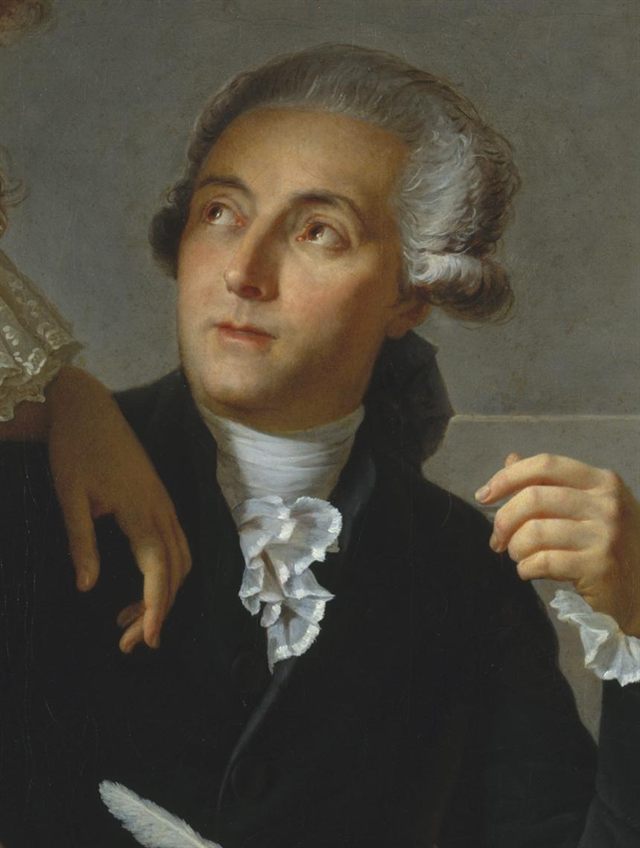
1743–1794
The tax farmer who weighed everything in sealed vessels, destroyed the phlogiston theory with a balance, rebuilt the language of chemistry, and was guillotined at fifty for the source of his money.
Lavoisier did not discover oxygen. He understood it, which was harder and mattered more. He established that matter is conserved, that respiration is slow combustion, and that a substance's name should state what it is made of. He also collected the King's taxes. These five chapters follow the science and the scaffold.
The five chapters
- The Tax Farmer — Where the money came from, and what it bought
- Weigh Everything, Sealed — The method, and the law that came out of it
- Naming Oxygen — Understanding what two other men had already made
- Marie-Anne — The translator, illustrator and laboratory partner
- A New Language, and Eight Minutes — The Traité of 1789, and 8 May 1794
Chapter 1 · The Tax Farmer
Where the money came from, and what it bought
1743 – 1771 · Paris
Antoine-Laurent Lavoisier was born in Paris in August 1743 into a wealthy family of lawyers. His mother died when he was five, leaving him a substantial inheritance. He trained in law, as expected, and turned to science.
In 1768, aged twenty-five, he bought a share in the *Ferme générale* — the private company that collected indirect taxes on behalf of the Crown. This is the decision that eventually killed him.
The Ferme was hated, and with reason. It bought the right to collect taxes for a fixed sum and kept everything above it, so its incentive was to extract as much as possible. It collected the *gabelle*, the salt tax, which fell hardest on the poor, and enforced it with armed guards, searches and severe penalties for smuggling. Lavoisier personally proposed and helped build a wall around Paris to prevent goods entering untaxed — a structure enormously resented, and completed shortly before the Revolution.
He was also a genuine and effective reformer within the system: he worked on improving the quality and honesty of tax assessment, on agricultural improvement, on gunpowder manufacture, on hospital ventilation, on water supply, and on the metric system.
The wealth bought him the best-equipped private laboratory in Europe — precision balances made to his order, capable of weighing to a fraction of a grain, and instruments nobody else possessed.
In 1771, aged twenty-eight, he married Marie-Anne Pierrette Paulze, the thirteen-year-old daughter of a fellow tax farmer.
“Nothing is lost, nothing is created, everything is transformed.”
— Attributed to Antoine Lavoisier, summarising conservation of mass
Why this matters
Lavoisier's chemistry depended on balances of a precision only great wealth could buy, and that wealth came from the tax system that cost him his life.
You have the Ferme, the wall and the balances. What would you ask?
Ask Lavoisier
- “What was the Ferme générale, and why was it hated?”
- “Did you know what the salt tax did to the poor?”
- “Why build a wall around Paris?”
- “What could you buy that other chemists could not?”
- “Could you have done the chemistry without the Ferme?”
Chapter 2 · Weigh Everything, Sealed
The method, and the law that came out of it
1772 – 1774 · Paris
Lavoisier's method can be stated in one sentence: carry out the reaction in a *sealed* vessel, and weigh everything before and after.
The sealing is the crucial part. Chemists had long known that a metal heated in air becomes a powdery *calx* and *gains* weight. Phlogiston theory said burning releases phlogiston, so the burnt substance should weigh less — and to save the theory, some had proposed that phlogiston has negative weight.
Lavoisier heated tin in a sealed retort. The tin turned to calx and gained weight, as expected. But the sealed vessel *as a whole* weighed exactly the same before and after — and when he opened it, air rushed *in*.
So the metal had gained weight by taking something from the air inside the vessel. The air had lost exactly what the metal gained. Nothing was created and nothing was destroyed; matter had been rearranged.
That is the *conservation of mass*, and it is the founding principle of quantitative chemistry. It is why a chemical equation must balance.
He also settled the water question. It was held that water could be transmuted into earth, since boiling water in a glass vessel for long enough leaves a residue. Lavoisier boiled water in a sealed glass pelican for 101 days, weighing everything. The water was unchanged; the vessel had lost exactly the weight of the residue. The earth came from the glass.
It is a small experiment and a complete demolition of a two-thousand-year-old belief, done with a balance and patience.
Why this matters
Conservation of mass is why a chemical equation must balance, and Lavoisier established it by refusing to let anything escape the vessel unweighed.
You have the sealed retort and the rushing air. What is your question?
Ask Lavoisier
- “Why does the sealed vessel change everything?”
- “Why did the metal gain weight when it burned?”
- “Tell me about the hundred and one days of boiling water.”
- “What does conservation of mass rule out?”
- “How good did your balances have to be?”
Chapter 3 · Naming Oxygen
Understanding what two other men had already made
1774 – 1783 · Paris
Scheele prepared oxygen around 1772 and could not publish. Priestley prepared it on 1 August 1774 and called it dephlogisticated air. In October 1774 Priestley described the preparation to Lavoisier at dinner in Paris. Scheele had written to Lavoisier in September 1774 describing his own method.
Lavoisier repeated the preparation and *interpreted* it, and the interpretation is the whole contribution.
On his account, ordinary air is a mixture of two gases. One — about a fifth of it — combines with substances when they burn, and is what an animal takes from the air when it breathes. The other supports neither. When a metal is heated in air it *combines* with the first gas to form a calx, which is why it gains weight and why the air is used up.
There is no phlogiston. Nothing is released. Something is *added*.
He named the active gas *oxygène* — acid-former — because he believed, wrongly, that it is the essential component of all acids. Davy disproved this with chlorine in 1810, and the name is a fossil of an error.
He named the inert remainder *azote*, meaning without life. In English it became nitrogen.
Then he and Laplace did something that connected chemistry to biology. They built an ice calorimeter — a chamber surrounded by packed ice, in which the mass of meltwater measures the heat produced — and put a live guinea pig in it. They measured its oxygen consumption, its carbon dioxide output, and its heat.
The ratios matched those of a burning candle. Respiration is a slow combustion, and it is the source of an animal's warmth.
Why this matters
Lavoisier's guinea pig in an ice calorimeter showed that respiration and combustion are the same chemistry, connecting the living world to the rest of it.
You have the dinner, the name and the guinea pig. What would you ask?
Ask Lavoisier
- “What did you add that Priestley and Scheele did not?”
- “Why name it 'acid-former' when it is not?”
- “How did the ice calorimeter measure heat?”
- “What does it mean that a guinea pig burns like a candle?”
- “Did you credit Priestley and Scheele adequately?”
Chapter 4 · Marie-Anne
The translator, illustrator and laboratory partner
1771 – 1794 · Paris · The Arsenal
Marie-Anne Pierrette Paulze was thirteen when she married Lavoisier — a marriage arranged partly to remove her from an unwanted suitor. She was twenty-eight years younger than she would be when she was widowed, and she became indispensable to the work.
She learned English, which Lavoisier did not read well, and translated the English chemical literature for him — including Richard Kirwan's *Essay on Phlogiston*, which she rendered into French together with a set of critical notes attacking its argument, written by her and by Lavoisier's circle. That translation is how the French assault on phlogiston was mounted.
She took drawing lessons from Jacques-Louis David, the leading painter in France, and produced the engravings for the *Traité élémentaire de chimie* — precise technical drawings of the apparatus, without which the experiments could not be reproduced. She signed some of the plates.
She kept the laboratory notebooks, recording the measurements as the experiments ran.
And she ran a salon, at which foreign scientists were entertained and argued with. There is a surviving sketch by her of one such session, in which she can be seen at a side table taking notes.
David's double portrait of the Lavoisiers hangs in the Metropolitan Museum. Antoine sits at a desk with instruments; Marie-Anne stands behind him, looking out at the viewer, one hand on his shoulder. It is not a portrait of a wife accompanying a scientist.
After his execution she was imprisoned briefly, recovered his papers and instruments, and in 1805 published his last memoirs with a preface furiously attacking the men who had let him die.
Why this matters
Marie-Anne Lavoisier translated the opposition, drew the apparatus, kept the notebooks and published the posthumous memoirs — the work is not fully attributable to one person.
You have the notebooks, the plates and the salon. What is your question?
Ask Lavoisier
- “What did Marie-Anne actually contribute?”
- “Why did the engravings matter so much?”
- “Why translate a book you intended to destroy?”
- “What happened at the salon?”
- “Should her name be on the Traité?”
Chapter 5 · A New Language, and Eight Minutes
The Traité of 1789, and 8 May 1794
1787 – 1794 · Paris
In 1787, with Berthollet, Fourcroy and Guyton de Morveau, Lavoisier published a reform of chemical nomenclature.
The old names were useless: oil of vitriol, butter of antimony, flowers of zinc, sugar of lead. They told you nothing about what the substance contained, and often came from alchemical tradition or from appearance.
The new system made a name a *statement of composition*. Sulphuric acid. Zinc oxide. Lead acetate. Copper sulphate. If you know the name you know what is in it, and you can write the reaction.
This is not tidying. Naming things so that the name carries information about structure is what allows a chemist to reason about substances they have never seen.
The *Traité élémentaire de chimie* followed in 1789, with Marie-Anne's plates: the first modern chemistry textbook, stating conservation of mass and listing thirty-three simple substances that resist decomposition. Most are genuine elements. Light and *caloric* — heat treated as a weightless fluid — are on the list, and are not.
Then the Revolution. Lavoisier supported reform, served on committees, worked on the metric system. It did not matter. In 1793 the Ferme générale was abolished and its members arrested. Jean-Paul Marat, whose scientific pretensions Lavoisier had dismissed years before, had attacked him publicly for years.
The twenty-eight tax farmers were tried on 8 May 1794 and condemned in a single day. Lavoisier's father-in-law was executed immediately before him. He was fifty.
The report that the judge said the Republic has no need of scientists is almost certainly apocryphal. What is documented is Lagrange's remark the next day: that it took only an instant to cut off that head, and a hundred years may not produce another like it.
Why this matters
Making a chemical name state its composition is what lets a chemist reason about substances they have never handled, and it is why chemical equations can be written at all.
You have the new language and the eight minutes on 8 May. What would you ask?
Ask Lavoisier
- “What was wrong with names like 'oil of vitriol'?”
- “Why are light and caloric on your list of elements?”
- “Did you understand the danger you were in?”
- “Why did Marat hate you?”
- “Should a scientist's politics decide how their work is judged?”
What Lavoisier changed
Lavoisier turned chemistry into a quantitative science. Conservation of mass, the oxygen theory of combustion, calorimetry, the demonstration that respiration is slow combustion, and systematic chemical naming all descend from his work, and the balance remains the instrument at the centre of the subject. Lagrange said of his execution that it took an instant to cut off that head, and a hundred years might not produce another like it.
A debate that continues
Whether Lavoisier gave adequate credit to Priestley and Scheele, who prepared oxygen before he interpreted it, is a long-standing argument; and the scale of Marie-Anne Lavoisier's contribution to the work published under his name is still being reassessed.
Keep exploring — ask Lavoisier
- “Which of your thirty-three simple substances would you remove?”
- “What did you owe the men whose gas you named?”
- “What would another twenty years of weighing have given you?”
Related lives
- Joseph Priestley — Discoverer of Dephlogisticated Air
- Carl Wilhelm Scheele — Who Found Seven Acids and Named None
- John Dalton — Who Got Atoms Out of the Weather
- Maximilien Robespierre — The Incorruptible · Committee of Public Safety
Related themes
Conservation of mass · Combustion and oxygen · Chemical naming and equations
Where Lavoisier appears in your course
Antoine Lavoisier has a genuine claim on 24 lessons of the Pearson Edexcel International GCSE science course built into Incandio. Six of them:
- Absorption and the Energy in Food — Biology: Burning a crisp under a tube of water is a crude version of an experiment Lavoisier did properly in the 1780s: he enclosed an animal in a jacket of ice and weighed the meltwater, turning warmth into a measurement. He also understood better than anyone how much heat escapes such an apparatus — which is precisely the difficulty that makes the practical on this page underestimate every time.
- Respiration and ATP — Biology: With Laplace, Lavoisier sealed a guinea pig inside a jacket of ice and weighed the water its warmth melted, while measuring the oxygen it consumed and the fixed air it gave out. The proportions matched a burning candle exactly. That experiment is where this lesson's equation comes from, and it is the moment respiration stopped being a mystery of life and became chemistry.
- Alveoli, Exercise and Smoking — Biology: Before Lavoisier, air was thought to be a single substance, and there was no way to say what breathing did to it. He showed that only one component is consumed and another is given back — which is why an alveolus needs two gradients running in opposite directions at once, and why ventilation has to keep replacing the air rather than simply filling the lungs.
- Blood — Biology: Lavoisier established that only one component of air is consumed by a living body, and that blood changes colour as it takes it up — dark blood becoming bright as it passes through the lungs. He could not know about haemoglobin, but he identified what the red cells of this lesson are built entirely around, and he did it by chemistry rather than by dissection.
- Homeostasis and the Control of Body Temperature — Biology: Temperature regulation is a balance between heat gained and heat lost, and Lavoisier established the source of the gain. Working with Laplace, he put a guinea pig inside a chamber packed with ice, measured the water that melted, and compared it with the heat released when charcoal was burned to produce the same carbon dioxide. The figures matched closely: the warmth of an animal comes from a slow combustion inside it. That is respiration, and it is the reason the body has heat to lose in the first place.
- Gas Exchange in Plants, Day and Night — Biology: This page is entirely about two gases moving in opposite directions, and Lavoisier is the reason they can be named at all. He established that the air is a mixture, identified the part that supports burning and named it oxygen, and showed that respiration consumes it and produces fixed air — carbon dioxide — which is one half of every equation on this page. Before that work, 'good air' and 'spoiled air' were the only available descriptions, and no exchange could be measured because nobody knew what was being exchanged.
Continue on Incandio
- Talk to Lavoisier — every question on this page is one tap from being asked, and the same page carries the Historical Brief, the achievements and the timeline
- All 280 figures · Incandio — learn every idea, teach it, then defend it