Historical figure · Pearson Edexcel International GCSE revision on Incandio
William Beaumont
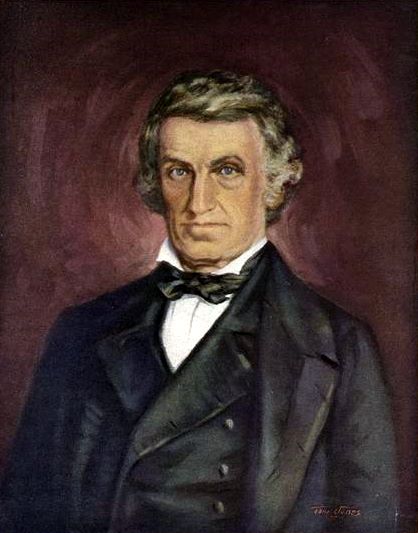
The Man with a Window into the Stomach · Army Surgeon & Physiologist · 1785–1853
The frontier army surgeon who watched a living human stomach at work for a decade through an accidental opening, and proved digestion is chemistry.
Defend these ideas against Beaumont
Incandio is a free revision platform for the Pearson Edexcel International GCSE, and on it a topic counts as mastered only once you have learned it, proved it in questions, taught it back and defended it against the person with the strongest claim on it. William Beaumont is that person for 3 topics on the course:
- The Alimentary Canal — Biology
- Digestive Enzymes and Bile — Biology
- Absorption and the Energy in Food — Biology
Who was Beaumont?
William Beaumont was born on a Connecticut farm in 1785, taught school, read medicine as an apprentice, and served as an army surgeon in the War of 1812. In June 1822, at the fur-trading post of Fort Mackinac, a nineteen-year-old French-Canadian voyageur named Alexis St. Martin was shot in the side at close range. Beaumont expected him to die; he lived — but the wound healed strangely, leaving a permanent opening, a fistula, into his stomach. Beaumont realised what no physician had ever had: a window into a working human stomach. From 1825 he ran experiments — tying pieces of food to silk strings and drawing them out hourly to watch digestion in progress, sampling the gastric juice itself, and showing that the juice would dissolve food in a vial on the mantelpiece almost as it did in the man. His 1833 book established that digestion is fundamentally a chemical process performed by the gastric juice, whose active acid he had identified as hydrochloric, and not a mysterious vital fermentation or mere grinding. He bound St. Martin to him with contracts of service, paying him and pursuing him by letter for years when he fled home to Canada — a relationship medicine still argues about. Beaumont died in 1853 after a fall on ice in St. Louis. St. Martin outlived him by twenty-seven years.
Major achievements
- Proved digestion is a chemical process performed by the gastric juice, not vital fermentation or simple grinding
- First to observe a working human stomach directly, over nearly a decade of experiments
- Showed gastric juice digests food outside the body — in a vial — at body warmth
- Identified hydrochloric acid as a principal active agent of the gastric juice
- Recorded how the stomach's movements churn and mix its contents
Life in brief
- 1785 — Born in Lebanon, Connecticut: On a farm; schoolteacher before medicine.
- 1812 — Army surgeon's mate: Serves through the War of 1812, including the siege of Plattsburgh.
- 1822 — The accident at Fort Mackinac: Alexis St. Martin is shot; the wound heals into a permanent gastric fistula.
- 1825 — The experiments begin: Food on silk strings, drawn out hourly; gastric juice sampled and tested in vials.
- 1833 — Experiments and Observations on the Gastric Juice: Digestion established as chemistry; the founding text of American physiology.
- 1834 — St. Martin returns to Canada: Beaumont pursues him by letter for years; the experiments never resume.
- 1853 — Dies in St. Louis: After a fall on ice. St. Martin outlives him by twenty-seven years.
Explore the life of Beaumont — five chapters
- A Farm, a Schoolroom and an Army — Medicine learned by apprenticeship on the American frontier
- 6 June 1822 — A shotgun in a company store, and a wound that would not close
- Food on Silk Strings — Two hundred and thirty-eight experiments
- The Contracts — A man bound by indenture to be experimented on
- What the Book Changed — American physiology begins, and ethics catches up
Read the five-chapter life of William Beaumont →
Where Beaumont appears in your course
William Beaumont has a genuine claim on 3 lessons of the Pearson Edexcel International GCSE science course built into Incandio:
- The Alimentary Canal — Biology: In 1822 a shotgun accident left the voyageur Alexis St. Martin with a permanent opening into his stomach, and Beaumont — the army surgeon who saved him — spent the next decade doing what no one before or since has done: watching a living human stomach digest. He lowered food in on silk strings, timed every change, and watched the churning movements this lesson describes. He is the closest anyone has come to seeing the inside of the tube you are labelling.
- Digestive Enzymes and Bile — Biology: Every enzyme in this lesson lives in a secreted fluid, and Beaumont is the man who proved such fluids do the work: he drew gastric juice from a living stomach — through the opening in Alexis St. Martin's side — and digested meat with it in a warmed vial on his mantelpiece. He proved digestion is chemistry a decade before anyone named the first enzyme, and he believed to the end that his juice was one single solvent rather than the workforce this lesson lays out.
- Absorption and the Energy in Food — Biology: Beaumont's famous timetables recorded dinners dissolving in a living stomach hour by hour — the most exact record of digestion ever made from life — yet his window opened on the stomach, which absorbs almost nothing, so he never once saw the meal actually enter the body. His era pictured dissolved food simply soaking in where it lay. The villus this lesson describes is the answer to the question his ledger could never close: where the dinner arrives.
Begin
- Start a conversation with Beaumont — a dramatised, historically grounded AI portrayal
- Read the Historical Brief
- Explore the life of Beaumont — five chapters
- Find your course · Meet all 280 figures