Historical figure · Pearson Edexcel International GCSE revision on Incandio
William Harvey
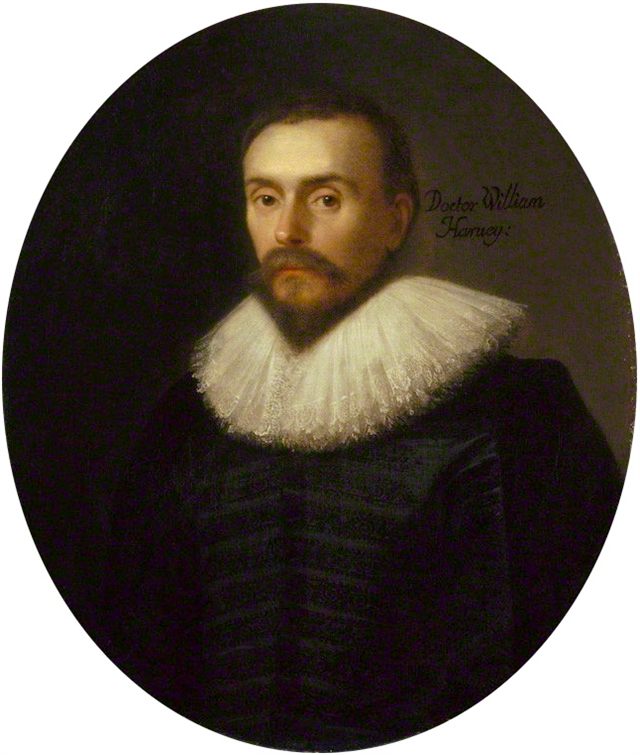
Discoverer of the Circulation · Physician & Anatomist · 1578–1657
The physician who proved that blood circulates in a closed loop driven by the heart, overturning the fourteen-hundred-year-old teaching of Galen — and who did it largely with arithmetic.
Defend these ideas against Harvey
Incandio is a free revision platform for the Pearson Edexcel International GCSE, and on it a topic counts as mastered only once you have learned it, proved it in questions, taught it back and defended it against the person with the strongest claim on it. William Harvey is that person for 2 topics on the course:
- The Heart, and What Goes Wrong With It — Biology
- The Human Reproductive Systems — Biology
Who was Harvey?
William Harvey trained at Cambridge and then at Padua under Fabricius, who had described the small valves inside the veins without discovering their purpose. Returning to London, he became physician to St Bartholomew's Hospital and later to James I and Charles I. The accepted account, inherited from Galen, held that blood was continuously manufactured in the liver and consumed by the tissues, ebbing and flowing in the vessels. Harvey destroyed it with a calculation: measure the volume the heart expels, multiply by the number of beats in an hour, and the liver would have to produce many times a man's own body weight in blood each day. Since that is impossible, the blood must return and be used again. He confirmed the direction of flow with ligature experiments on living arms and by showing that the venous valves permit passage only towards the heart, and published De Motu Cordis in 1628. He could not see how blood crossed from artery to vein — no lens available to him would show it — and argued that it must pass through connections too small to observe. Marcello Malpighi saw those capillaries in 1661, four years after Harvey's death.
Major achievements
- Proved that blood circulates continuously in a closed loop
- Showed the heart is a muscular pump rather than a source of heat
- Established the true function of the valves in the veins
- Used quantitative reasoning to refute Galen, a novel method in medicine
- Published De Motu Cordis (1628), one of the foundational texts of physiology
Life in brief
- 1578 — Born in Folkestone: Eldest son of a prosperous Kentish family.
- 1600 — Studies at Padua: Under Fabricius, who had described the valves in the veins.
- 1609 — Physician at St Bartholomew's: Begins a long London medical career.
- 1618 — Physician to James I: Later serves Charles I as well.
- 1628 — De Motu Cordis: Publishes the proof that blood circulates.
- 1642 — Civil War: Follows the King; his papers and lodgings are lost.
- 1651 — De Generatione Animalium: His work on the development of the embryo.
- 1657 — Dies: Four years before capillaries were first observed.
Explore the life of Harvey — five chapters
- Padua, and a Teacher Who Missed It — The valves described without their purpose
- The Arithmetic That Settled It — How much blood can a liver make in a day?
- The Vessels He Could Not See — Inferring what no lens would show
- Circulator — A quarter-century being called a quack
- Out of Everything, an Egg — Embryology, a lost library, and a childless marriage
Read the five-chapter life of William Harvey →
Where Harvey appears in your course
William Harvey has a genuine claim on 5 lessons of the Pearson Edexcel International GCSE science course built into Incandio:
- Blood — Biology: Before Harvey, blood was thought to be manufactured in the liver and used up by the body. If that were true, blood could not be a transport medium at all — it would be a supply. He proved by measuring the heart's output that the same blood must return and be reused, which is precisely what allows plasma to collect carbon dioxide here and deliver it there, and to carry heat from a warm organ to a cold one.
- The Heart, and What Goes Wrong With It — Biology: Everything on this page depends on the heart being a pump driving blood round a circuit, and that was established by Harvey in 1628 against the settled opinion of every physician in Europe. His decisive argument was not a dissection but a calculation: multiply what the heart holds by the beats in an hour, and the liver would have to manufacture many times a man's own weight in blood each day.
- Blood Vessels and the Circulation — Biology: Harvey proved blood travels out through arteries and back through veins, which requires something joining the two — and no lens available to him would show it. He argued the connections must exist and be too small to see, and was mocked for it. Marcello Malpighi saw the capillaries under a microscope in 1661, four years after Harvey died.
- The Kidney and the Nephron — Biology: Filtration in the glomerulus is driven by blood pressure, and blood only has pressure because a muscular heart generates it and drives blood round a closed circuit. Before Harvey, blood was thought to seep and ebb rather than be pumped — and a kidney could not have worked this way at all in that picture. His circulation is what makes the mechanism on this page possible.
- ADH and the Water Balance of the Blood — Biology: ADH is made in one organ and acts on another, several handspans away, with nothing connecting them but blood. That only works if blood genuinely travels in a circuit reaching every organ and returning — which is Harvey's discovery. In a body where blood ebbed and seeped as the ancients believed, chemical messaging of this kind would be impossible.
Begin
- Start a conversation with Harvey — a dramatised, historically grounded AI portrayal
- Read the Historical Brief
- Explore the life of Harvey — five chapters
- Find your course · Meet all 280 figures