Pearson Edexcel International GCSE in Biology · 4BI1 · Free · no account needed
The Kidney and the Nephron
The kidney does not pick out the waste. It throws almost everything away and then takes back what it wants — and that is a far cleverer design than it sounds.
On the specification this is structure of the urinary system · structure of a nephron — 4BI1 statements 2.72–2.74.
Topic 2 · Structures and functions in living organisms — one of 34 lessons in this topic, and one of 68 in Biology.
This lesson ends with Marcello Malpighi. Learn the Kidney and the Nephron, teach it, then defend it against Marcello Malpighi.
The definition this lesson teaches, word for word — every Biology definition.
- Osmoregulation
- The control of the water and dissolved ion content of the body fluids, keeping their concentration constant regardless of how much is taken in or lost.
What this lesson covers in the specification
Incandio is aligned to this specification. It is not published by, endorsed by or affiliated with Pearson, and it reproduces none of Pearson's wording — the statement numbers are given so you can check every lesson against your own copy.
- 2.72 — How the kidney carries out excretion and osmoregulation (bold B statement — Paper 2 only)
- 2.73 — The structure of the urinary system: kidneys, ureters, bladder, urethra (bold B statement — Paper 2 only)
- 2.74 — The structure of a nephron (bold B statement — Paper 2 only)
Specification section 2(i) Excretion — also taught in Excretion: Getting Rid of What You Made, Ultrafiltration and Selective Reabsorption, ADH and the Water Balance of the Blood.
1 · Understand it
No exam language yet. The only question this section answers is: do I actually understand what is happening?
The kidney has two jobs, and they are genuinely different. The first is EXCRETION: removing urea, the toxic waste the liver makes from surplus amino acids. The second is OSMOREGULATION: controlling how much water and how many dissolved ions the blood contains, so that the concentration of your body fluids stays steady whether you have just drunk a litre of water or spent an afternoon sweating. One organ, two jobs — and the design that lets it do both at once is the interesting part.

The plumbing, in order
- The RENAL ARTERY brings blood to the kidney, at high pressure, straight from the aorta.
- The KIDNEY processes it, producing urine.
- The RENAL VEIN carries the filtered blood away — with much less urea in it than when it arrived.
- A URETER carries urine from each kidney down to the bladder. There are two, one per kidney.
- The BLADDER stores the urine until it is convenient to release it.
- The URETHRA carries urine out of the body. There is only one, and it is the last stage.
- Learn ureter and urethra as a pair or you will confuse them: ureterS, plural, from the kidneys; urethra, singular, to the outside.
Now the design. You might expect a kidney to work like a security guard — inspect each substance in the blood and pull out the harmful ones. It does nothing of the kind, and could not: it would need to recognise every possible toxin in advance, including ones the body has never met. What it does instead is far simpler and much more robust. It filters almost EVERYTHING small out of the blood indiscriminately, and then goes back through the filtrate and reclaims the things worth keeping. Anything not reclaimed leaves as urine.
Why filter-then-reclaim is the better design
- The filter does not need to recognise anything. It only needs a hole size — small molecules through, large ones held back.
- So urea, glucose, water, ions and amino acids all pass out of the blood together, with no distinction made between them.
- The reclaiming step only has to recognise the SHORT list of things the body wants back: glucose, most of the water, and the right quantity of ions.
- Anything unfamiliar or unwanted is simply never reclaimed, and leaves in the urine by default.
- That is the elegance of it. A novel toxin the body has never encountered is removed automatically, because the kidney's default is to throw away.
The cost of that design is a startling amount of work. About 180 dm³ of fluid is filtered out of the blood each day, and about 178.5 dm³ of it is taken straight back — leaving something like one and a half litres of urine. Roughly ninety-nine per cent of everything filtered is reclaimed. The kidney is spending enormous effort undoing almost all of what it just did, and it is worth it because the alternative is a filter clever enough to recognise every substance in the world.
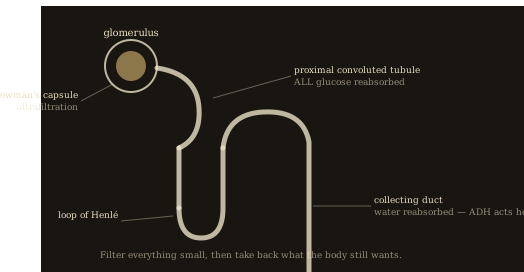
The nephron — where all of this actually happens
- Blood arrives in a knot of capillaries called the GLOMERULUS, which sits cupped inside the BOWMAN'S CAPSULE. This is where filtering happens, driven by the high blood pressure.
- Filtrate passes into the PROXIMAL CONVOLUTED TUBULE, the first coiled section, where most reclaiming takes place.
- It then travels down and back up the LOOP OF HENLÉ, a hairpin that dips into the middle of the kidney and is central to concentrating the urine.
- Next comes the DISTAL CONVOLUTED TUBULE, where fine adjustments to ions are made.
- Finally the COLLECTING DUCT, where the amount of water reclaimed is controlled — and so where osmoregulation is settled.
- Whatever is left at the end of the collecting duct is urine, and it drains towards the ureter.
2 · Grade 9 Notes
A different job from the section above. You have already understood it; this is the precise set of things to LEARN — definitions to reproduce word for word, processes in order, equations with units, and the answers that score full marks.
Learn this definition · Osmoregulation
The control of the water and dissolved ion content of the body fluids, keeping their concentration constant regardless of how much is taken in or lost.
The urinary system — what each part does
- Renal artery
- brings blood to the kidney at high pressure, direct from the aorta
- Kidney
- filters the blood and reclaims what is needed, producing urine
- Renal vein
- carries the filtered blood away, now containing far less urea
- Ureters
- two tubes, one from each kidney, carrying urine down to the bladder
- Bladder
- stores urine until it is released
- Urethra
- the single tube carrying urine out of the body
The nephron — the parts, in the order the filtrate meets them
- Glomerulus
- a knot of capillaries where the blood is filtered, driven by high blood pressure
- Bowman's capsule
- the cup surrounding the glomerulus that collects the filtrate
- Proximal convoluted tubule
- the first coiled section, where most reabsorption takes place
- Loop of Henlé
- a hairpin dipping into the kidney's centre, central to concentrating the urine
- Distal convoluted tubule
- where fine adjustments to the ion content are made
- Collecting duct
- where the amount of water reabsorbed is controlled, settling the concentration of the urine
The kidney's two jobs — both, every time
A. EXCRETION: removing urea, the toxic nitrogenous waste made by the liver from surplus amino acids. If it accumulated it would poison the body.
B. OSMOREGULATION: controlling the water and ion content of the blood, so that body fluid concentration stays constant whether a person drinks heavily or sweats heavily.
Model answer [3 marks]
Describe the path taken by urine from where it is made to where it leaves the body. [3]
Urine is produced in the nephrons of the kidney and drains into the collecting ducts. It passes from each kidney down a ureter to the bladder, where it is stored. It then leaves the body through the urethra.
Model answer [4 marks]
Explain why the kidney filters almost everything out of the blood and then reabsorbs most of it, rather than removing only the waste. [4]
A filter that removed only waste would have to recognise every harmful substance, including ones the body has never encountered. Instead the glomerulus filters by size alone, so all small molecules leave the blood together. The tubule then reabsorbs only the short list of substances the body needs, such as glucose, most of the water and the required ions. Anything not reabsorbed leaves in the urine automatically, so unfamiliar toxins are removed without the kidney needing to identify them.
Mark-losing trap. UreterS carry urine from the kidneys to the bladder; the urethra carries it out. Two of one, one of the other.
Mark-losing trap. The glomerulus is a knot of CAPILLARIES; Bowman's capsule is the cup around it. They are not the same structure.
Mark-losing trap. The kidney has two jobs. An answer naming only excretion has missed osmoregulation, which is half the statement.
Mark-losing trap. Blood enters and leaves by the renal artery and vein. Urine only travels one way, downwards, and never returns.
3 · Prove it — the five questions
The five questions climb Grade 6 → Grade 7 → Grade 8 → Grade 9 → Grade 9 challenge, and are marked inside Incandio on your own device, by rule, with an authored diagnosis of the mistake you actually made. The mark schemes stay in the app so that the practice is worth doing; the questions themselves are here.
- Grade 6 · Identify [1 mark] — Which tube carries urine from a kidney to the bladder?
- Grade 7 · State [1 mark] — Name the structure in which the glomerulus sits, and which collects the fluid filtered from it.
- Grade 8 · Explain [4 marks] — The kidney filters almost everything small out of the blood and then reabsorbs nearly all of it, rather than removing only the waste. Select every statement that belongs in a full-mark explanation of why this design is used.
- Grade 9 · Calculate [3 marks] — A person's kidneys filter about 180 dm³ of fluid from the blood each day, and produce about 1.5 dm³ of urine. Calculate the percentage of the filtered fluid that is reabsorbed, to one decimal place.
- 9+ · Analyse [5 marks] — A patient suffers severe blood loss. Their blood pressure falls sharply, and although their kidneys are undamaged they produce almost no urine until the blood loss is treated. Select every statement that belongs in a full-mark explanation.
The people behind this science
Two ways into the same idea — the one who found a kidney is not a solid thing, and the one who explained where the pressure comes from. Inside Incandio each of them answers knowing exactly which lesson you have just finished.
Marcello Malpighi — the one who found a kidney is not a solid thing
To the naked eye a kidney is a dense red mass with no visible structure at all. Malpighi put one under a lens and found it densely packed with tiny knots of blood vessels and fine tubules — a machine rather than a sponge. The knots are still called Malpighian corpuscles, and this lesson's nephron is what he was looking at without being able to say what it did.
- “What did you expect to find inside a kidney before you looked?”
- “How did you work out that the tiny knots were made of blood vessels?”
- “Why does it matter that the kidney has structure rather than being uniform?”
- “What would you most want to know about what those tubules were doing?”
William Harvey — the one who explained where the pressure comes from
Filtration in the glomerulus is driven by blood pressure, and blood only has pressure because a muscular heart generates it and drives blood round a closed circuit. Before Harvey, blood was thought to seep and ebb rather than be pumped — and a kidney could not have worked this way at all in that picture. His circulation is what makes the mechanism on this page possible.
- “Where does the pressure driving blood through an organ actually come from?”
- “Why could an organ not filter blood if the blood merely ebbed and flowed?”
- “How did you measure how forcefully the heart pushes blood out?”
- “What happens to an organ if the pressure reaching it falls?”
Think you understand it?
Reading is the start. On Incandio a topic counts as mastered only once you have taught it and defended it — the two things a revision guide cannot ask of you.
Incandio this topic → Prove it. Teach it. Defend it. What does “Incandio it” mean?
- Prove it — five questions on the Kidney and the Nephron, marked on the spot, that tell you what was missing rather than just what was wrong.
- Teach it — Explain the Kidney and the Nephron in your own words to Ember, an AI pupil who does not have it yet and asks the awkward question. Understanding is credited; wording is not required.
- Defend it — Argue the Kidney and the Nephron against Marcello Malpighi — three rounds, marked against descriptors you can read before you begin.
- Then the exam — read all 10 authored exam-style questions on this unit, each with its command word and its tariff, then have them marked on Incandio with the mistake you actually made named.
Completely free. No subscriptions, no paywalls, no account needed to start.
Carry on through the course
- Previous lesson: Excretion: Getting Rid of What You Made
- Next lesson: Ultrafiltration and Selective Reabsorption
- Levels of Organisation — From organelle to organism — the five-step ladder that every later topic in biology is built on.
- Comparing Cells, and Stem Cells — What plant and animal cells share and where they differ — then why a cell specialising is one of the most powerful ideas in biology.
- Carbohydrates, Proteins and Lipids — The three big food molecules — what they are made of, what they are built from, and how to test for them.
- Enzymes: Catalysts With a Shape — Why a protein with a hole in it speeds up a reaction, and why heat destroys that ability permanently.
- Enzymes and pH — Why acid ruins one enzyme and is the only condition another will work in — and how to find an enzyme's best pH by experiment.
- All of Biology · Biology key terms · required practicals · Incandio Science · The 4BI1 specification