Pearson Edexcel International GCSE in Biology · 4BI1 · Free · no account needed
The Heart, and What Goes Wrong With It
Two pumps in one organ, and why the muscle that pushes blood everywhere can still starve for want of it.
On the specification this is structure of the heart and how it functions — 4BI1 statements 2.65–2.67.
Topic 2 · Structures and functions in living organisms — one of 34 lessons in this topic, and one of 68 in Biology.
This lesson ends with William Harvey. Learn the Heart, and What Goes Wrong With It, teach it, then defend it against William Harvey.
The definition this lesson teaches, word for word — every Biology definition.
- Double circulation
- A circulatory system in which blood passes through the heart twice on each complete circuit of the body — once to be pumped to the lungs, and once to be pumped to the rest of the body.
What this lesson covers in the specification
Incandio is aligned to this specification. It is not published by, endorsed by or affiliated with Pearson, and it reproduces none of Pearson's wording — the statement numbers are given so you can check every lesson against your own copy.
- 2.65 — The structure of the heart and how it functions
- 2.66 — How heart rate changes during exercise and under adrenaline
- 2.67 — Factors that increase the risk of coronary heart disease
Specification section 2(h) Transport — also taught in Why Transport Systems Exist, and the Two Plant Vessels, Water Uptake and Transpiration, Blood, Immunity and Clotting.
1 · Understand it
No exam language yet. The only question this section answers is: do I actually understand what is happening?
The heart is usually described as a pump, which is true and slightly misleading. It is TWO pumps, bolted together and beating in time, and once you see why there have to be two, the whole structure explains itself.
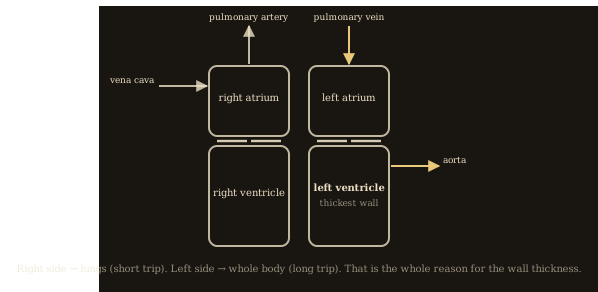
Why the heart has to be a double pump
- Blood leaves the right side and is pushed through the lungs, where it passes through capillaries so fine that red blood cells go single file.
- Squeezing through that network costs a great deal of pressure. Blood emerges from the lungs oxygenated but moving slowly and at low pressure.
- If it went straight on to the body from there, it would never reach your feet and your brain in any useful time.
- So it returns to the heart first, to be re-pressurised by the left side before being sent round the body.
- Every drop of blood therefore passes through the heart TWICE on each complete circuit — once to be sent to the lungs, once to be sent to the body. That is what double circulation means.
That single fact explains the most examined feature of the heart's structure. The left ventricle has a much thicker muscular wall than the right, because it has to generate enough pressure to drive blood around the entire body, while the right only has to push it as far as the lungs, which are next door. The atria have thin walls because they only push blood down into the ventricles below them, a matter of centimetres.
What the valves are doing
- A pump that pushes fluid in both directions achieves nothing. Something must stop the blood going backwards.
- The atrioventricular valves sit between each atrium and its ventricle. When the ventricle contracts, they slam shut and stop blood going back up into the atrium.
- The semilunar valves sit at the exits, where the arteries leave. When the ventricle relaxes, they shut and stop blood falling back in from the arteries.
- Both open and close passively — they are pushed by the blood itself, not operated by anything.
Now the detail that catches people out. The heart is a thick block of muscle, and it is full of blood — but it cannot use the blood inside its chambers, any more than a water pipe can drink. The muscle is supplied by its own vessels running over its surface, the CORONARY ARTERIES, which branch off the aorta the moment blood leaves the heart. The heart is the first organ served by its own output.
Coronary heart disease, one step at a time
- Fatty material builds up in the wall of a coronary artery, narrowing it.
- Less blood can flow through, so the heart muscle beyond that point receives less oxygen and glucose.
- During exertion the muscle needs more than it is getting, and the shortage causes chest pain — angina.
- If a blood clot forms at the narrowed point, it can block the artery completely.
- The muscle beyond it is then cut off entirely, cannot respire aerobically, and dies. That is a heart attack — and the damage is permanent, because heart muscle does not regrow.
Heart rate is not fixed, and it changes for two quite different reasons. During exercise, the muscles respire faster and produce more carbon dioxide; the body detects this and raises the heart rate and the force of each beat, so more blood circulates per minute — delivering oxygen faster and removing carbon dioxide faster. Adrenaline does something subtler: released when you are frightened, angry or under stress, it raises heart rate BEFORE any extra demand exists, preparing the body for activity that may be about to happen. One response answers a demand; the other anticipates it.
2 · Grade 9 Notes
A different job from the section above. You have already understood it; this is the precise set of things to LEARN — definitions to reproduce word for word, processes in order, equations with units, and the answers that score full marks.
Learn this definition · Double circulation
A circulatory system in which blood passes through the heart twice on each complete circuit of the body — once to be pumped to the lungs, and once to be pumped to the rest of the body.
The path of the blood — learn this in order
- Deoxygenated blood returns from the body in the vena cava to the right atrium.
- It passes into the right ventricle, which pumps it through the pulmonary artery to the lungs.
- Oxygenated blood returns from the lungs in the pulmonary vein to the left atrium.
- It passes into the left ventricle, which pumps it through the aorta to the rest of the body.
Structure and the reason for it — this is where the marks are
- Thick left ventricle wall
- generates the high pressure needed to pump blood all round the body
- Thinner right ventricle wall
- only has to pump blood as far as the lungs, so less pressure is needed
- Thin atrium walls
- only push blood down into the ventricles below, a very short distance
- Atrioventricular valves
- prevent backflow from the ventricles into the atria when the ventricles contract
- Semilunar valves
- prevent backflow from the arteries into the ventricles when the ventricles relax
- Coronary arteries
- supply the heart muscle itself with oxygen and glucose; the heart cannot use the blood inside its chambers
From narrowed artery to heart attack — the chain to write
- Fatty material builds up in the wall of a coronary artery, narrowing it.
- Less blood, and so less oxygen and glucose, reaches the heart muscle beyond that point.
- During exertion the muscle cannot get what it needs, causing chest pain known as angina.
- If a clot blocks the narrowed artery completely, that region of muscle is cut off entirely.
- It cannot respire aerobically and the muscle dies — a heart attack, and the damage is permanent.
Factors that increase the risk of coronary heart disease
- Smoking — carbon monoxide reduces oxygen carriage and nicotine raises blood pressure
- A diet high in saturated fat, raising blood cholesterol and fatty deposits in the arteries
- High blood pressure, which damages artery walls
- Lack of exercise
- Obesity
- Long-term stress
- Increasing age, and a family history of the disease — neither of which can be changed
Exercise against adrenaline — both raise heart rate, for different reasons
A. EXERCISE: the muscles are already respiring faster and producing more carbon dioxide. The heart rate rises in response to a demand that already exists, to deliver oxygen and remove carbon dioxide faster.
B. ADRENALINE: released in fear, anger or stress. It raises heart rate in ANTICIPATION of activity, before any extra demand has arisen, preparing the body for action that may not even happen.
Model answer [3 marks]
Explain why the wall of the left ventricle is thicker than the wall of the right ventricle. [3]
The left ventricle pumps blood all round the body, so it must generate a high pressure to force blood through a very long circuit. The right ventricle only pumps blood to the lungs, which are close by, so much less pressure is needed. A thicker muscular wall can contract more forcefully and so produce the higher pressure the left side requires.
Model answer [4 marks]
Explain why a blockage in a coronary artery damages the heart muscle, even though the heart is full of blood. [4]
The heart muscle cannot obtain oxygen from the blood inside its chambers; it is supplied by the coronary arteries running over its surface. A blockage stops blood flowing through that artery, so the muscle beyond it receives no oxygen or glucose. Without oxygen it cannot respire aerobically and releases too little energy to keep working. That region of muscle therefore dies, and because heart muscle does not regrow the damage is permanent.
Mark-losing trap. The heart cannot use the blood in its own chambers. Name the coronary arteries or the explanation does not work.
Mark-losing trap. Left ventricle thicker because it pumps to the WHOLE BODY. 'Because it is stronger' explains nothing and scores nothing.
Mark-losing trap. Valves are pushed open and shut by the blood itself. They are not muscles and they do not operate under their own power.
Mark-losing trap. The right side is drawn on the LEFT of a diagram. You are looking at the heart from in front of the person.
3 · Prove it — the five questions
The five questions climb Grade 6 → Grade 7 → Grade 8 → Grade 9 → Grade 9 challenge, and are marked inside Incandio on your own device, by rule, with an authored diagnosis of the mistake you actually made. The mark schemes stay in the app so that the practice is worth doing; the questions themselves are here.
- Grade 6 · Identify [1 mark] — Which chamber of the heart pumps oxygenated blood out to the body?
- Grade 7 · Explain [2 marks] — Explain the function of the valves in the heart.
- Grade 8 · Explain [4 marks] — Explain why the wall of the left ventricle is much thicker than the wall of the right ventricle. Select every statement that belongs in a full-mark explanation.
- Grade 9 · Calculate [4 marks] — At rest a person's heart beats 72 times a minute and pumps 70 cm³ of blood from the left ventricle with each beat. During hard exercise this rises to 180 beats a minute and 120 cm³ per beat. Calculate how many times greater the volume pumped per minute becomes.
- 9+ · Analyse [5 marks] — A man feels chest pain when walking uphill but none when sitting still. Later a clot forms in the same artery and part of his heart muscle dies permanently. Explain both events. Select every statement that belongs in a full-mark explanation.
The people behind this science
Two ways into the same idea — the one who proved the heart is a pump, and the one who built a glass heart to watch the valves close. Inside Incandio each of them answers knowing exactly which lesson you have just finished.
William Harvey — the one who proved the heart is a pump
Everything on this page depends on the heart being a pump driving blood round a circuit, and that was established by Harvey in 1628 against the settled opinion of every physician in Europe. His decisive argument was not a dissection but a calculation: multiply what the heart holds by the beats in an hour, and the liver would have to manufacture many times a man's own weight in blood each day.
- “How did multiplying heartbeats prove Galen wrong?”
- “Why is it so important that the blood returns rather than being used up?”
- “What did the valves in the veins tell you about which way blood travels?”
- “How did it feel to be called a quack for twenty years?”
- “What did you think the heart was actually for, if not making heat?”
Leonardo da Vinci — the one who built a glass heart to watch the valves close
Leonardo cast a bull's aorta in wax, made a glass model from the cast, and pumped water seeded with grass seeds through it so he could watch the flow. He saw the swirling vortices that push the valve shut — a discovery not confirmed again until the twentieth century, and made because he built the apparatus rather than merely dissecting the organ.
- “Why did you build a glass model instead of dissecting another heart?”
- “What did the seeds in the water show you that a still organ could not?”
- “How does a valve close if nothing is operating it?”
- “What did you conclude the heart was doing to the blood?”
Think you understand it?
Reading is the start. On Incandio a topic counts as mastered only once you have taught it and defended it — the two things a revision guide cannot ask of you.
Incandio this topic → Prove it. Teach it. Defend it. What does “Incandio it” mean?
- Prove it — five questions on the Heart, and What Goes Wrong With It, marked on the spot, that tell you what was missing rather than just what was wrong.
- Teach it — Explain the Heart, and What Goes Wrong With It in your own words to Ember, an AI pupil who does not have it yet and asks the awkward question. Understanding is credited; wording is not required.
- Defend it — Argue the Heart, and What Goes Wrong With It against William Harvey — three rounds, marked against descriptors you can read before you begin.
- Then the exam — read all 9 authored exam-style questions on this unit, each with its command word and its tariff, then have them marked on Incandio with the mistake you actually made named.
Completely free. No subscriptions, no paywalls, no account needed to start.
Carry on through the course
- Previous lesson: Immunity and Clotting
- Next lesson: Blood Vessels and the Circulation
- Levels of Organisation — From organelle to organism — the five-step ladder that every later topic in biology is built on.
- Comparing Cells, and Stem Cells — What plant and animal cells share and where they differ — then why a cell specialising is one of the most powerful ideas in biology.
- Carbohydrates, Proteins and Lipids — The three big food molecules — what they are made of, what they are built from, and how to test for them.
- Enzymes: Catalysts With a Shape — Why a protein with a hole in it speeds up a reaction, and why heat destroys that ability permanently.
- Enzymes and pH — Why acid ruins one enzyme and is the only condition another will work in — and how to find an enzyme's best pH by experiment.
- All of Biology · Biology key terms · required practicals · Incandio Science · The 4BI1 specification