Pearson Edexcel International GCSE in Biology · 4BI1 · Free · no account needed
Genetic Engineering
Cutting a gene out of one organism and making another organism read it — and the reason that works at all.
Topic 5 · Use of biological resources — one of 8 lessons in this topic, and one of 68 in Biology.
This lesson ends with Paul Berg. Learn Genetic Engineering, teach it, then defend it against Paul Berg.
The 2 definitions this lesson teaches, word for word — every Biology definition.
- Genetic engineering
- Cutting a gene out of the DNA of one organism and inserting it into the DNA of another, so that the second organism makes the protein the gene codes for.
- Transgenic
- Describes an organism containing genetic material transferred to it from a different species.
What this lesson covers in the specification
Incandio is aligned to this specification. It is not published by, endorsed by or affiliated with Pearson, and it reproduces none of Pearson's wording — the statement numbers are given so you can check every lesson against your own copy.
- 5.12 — How restriction enzymes cut DNA and ligase enzymes join it
- 5.13 — How plasmids and viruses act as vectors carrying recombinant DNA into cells
- 5.16 — The term transgenic: transfer of genetic material between species
Specification section 5(b) Selective breeding — also taught in Fish Farming and Selective Breeding.
1 · Understand it
No exam language yet. The only question this section answers is: do I actually understand what is happening?
Start with the fact that makes all of this possible, because it is usually left out. A gene is a length of DNA, and DNA is written in one alphabet everywhere: four bases, read three at a time, and each triplet specifies one amino acid. That code is the same in a bacterium, in a wheat plant and in you — the triplet that means one particular amino acid in a human cell means the same amino acid in a bacterium. So if you can physically get a human gene inside a bacterium, the bacterium's ribosomes will read it and build the human protein, because they have no way of telling where the instruction came from. Genetic engineering is not persuading a bacterium to do something foreign. It is handing it an instruction it cannot tell apart from its own.
That leaves a practical problem: DNA is a very long molecule, and you need one gene out of it, cut cleanly at both ends. The tools for that were not invented — they were found. Bacteria are attacked by viruses, and they defend themselves with enzymes that chop up any DNA that does not belong to them. Each of these RESTRICTION ENZYMES recognises one short sequence of bases, a few letters long, and cuts the DNA wherever that sequence appears. Give the same enzyme the same DNA a thousand times and it cuts in exactly the same places every time.
Think of it like tearing two sheets along the same perforation
Imagine a machine that punches an identical zig-zag perforation into every sheet of paper you feed it, always in the same pattern. Tear one sheet along that perforation and you get a jagged edge. Tear a completely different sheet on the same machine and you get the same jagged edge — so the two torn pieces interlock, even though they came from different sheets and were never meant to fit. That is what a restriction enzyme does to DNA. The ones used for this work do not cut straight across: they cut the two strands a few bases apart, leaving a short run of unpaired bases hanging off each end. Any two pieces cut by that same enzyme have matching overhangs, so they will pair with each other. This is why the rule is not 'use a restriction enzyme' but 'use the SAME restriction enzyme on both'.
Those overhangs are called STICKY ENDS, and 'sticky' is a fair description: the unpaired bases on one end pair by complementary base pairing with the unpaired bases on the other, holding the two pieces together. But base pairing is a weak grip and it only holds the middle of the join — the sugar-phosphate backbones of the two pieces are still broken. A second enzyme, DNA LIGASE, seals those breaks and makes the join permanent. The pieces are held together by base pairing; they are joined by ligase. Those are two different events and examiners test whether you can separate them.
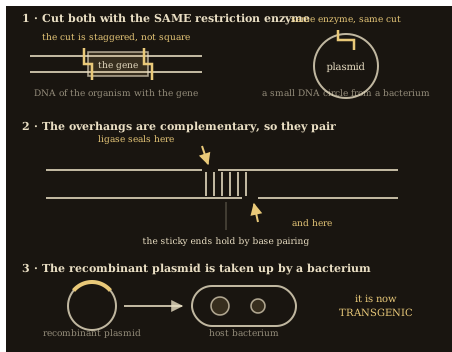
Now the gene has to get inside a living cell, and a bare piece of DNA dropped into a solution of bacteria will achieve nothing: it will not reliably enter, and if it did it would not be copied when the cell divided. It needs a VECTOR — something that carries it in and gets it replicated. The two the specification names are plasmids and viruses, and each is used because of what it already does for a living.
Why a plasmid works as a vector
- A PLASMID is a small circle of DNA found in bacteria, separate from the main bacterial chromosome.
- It is cut open with the same restriction enzyme used on the gene, so it now has matching sticky ends — and because it is a CIRCLE, one cut does not divide it into pieces; it simply opens it into a line.
- The gene is added, its sticky ends pair with the plasmid's, and ligase seals the backbone. The plasmid is a closed circle again, now carrying a gene it did not have. That is RECOMBINANT DNA — DNA made of pieces from more than one source.
- Bacteria will take plasmids up from their surroundings, particularly if they are treated to make their membranes more permeable.
- Once inside, the plasmid is copied by the bacterium along with everything else, so every daughter cell inherits the gene — and a single bacterium becomes billions overnight.
A virus is used for the same reason from the other direction. Injecting its own genetic material into a cell and getting that cell to copy it is the whole of a virus's existence, so a virus with a human gene inserted into its genetic material is a delivery system that already works. Viruses are the usual vector for getting genes into animal and plant cells, which do not take up plasmids the way bacteria do, and they are the vector used in gene therapy, where the target is a person's own cells. The obvious risk is the one you would expect: the virus must first be altered so that it cannot cause disease.
An organism that ends up carrying a gene transferred from a different species is TRANSGENIC — and that word is worth being precise about, because it is not a synonym for 'genetically modified'. An organism could be modified by having one of its own genes altered or switched off, and that would not make it transgenic. Transgenic specifically means genetic material has crossed from one species to another: a bacterium carrying a human gene, a sheep carrying a human gene, a maize plant carrying a bacterial gene. The species boundary is the point.
One last thing, because it explains why this technique arrived with an argument attached rather than acquiring one later. The first recombinant molecule was made in 1972, and the group that made it did not go on to put it into gut bacteria. They stopped, published a letter asking every laboratory in the world to pause, and spent four days in 1975 arguing out what should and should not be attempted. Nothing in the biology told them to do that. It is the one occasion in modern science where the people who opened a door asked, in public, whether to walk through it.
2 · Grade 9 Notes
A different job from the section above. You have already understood it; this is the precise set of things to LEARN — definitions to reproduce word for word, processes in order, equations with units, and the answers that score full marks.
Learn this definition · Genetic engineering
Cutting a gene out of the DNA of one organism and inserting it into the DNA of another, so that the second organism makes the protein the gene codes for.
The six words this topic is marked on
- Restriction enzyme
- An enzyme that cuts DNA at a specific sequence of bases, usually leaving short single-stranded sticky ends.
- Sticky ends
- The short run of unpaired bases left at a cut end, which pairs with a complementary run on another piece.
- DNA ligase
- An enzyme that seals the sugar-phosphate backbone, permanently joining two pieces of DNA.
- Vector
- Something that carries DNA into a host cell and gets it replicated there — a plasmid or a virus.
- Plasmid
- A small circle of DNA in a bacterium, separate from its main chromosome and copied independently.
- Recombinant DNA
- A DNA molecule made from pieces that came from more than one organism.
Learn this definition · Transgenic
Describes an organism containing genetic material transferred to it from a different species.
Statements 5.12 and 5.13 — inserting a gene into a bacterium, the sequence to write
- The chosen gene is cut out of the donor organism's DNA using a restriction enzyme, which leaves sticky ends.
- A plasmid is cut open with the SAME restriction enzyme, so its sticky ends are complementary to the gene's.
- The gene and the opened plasmid are mixed; the sticky ends pair by complementary base pairing.
- DNA ligase seals the sugar-phosphate backbone, producing a recombinant plasmid.
- The recombinant plasmid is taken up by bacteria, which are then grown; every daughter cell inherits it.
The two vectors named by the specification
| Plasmid | Virus | |
|---|---|---|
| What it is | a small circle of DNA from a bacterium | an infectious particle carrying its own genetic material |
| How it gets in | taken up from the surroundings by bacteria | injects its genetic material into the cell, as it does naturally |
| Usually used for | putting genes into bacteria | putting genes into animal and plant cells, and gene therapy |
| Why it is replicated | the bacterium copies it along with its own DNA | the host cell is made to copy the viral material |
| The precaution needed | bacteria are treated so their membranes take it up | it must first be altered so it cannot cause disease |
Why a human gene works inside a bacterium at all
- The GENETIC CODE IS UNIVERSAL — the same triplet of bases specifies the same amino acid in almost every organism
- So a bacterium's ribosomes read a human gene exactly as they read a bacterial one
- The amino acids are assembled in the same order, so the protein produced is the human protein
- The bacterium has no mechanism for recognising that the instruction came from elsewhere
The two enzymes — what each one actually does
A. RESTRICTION ENZYME: cuts DNA at a specific base sequence, in a staggered way, leaving sticky ends. It is the enzyme that opens things.
B. DNA LIGASE: seals the sugar-phosphate backbone where two pieces have paired, making the join permanent. It is the enzyme that closes things.
Model answer [3 marks]
Explain why the gene and the plasmid must be cut with the same restriction enzyme. [3]
A restriction enzyme cuts DNA at one specific sequence of bases, and always in the same staggered way, so it always leaves the same sticky ends. If the gene and the plasmid are cut with the same enzyme, the unpaired bases left on the gene are complementary to those left on the plasmid. The two sets of sticky ends can therefore pair with each other, holding the gene in the plasmid so that ligase can seal it. A different enzyme would leave a different sequence of unpaired bases, which would not be complementary and would not pair.
Model answer [2 marks]
State what is meant by a transgenic organism and give one example. [2]
A transgenic organism is one that contains genetic material transferred into it from a different species. An example is a bacterium into which the human gene for insulin has been inserted.
Not this: Sticky ends are glue, so once the sticky ends have joined, the job is done.
This: Sticky ends hold the pieces together by complementary base pairing only, and the sugar-phosphate backbone is still broken on both strands. Ligase is what actually joins them, and an answer that leaves it out loses the mark.
Mark-losing trap. The SAME restriction enzyme on both the gene and the plasmid. Not 'a restriction enzyme' — the same one.
Mark-losing trap. Restriction enzyme CUTS, ligase JOINS. Naming them the wrong way round is a factual error and will not be credited.
Mark-losing trap. A plasmid is a CIRCLE, so one cut opens it rather than dividing it into two pieces.
Mark-losing trap. Transgenic means the genetic material came from ANOTHER SPECIES — say so, don't just say 'modified'.
3 · Prove it — the five questions
The five questions climb Grade 6 → Grade 7 → Grade 8 → Grade 9 → Grade 9 challenge, and are marked inside Incandio on your own device, by rule, with an authored diagnosis of the mistake you actually made. The mark schemes stay in the app so that the practice is worth doing; the questions themselves are here.
- Grade 6 · State [1 mark] — What does a restriction enzyme do to DNA?
- Grade 7 · Explain [2 marks] — A cut-out gene could in principle be added straight to a flask of bacteria. Explain why it is put into a vector such as a plasmid or a virus instead.
- Grade 8 · Describe [5 marks] — A gene from a human cell is to be inserted into a bacterium. Select every statement that belongs in a full-mark description of how this is done.
- Grade 9 · Deduce [3 marks] — A circular plasmid is treated with one restriction enzyme, and afterwards it is found to be in three separate pieces. Deduce how many places on that plasmid the enzyme recognised and cut.
- 9+ · Explain [6 marks] — A gene taken from a human cell is inserted into a bacterium, and the bacterium then produces the human protein. Select every statement that belongs in a full-mark explanation of why this works.
The people behind this science
Two ways into the same idea — the one who did it first, and then asked everyone to stop, and the one whose evidence explains why the trick is possible. Inside Incandio each of them answers knowing exactly which lesson you have just finished.
Paul Berg — the one who did it first, and then asked everyone to stop
In 1972 Berg's laboratory joined DNA from a monkey virus to DNA from a bacterial virus, making the first molecule to contain genes from two different organisms — the act this whole page describes. The obvious next step was to put it into the gut bacterium Escherichia coli, and he did not do it, because a colleague telephoned to say that nobody could predict what a tumour-virus gene would do loose in a bacterium that lives in people. He called for a worldwide pause instead, and chaired the 1975 conference that wrote the field's own safety rules.
- “What did it feel like to hold a molecule that had never existed before?”
- “Why did you stop before putting it into a gut bacterium?”
- “Should scientists be the ones deciding what scientists may attempt?”
- “Nothing went wrong in the end — does that mean the caution was unnecessary?”
- “What would you say to someone editing a human gene today?”
Rosalind Franklin — the one whose evidence explains why the trick is possible
Nothing on this page makes sense without the structure Franklin's X-ray photographs established: two strands running in opposite directions, held together because each base pairs with one specific partner and no other. That is precisely why a staggered cut produces an end that will pair with another end cut the same way — the specificity is in the base pairing, and the base pairing is what her data showed. She also worked on virus structure for the last years of her life, which is the other half of this lesson.
- “What did your photographs show about how the two strands are held together?”
- “Why can only certain bases pair with each other?”
- “How does the structure of DNA explain why a cut end is sticky?”
- “What did you learn about viruses in your last years of work?”
- “Would you have believed a gene could be moved between species?”
Think you understand it?
Reading is the start. On Incandio a topic counts as mastered only once you have taught it and defended it — the two things a revision guide cannot ask of you.
Incandio this topic → Prove it. Teach it. Defend it. What does “Incandio it” mean?
- Prove it — five questions on Genetic Engineering, marked on the spot, that tell you what was missing rather than just what was wrong.
- Teach it — Explain Genetic Engineering in your own words to Ember, an AI pupil who does not have it yet and asks the awkward question. Understanding is credited; wording is not required.
- Defend it — Argue Genetic Engineering against Paul Berg — three rounds, marked against descriptors you can read before you begin.
- Then the exam — read all 9 authored exam-style questions on this unit, each with its command word and its tariff, then have them marked on Incandio with the mistake you actually made named.
Completely free. No subscriptions, no paywalls, no account needed to start.
Carry on through the course
- Previous lesson: Fish Farming and Selective Breeding
- Next lesson: GM Insulin and GM Crops
- Increasing Crop Yield — Everything a grower does is one of two things — remove whatever is limiting the crop, or remove whatever is competing with it.
- Yeast, Bread and Fermentation — One organism respiring without oxygen — and two industries built on the two different products it makes.
- Yoghurt and the Industrial Fermenter — Bacteria turned into a manufacturing process — and the vessel built to give them the best conditions they will ever have.
- Fish Farming and Selective Breeding — Growing food by controlling every loss of energy — and by doing deliberately what the environment does by accident.
- GM Insulin and GM Crops — The same technique used twice — once to brew a human hormone in a tank, and once to change what a field can grow.
- All of Biology · Biology key terms · required practicals · Incandio Science · The 4BI1 specification