Pearson Edexcel International GCSE in Biology · 4BI1 · Free · no account needed
Yoghurt and the Industrial Fermenter
Bacteria turned into a manufacturing process — and the vessel built to give them the best conditions they will ever have.
On the specification this is role of Lactobacillus in yoghurt production — 4BI1 statements 5.7 · 5.8.
Topic 5 · Use of biological resources — one of 8 lessons in this topic, and one of 68 in Biology.
This lesson ends with Élie Metchnikoff. Learn Yoghurt and the Industrial Fermenter, teach it, then defend it against Élie Metchnikoff.
The definition this lesson teaches, word for word — every Biology definition.
- Industrial fermenter
- A large sterile vessel in which microorganisms are grown under carefully controlled conditions to produce a useful product.
What this lesson covers in the specification
Incandio is aligned to this specification. It is not published by, endorsed by or affiliated with Pearson, and it reproduces none of Pearson's wording — the statement numbers are given so you can check every lesson against your own copy.
- 5.7 — The role of Lactobacillus in yoghurt production
- 5.8 — The industrial fermenter and the conditions it must provide
Specification section 5(a) Food production — also taught in Increasing Crop Yield, Yeast, Bread and Fermentation, Fish Farming and Selective Breeding.
1 · Understand it
No exam language yet. The only question this section answers is: do I actually understand what is happening?
Making yoghurt — the sequence, and the reason for each step
- The milk is PASTEURISED by heating, which kills any unwanted microorganisms already in it so that they cannot compete with the culture or spoil the product.
- It is COOLED to about 40 °C — the optimum for the bacteria's enzymes. Adding the culture to hot milk would denature those enzymes and kill it.
- A starter culture of LACTOBACILLUS bacteria is added, and the vessel is kept at that temperature.
- The bacteria respire the milk sugar, LACTOSE, anaerobically, producing LACTIC ACID.
- The lactic acid lowers the pH of the milk, which causes the milk proteins to coagulate — they clump together and the liquid thickens into a solid.
- The acid also gives yoghurt its sour taste, and preserves it by making conditions too acidic for most spoilage organisms.
- Flavourings or fruit are added, and the yoghurt is cooled and packaged.
Notice that a single product — lactic acid — is doing three separate jobs: thickening the milk, souring it, and preserving it. That is why yoghurt exists as a food at all. It was originally a way of keeping milk edible for days rather than hours, in places with no refrigeration, and the taste and texture people now buy it for are side effects of the preservation.
It is also worth comparing this fermentation with yeast's. Both are anaerobic respiration of a sugar, and both release far less energy than aerobic respiration would. But yeast produces ethanol and carbon dioxide, while Lactobacillus produces lactic acid — the same product as your muscles make during hard exercise. Different organism, same shortage of oxygen, different waste product, entirely different industry.
The equation to hold is short: lactose → lactic acid, carried out by Lactobacillus respiring anaerobically at about 40 °C. Everything yoghurt is — its thickness, its sourness and its keeping quality — comes from that single product lowering the pH of the milk.
Now the general case. An INDUSTRIAL FERMENTER is a large sterile vessel in which microorganisms are grown to make a useful product — antibiotics such as penicillin, enzymes for washing powders, mycoprotein for food, or the insulin made by modified bacteria in the next lesson. Its job is to hold every condition at the optimum for as long as the culture is growing, and every feature of it exists to control one condition.
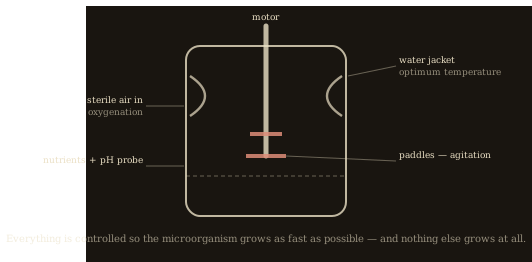
The fermenter, part by part — and the condition each one controls
- STERILISATION with superheated steam before use, so that unwanted microorganisms cannot compete with the culture for nutrients or contaminate the product.
- A WATER JACKET around the vessel. Respiration by the culture releases heat, so a large fermenter would otherwise overheat and denature the microorganisms' enzymes — the jacket carries that heat away and keeps the temperature at the optimum.
- PADDLES or a stirrer, to mix the contents. This keeps the microorganisms suspended rather than settling, and distributes nutrients, oxygen and heat evenly through the vessel.
- An AIR INLET, bubbling sterile air through the vessel where the process is aerobic, so the organisms have the oxygen for respiration. Some processes are anaerobic and are sealed instead.
- NUTRIENTS added, supplying the carbohydrate, nitrogen source and mineral ions the organisms need to grow and to make the product.
- PROBES monitoring temperature and pH continuously, so that conditions can be corrected automatically rather than drifting.
Think of it like a greenhouse for microorganisms
A glasshouse raises yield by controlling every factor that might limit a crop — temperature, carbon dioxide, water, light. A fermenter does exactly the same for a culture of microorganisms: hold each condition at its optimum and remove every competitor, and the population grows as fast as it biologically can. The one difference is scale of attention. A crop can survive a bad afternoon; a culture in a sealed vessel has no reserves and no way to recover, so the conditions are monitored continuously rather than checked.
The temperature point deserves emphasis because it is counter-intuitive. A large fermenter's problem is not keeping warm but keeping COOL. Millions of microorganisms respiring in a confined space release a great deal of heat, and without the water jacket the temperature would climb past the optimum and denature the very enzymes the process depends on. The bigger the vessel, the worse the problem, because the volume producing heat rises faster than the surface area that can lose it — the surface-area-to-volume ratio from Topic 2, appearing in a factory.
Sterility is the other thing worth understanding rather than memorising. A fermenter is a vessel full of warm nutrient solution at a perfect temperature, which is ideal for the culture and equally ideal for anything else that gets in. A contaminating organism competes for the nutrients, may grow faster than the culture, and can ruin an entire batch — which is why the vessel is steam-sterilised before use and the air bubbled through it is filtered.
2 · Grade 9 Notes
A different job from the section above. You have already understood it; this is the precise set of things to LEARN — definitions to reproduce word for word, processes in order, equations with units, and the answers that score full marks.
Learn this definition · Industrial fermenter
A large sterile vessel in which microorganisms are grown under carefully controlled conditions to produce a useful product.
lactose → lactic acid
Conditions: Anaerobic respiration by Lactobacillus at about 40 °C
Statement 5.7 — making yoghurt, the sequence to write
- The milk is pasteurised by heating, to kill unwanted microorganisms that would compete with the culture or spoil the product.
- It is cooled to about 40 °C, the optimum for the bacteria's enzymes — adding the culture to hot milk would denature them.
- A starter culture of Lactobacillus is added and the temperature is maintained.
- The bacteria respire the lactose in the milk anaerobically, producing lactic acid.
- The lactic acid lowers the pH, which coagulates the milk proteins so the milk thickens and solidifies.
- The acid also gives the sour taste and preserves the yoghurt; flavourings are added and it is cooled and packaged.
Statement 5.8 — the parts of a fermenter and what each controls
- Sterilisation with steam
- Kills unwanted microorganisms before use, so they cannot compete with the culture or contaminate the product.
- Water jacket
- Removes the heat released by the culture's respiration, keeping the temperature at the optimum so the enzymes are not denatured.
- Paddles or stirrer
- Keep the microorganisms suspended and distribute nutrients, oxygen and heat evenly through the vessel.
- Air inlet with filtered air
- Supplies oxygen for aerobic respiration, and the filter keeps contaminating organisms out.
- Nutrient supply
- Provides the carbohydrate, nitrogen source and mineral ions the microorganisms need to grow and make the product.
- Temperature and pH probes
- Monitor conditions continuously so they can be corrected automatically rather than being allowed to drift.
Why a large fermenter must be COOLED rather than heated
- Respiration by millions of microorganisms releases a great deal of heat
- In a sealed vessel that heat cannot escape quickly enough on its own
- The larger the vessel, the worse the problem: volume rises faster than surface area, so there is less surface per unit of volume to lose heat through
- Without cooling, the temperature would rise past the optimum and DENATURE the enzymes controlling the reactions the process depends on
- The water jacket carries the heat away, holding the temperature at the optimum; very large vessels also use internal cooling coils to add cooling surface inside the vessel
The two fermentations of this topic — same idea, different organism and product
A. YEAST: a fungus, respiring glucose anaerobically to ethanol and carbon dioxide. Used in brewing and baking.
B. LACTOBACILLUS: a bacterium, respiring lactose anaerobically to lactic acid. Used in yoghurt, where the acid thickens, sours and preserves the milk.
Not this: The milk in yoghurt-making is heated to kill the Lactobacillus once it has done its job.
This: The milk is pasteurised BEFORE the culture is added, to remove competing microorganisms — and is then cooled to about 40 °C, because adding the culture to hot milk would denature its enzymes and kill it.
Model answer [5 marks]
Describe how yoghurt is made from milk. [5]
The milk is first pasteurised by heating, which kills unwanted microorganisms that would compete with the culture or spoil the product. It is then cooled to about 40 °C, which is the optimum temperature for the bacteria's enzymes. A starter culture of Lactobacillus is added. The bacteria respire the lactose in the milk anaerobically, producing lactic acid. The lactic acid lowers the pH, which causes the milk proteins to coagulate so that the milk thickens, and it also gives the sour taste and preserves the yoghurt.
Model answer [3 marks]
Explain why an industrial fermenter needs a water jacket. [3]
The microorganisms in the fermenter respire, and respiration releases heat. In a large sealed vessel this heat cannot escape quickly enough, so the temperature would rise above the optimum and the microorganisms' enzymes would be denatured, stopping the process. Cold water circulating in the jacket removes that heat and keeps the temperature at the optimum.
Model answer [3 marks]
Explain why a fermenter is sterilised before use and why the air supplied to it is filtered. [3]
A fermenter contains warm nutrient solution, which provides ideal conditions for any microorganism, not only the one being cultured. A contaminating organism would compete with the culture for the nutrients and could grow faster than it, reducing the yield of the product. It might also produce unwanted or harmful substances, so the whole batch would have to be discarded. Sterilising the vessel and filtering the air prevent contaminants from entering.
Mark-losing trap. The milk is pasteurised BEFORE the culture is added, and cooled to 40 °C first — hot milk would kill the bacteria.
Mark-losing trap. Lactic acid does THREE jobs: coagulates the proteins, sours the taste, preserves the yoghurt. Say more than one.
Mark-losing trap. A fermenter is COOLED, not heated. Respiration by the culture releases heat that must be removed.
Mark-losing trap. Give the FUNCTION of each fermenter part, not just its name. The label alone earns nothing.
Mark-losing trap. Lactobacillus makes LACTIC ACID; yeast makes ethanol. Do not swap the products of the two fermentations.
3 · Prove it — the five questions
The five questions climb Grade 6 → Grade 7 → Grade 8 → Grade 9 → Grade 9 challenge, and are marked inside Incandio on your own device, by rule, with an authored diagnosis of the mistake you actually made. The mark schemes stay in the app so that the practice is worth doing; the questions themselves are here.
- Grade 6 · State [1 mark] — Which substance does Lactobacillus produce from the lactose in milk?
- Grade 7 · Explain [2 marks] — Explain why the milk is cooled to about 40 °C before the Lactobacillus culture is added.
- Grade 8 · Describe [5 marks] — Describe how yoghurt is made from milk. Select every statement that belongs in a full-mark answer.
- Grade 9 · Calculate [4 marks] — A fermenter of volume 40 000 dm³ produces 620 kg of an antibiotic in a 14-day run. Calculate the mean yield in grams of antibiotic per dm³ of fermenter volume per day.
- 9+ · Analyse [5 marks] — A company scales a fermentation up from a 50 dm³ laboratory vessel to a 50 000 dm³ industrial one. The yield per dm³ falls sharply, and probes show the temperature in the centre of the large vessel is 8 °C above the optimum while the temperature near the wall is correct. Select every statement that belongs in a full-mark explanation.
The people behind this science
Two ways into the same idea — the one whose name is on the first step, and the one whose discovery is grown in these vessels. Inside Incandio each of them answers knowing exactly which lesson you have just finished.
Louis Pasteur — the one whose name is on the first step
The first step of yoghurt-making is pasteurisation, and it is his. Pasteur showed that spoilage and fermentation are caused by living microorganisms rather than by spontaneous chemical change, and that gently heating a liquid kills enough of them to keep it sound without ruining it. He also showed that different microbes produce different products from the same material — which is exactly the difference between the yeast of the last lesson and the Lactobacillus of this one, and the reason a starter culture has to be a specific organism rather than just 'some bacteria'.
- “Why does heating a liquid stop it spoiling?”
- “How did you show that microorganisms were responsible rather than the air itself?”
- “Why do different microbes produce different products from the same milk?”
- “What convinced people who thought fermentation was purely chemical?”
- “Why does it matter which organism you start with?”
Alexander Fleming — the one whose discovery is grown in these vessels
The industrial fermenter on this page exists largely because of what happened to Fleming's discovery. He found penicillin in 1928 but could not produce it in any useful quantity — the mould made tiny amounts and he could not purify it, so it stayed a laboratory curiosity for over a decade. Turning it into a medicine required exactly the vessel described here: sterile, stirred, aerated, temperature-controlled, at a scale of thousands of litres. The biology was his; the fermenter is what made it a treatment.
- “Why could you not produce enough penicillin to treat anyone?”
- “What conditions does the mould need to grow well?”
- “What difference did large-scale production make?”
- “Did you expect it to become a medicine when you first saw it?”
Think you understand it?
Reading is the start. On Incandio a topic counts as mastered only once you have taught it and defended it — the two things a revision guide cannot ask of you.
Incandio this topic → Prove it. Teach it. Defend it. What does “Incandio it” mean?
- Prove it — five questions on Yoghurt and the Industrial Fermenter, marked on the spot, that tell you what was missing rather than just what was wrong.
- Teach it — Explain Yoghurt and the Industrial Fermenter in your own words to Ember, an AI pupil who does not have it yet and asks the awkward question. Understanding is credited; wording is not required.
- Defend it — Argue Yoghurt and the Industrial Fermenter against Élie Metchnikoff — three rounds, marked against descriptors you can read before you begin.
- Then the exam — read all 10 authored exam-style questions on this unit, each with its command word and its tariff, then have them marked on Incandio with the mistake you actually made named.
Completely free. No subscriptions, no paywalls, no account needed to start.
Carry on through the course
- Previous lesson: Yeast, Bread and Fermentation
- Next lesson: Fish Farming and Selective Breeding
- Increasing Crop Yield — Everything a grower does is one of two things — remove whatever is limiting the crop, or remove whatever is competing with it.
- Yeast, Bread and Fermentation — One organism respiring without oxygen — and two industries built on the two different products it makes.
- Fish Farming and Selective Breeding — Growing food by controlling every loss of energy — and by doing deliberately what the environment does by accident.
- Genetic Engineering — Cutting a gene out of one organism and making another organism read it — and the reason that works at all.
- GM Insulin and GM Crops — The same technique used twice — once to brew a human hormone in a tank, and once to change what a field can grow.
- All of Biology · Biology key terms · required practicals · Incandio Science · The 4BI1 specification