Pearson Edexcel International GCSE in Biology · 4BI1 · Free · no account needed
GM Insulin and GM Crops
The same technique used twice — once to brew a human hormone in a tank, and once to change what a field can grow.
Topic 5 · Use of biological resources — one of 8 lessons in this topic, and one of 68 in Biology.
This lesson ends with Frederick Banting. Learn GM Insulin and GM Crops, teach it, then defend it against Frederick Banting.
The definition this lesson teaches, word for word — every Biology definition.
- Genetically modified organism
- An organism whose DNA has been deliberately altered by genetic engineering, usually by inserting a gene that gives it a characteristic it did not have.
What this lesson covers in the specification
Incandio is aligned to this specification. It is not published by, endorsed by or affiliated with Pearson, and it reproduces none of Pearson's wording — the statement numbers are given so you can check every lesson against your own copy.
- 5.14 — How human insulin is manufactured from genetically modified bacteria in a fermenter
- 5.15 — How genetically modified plants can improve food production
Specification section 5(c) Genetic modification (genetic engineering) — also taught in Genetic Engineering, Micropropagation.
1 · Understand it
No exam language yet. The only question this section answers is: do I actually understand what is happening?
Until 1982 there was only one place to get insulin: the pancreas of a dead animal. Pancreases were collected from abattoirs, and the insulin was extracted from cattle and pigs — which works, because their insulin is nearly the same molecule as ours. Nearly. Pig insulin differs from human insulin by one amino acid and cattle insulin by three, and a protein that is not quite right is a protein the immune system may react to. There were other problems the biology does not mention but the patients did. Supply depended on how many animals were being slaughtered for meat, so the number of people who could be treated was set by something with nothing to do with medicine. And some people would not take a product from a pig, or from a cow, for reasons they were entitled to hold.
Genetic engineering solved all of it at once. If a bacterium can be given the human gene, it will make human insulin — not a near-copy, the identical molecule — and bacteria can be grown in any quantity you can build a tank for.
How human insulin is manufactured — and what each stage is for
- The HUMAN GENE for insulin is obtained and cut so that it has sticky ends.
- A PLASMID is cut open with the same restriction enzyme, the gene is inserted, and ligase seals it — a recombinant plasmid.
- The plasmid is taken up by BACTERIA. Only some take it up, so the ones that did are identified and selected, and it is those that are grown on.
- The selected bacteria are put into a FERMENTER — a large sterile tank — with a supply of nutrients.
- The CONDITIONS are controlled: optimum temperature, optimum pH, oxygen supplied through sterile air, and constant stirring so nutrients and oxygen reach every cell.
- The bacteria multiply rapidly, and every one of them reads the human gene and makes human insulin, because every division copies the plasmid too.
- The insulin is EXTRACTED from the culture and PURIFIED, then tested and packaged. What comes out is chemically identical to the insulin a human pancreas makes.
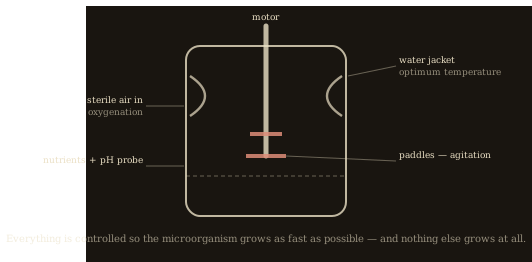
One honest detail, because it is the part that is usually smoothed over. The gene is not simply snipped out of a human chromosome and dropped into the plasmid. A human gene contains stretches that do not code for the protein, and a human cell removes them before the message is read — a bacterium has no machinery for doing that, and would build nonsense. So the version of the gene that goes into the plasmid is one from which those stretches are already absent. The principle on the previous page holds exactly: the code is universal. The editing a human cell does is not.
Think of it like changing where a factory gets its parts
Animal insulin was a salvage operation: you took what you needed from something being processed for another purpose entirely, so you got as much as the meat trade happened to produce and no more, and what you got was very slightly the wrong specification. Genetically modified bacteria are a production line. You decide how much to make and you make it; the specification is exactly right because the instruction being followed is the human one; and if demand doubles you build another tank rather than hoping more animals are slaughtered. Nothing about the medicine changed. What changed is that the supply stopped being a by-product of something else.
Now the second use, which is the same technique pointed at a field. A GENETICALLY MODIFIED CROP is a plant given a gene — usually from another species, which makes it transgenic — that changes what it can do. There are four kinds of change worth knowing, and each attacks a different reason that crops fail to feed people.
What genes are added to crops, and what each one is for
- INSECT RESISTANCE. A gene from the soil bacterium Bacillus thuringiensis makes the plant produce a protein toxic to the caterpillars that eat it, so less of the crop is lost and less insecticide has to be sprayed.
- HERBICIDE TOLERANCE. A gene that makes the crop unaffected by a particular weedkiller lets the farmer spray the whole field: the weeds die, the crop does not, and the crop no longer competes with weeds for light, water and minerals.
- IMPROVED NUTRITION. Genes can be added so the edible part makes a substance it otherwise would not — the best-known example is a rice that produces beta-carotene, which the body converts into vitamin A, aimed at the deficiency that causes childhood blindness.
- TOLERANCE OF HARD CONDITIONS. Genes for tolerance of drought, cold or salty soil let a crop be grown on land where it would otherwise fail — and land that cannot grow food is the limit that matters in much of the world.
- A fifth is commercial rather than agricultural: genes that slow ripening give fruit a longer shelf life, so less of it rots between the field and the plate.
The case against is not one argument but several, and they are not all of the same strength. The strongest is biological: pollen from a modified crop can reach wild relatives or a neighbour's unmodified crop, and a gene, once out, cannot be recalled. The second is one this course has already taught in another form — insects that survive a toxin breed, so a pest population under constant selection by a Bt crop will tend to become resistant to it, exactly as bacteria become resistant to an antibiotic. The third is economic rather than biological: modified seed is bought from the company that owns it, often each year, which can put it out of reach of the poorest farmers who would gain most. The fourth is that the long-term effects cannot be known in advance — which is true, and is a reason for monitoring rather than a finding of harm; no evidence of harm to health has emerged from crops approved so far.
It is worth noticing what has not changed. Humans have been altering the genetics of crops for ten thousand years by choosing which plants breed, and every cereal in every field is the product of it. Selective breeding moves thousands of genes at once, blindly, and only between organisms that will interbreed. Genetic engineering moves one known gene, deliberately, and can move it between species that never could. Which of those is the more drastic intervention is a genuinely arguable question, and an evaluation answer that recognises it is worth more than one that treats 'GM' as a category of thing rather than a method.
2 · Grade 9 Notes
A different job from the section above. You have already understood it; this is the precise set of things to LEARN — definitions to reproduce word for word, processes in order, equations with units, and the answers that score full marks.
Learn this definition · Genetically modified organism
An organism whose DNA has been deliberately altered by genetic engineering, usually by inserting a gene that gives it a characteristic it did not have.
Statement 5.14 — manufacturing human insulin, the sequence to write
- The human insulin gene is cut out with a restriction enzyme, leaving sticky ends.
- A plasmid is cut with the same enzyme, the gene is inserted, and ligase seals it.
- Bacteria take up the recombinant plasmid, and those that have taken it up are selected.
- The selected bacteria are grown in a fermenter with nutrients, at optimum temperature and pH, with sterile air and stirring.
- The bacteria multiply and make human insulin, which is then extracted and purified.
The fermenter conditions, each with the reason it is controlled
- STERILE throughout — so no other microorganism competes for the nutrients or contaminates the product
- OPTIMUM TEMPERATURE, kept constant by a water jacket — enzymes work fastest; too hot and they denature
- OPTIMUM pH, monitored and corrected — enzymes are denatured by a change in pH
- OXYGEN, supplied as sterile air — for aerobic respiration, which releases the energy for growth
- STIRRING by paddles — keeps nutrients, oxygen and heat evenly distributed and cells in suspension
- NUTRIENTS supplied continuously — a source of carbon for energy and of nitrogen for making proteins
Why insulin from genetically modified bacteria is better than insulin from animals
- It is IDENTICAL to human insulin, so it is less likely to cause an immune reaction than pig or cattle insulin
- It can be made in ANY QUANTITY, so supply no longer depends on how many animals are slaughtered
- It is CHEAPER to produce at scale once the process is running
- It is free of animal products, so it is acceptable to people whose beliefs or ethics rule those out
- It carries no risk of transmitting a disease from the donor animal
Statement 5.15 — genetically modified crops, argued both ways
| The case for | The case against | |
|---|---|---|
| Yield | less lost to insect pests and to competition from weeds | pests may evolve resistance to the toxin, as bacteria do to antibiotics |
| Chemicals | insect-resistant crops need less insecticide sprayed | herbicide-tolerant crops may encourage heavier use of weedkiller |
| Nutrition | added vitamins can address deficiency diseases in poor regions | the seed is owned commercially and may be unaffordable to those farmers |
| Land | drought and salt tolerance allow food to be grown where it could not be | pollen can carry the added gene to wild relatives, and it cannot be recalled |
| Safety | no evidence of harm to health has emerged from approved crops | long-term effects cannot be known in advance, so monitoring is needed |
Genetic engineering against selective breeding — the same aim, different reach
A. SELECTIVE BREEDING moves thousands of genes at once, blindly, over many generations, and only between organisms that can interbreed.
B. GENETIC ENGINEERING moves one known gene, deliberately, in one generation, and can move it between species that could never interbreed.
Model answer [4 marks]
Explain two advantages of using insulin made by genetically modified bacteria rather than insulin extracted from pigs. [4]
The insulin made by the bacteria is identical to human insulin, because the bacteria are reading the human gene, whereas pig insulin differs by one amino acid and is therefore more likely to provoke a reaction from the patient's immune system. The bacteria can also be grown in a fermenter in any quantity required, so the amount of insulin available is decided by how much is needed rather than by how many pigs happen to be slaughtered for meat.
Model answer [3 marks]
Explain how a gene for insect resistance can increase the yield of a crop. [3]
The gene makes the plant produce a protein that is toxic to the insect larvae that feed on it, so the larvae are killed and less of the crop is eaten. More of each plant therefore survives to be harvested, and more of the energy the plant captures goes into the part that is eaten rather than into replacing damaged tissue. Less insecticide also has to be sprayed, which reduces the cost of growing the crop.
Not this: Genetically modified bacteria make something like insulin, so it is a substitute for the real thing.
This: They make human insulin itself. The bacteria are following the human gene, and the genetic code is the same in both, so the protein produced has the same sequence of amino acids as the insulin a pancreas makes.
Mark-losing trap. Say the insulin is IDENTICAL to human insulin. 'Similar' is the animal-insulin answer and loses the mark.
Mark-losing trap. For fermenter marks, give the REASON for each condition, not just the list of conditions.
Mark-losing trap. Sterility is a condition in its own right — nothing else may be allowed to grow in the tank.
Mark-losing trap. Evaluating GM crops means both sides plus a judgement, not a list of dangers.
3 · Prove it — the five questions
The five questions climb Grade 6 → Grade 7 → Grade 8 → Grade 9 → Grade 9 challenge, and are marked inside Incandio on your own device, by rule, with an authored diagnosis of the mistake you actually made. The mark schemes stay in the app so that the practice is worth doing; the questions themselves are here.
- Grade 6 · State [1 mark] — Genetically modified bacteria that make human insulin are grown in a large sterile tank. What is this tank called?
- Grade 7 · Explain [2 marks] — A crop is genetically modified so that a particular weedkiller has no effect on it. Explain how this increases the yield of the crop.
- Grade 8 · Describe [5 marks] — Select every statement that belongs in a full-mark description of how human insulin is manufactured using genetically modified bacteria.
- Grade 9 · Calculate [3 marks] — One production run of a fermenter yields 156 g of purified human insulin. A person with type 1 diabetes uses about 15 mg of insulin per week. Calculate how many patient-years of insulin one production run supplies.
- 9+ · Evaluate [6 marks] — A government is deciding whether to approve an insect-resistant genetically modified maize for farmers in a region where crop losses to caterpillars are severe. Select every statement that belongs in a full-mark evaluation.
The people behind this science
Two ways into the same idea — the one who first got insulin out of an animal, and the one who asked what happens to everything the spraying was not aimed at. Inside Incandio each of them answers knowing exactly which lesson you have just finished.
Frederick Banting — the one who first got insulin out of an animal
Every advantage listed on this page is measured against what Banting had. In 1921 he and Charles Best tied off the pancreatic ducts of dogs, extracted what remained of the gland, and produced something that kept a depancreatised animal alive; James Collip purified it enough for a human being, and in January 1922 a fourteen-year-old dying in a Toronto ward recovered. Every dose after that came out of a cattle or pig pancreas for sixty years. He sold the patent to his university for one dollar so that nobody could own the supply — which is the exact question genetically modified crops now raise again.
- “What did the diabetic ward look like before you had anything to give them?”
- “How much animal pancreas did one patient need in a year?”
- “Why did you sell the patent for a single dollar?”
- “What would you say about insulin being brewed by bacteria?”
- “What went wrong with the first extracts you tried on patients?”
Rachel Carson — the one who asked what happens to everything the spraying was not aimed at
The strongest argument for insect-resistant crops is that they replace spraying, and spraying is what Carson spent her last years documenting: insecticide applied to a field does not stay in the field, does not kill only the target, and selects for pests that survive it. A crop that makes its own toxin answers the first two objections and not the third — the selection pressure is now constant rather than occasional. She is the person best placed to say whether that is progress, and she would ask what else eats the plant.
- “Is a crop that makes its own insecticide better than spraying one?”
- “What happens to the insects the toxin was never aimed at?”
- “Why do pests keep coming back stronger after we control them?”
- “How should we decide whether a new agricultural technology is safe?”
- “What did you learn about how far a sprayed chemical actually travels?”
Think you understand it?
Reading is the start. On Incandio a topic counts as mastered only once you have taught it and defended it — the two things a revision guide cannot ask of you.
Incandio this topic → Prove it. Teach it. Defend it. What does “Incandio it” mean?
- Prove it — five questions on GM Insulin and GM Crops, marked on the spot, that tell you what was missing rather than just what was wrong.
- Teach it — Explain GM Insulin and GM Crops in your own words to Ember, an AI pupil who does not have it yet and asks the awkward question. Understanding is credited; wording is not required.
- Defend it — Argue GM Insulin and GM Crops against Frederick Banting — three rounds, marked against descriptors you can read before you begin.
- Then the exam — read all 9 authored exam-style questions on this unit, each with its command word and its tariff, then have them marked on Incandio with the mistake you actually made named.
Completely free. No subscriptions, no paywalls, no account needed to start.
Carry on through the course
- Previous lesson: Genetic Engineering
- Next lesson: Micropropagation
- Increasing Crop Yield — Everything a grower does is one of two things — remove whatever is limiting the crop, or remove whatever is competing with it.
- Yeast, Bread and Fermentation — One organism respiring without oxygen — and two industries built on the two different products it makes.
- Yoghurt and the Industrial Fermenter — Bacteria turned into a manufacturing process — and the vessel built to give them the best conditions they will ever have.
- Fish Farming and Selective Breeding — Growing food by controlling every loss of energy — and by doing deliberately what the environment does by accident.
- Genetic Engineering — Cutting a gene out of one organism and making another organism read it — and the reason that works at all.
- All of Biology · Biology key terms · required practicals · Incandio Science · The 4BI1 specification