Pearson Edexcel International GCSE in Biology · 4BI1 · Free · no account needed
Food Chains, Webs and Pyramids
Who eats whom, drawn three different ways — and why only one of the three can come out upside down.
On the specification this is trophic levels — 4BI1 statements 4.6 · 4.7.
Topic 4 · Ecology and the environment — one of 8 lessons in this topic, and one of 68 in Biology.
This lesson ends with Aristotle. Learn Food Chains, Webs and Pyramids, teach it, then defend it against Aristotle.
What this lesson covers in the specification
Incandio is aligned to this specification. It is not published by, endorsed by or affiliated with Pearson, and it reproduces none of Pearson's wording — the statement numbers are given so you can check every lesson against your own copy.
- 4.6 — Trophic levels: producers, primary, secondary and tertiary consumers, decomposers
- 4.7 — Food chains, food webs, and pyramids of number, biomass and energy transfer
Specification section 4(b) Feeding relationships — also taught in Biodiversity, Distribution and Limiting Factors, Energy Transfer Along a Food Chain.
1 · Understand it
No exam language yet. The only question this section answers is: do I actually understand what is happening?
A food chain shows the direction that energy and materials travel through a community, and the arrows are the part people get wrong. An arrow means IS EATEN BY, so it points from the organism being eaten to the organism eating it — grass → rabbit → fox. The arrow follows the food, and therefore the energy, and it never points towards the mouth.
The trophic levels — the position an organism occupies in a chain
- PRODUCER — a green plant or alga, which makes its own food by photosynthesis. Every food chain begins with one, because a producer is the only thing that brings energy into the community from outside.
- PRIMARY CONSUMER — eats the producer. A herbivore.
- SECONDARY CONSUMER — eats the primary consumer. A carnivore.
- TERTIARY CONSUMER — eats the secondary consumer. Usually a predator with few or no predators of its own.
- DECOMPOSER — a bacterium or fungus that feeds on dead organisms and waste, breaking them down and releasing the mineral ions back into the soil for producers to take up again.
Two points of precision. A trophic level is a POSITION, not a kind of animal — the same fox is a secondary consumer when it eats a rabbit and a tertiary consumer when it eats a stoat that ate a rabbit. And 'producer' does not mean the plant produces energy; it produces FOOD, by capturing energy that was already arriving as sunlight. Energy is never created anywhere on this page.
A food chain is a simplification, and usually a severe one. Real organisms eat several things and are eaten by several things, so the honest picture is a FOOD WEB — many chains interlinked. Its value is that it shows the consequences of a change: remove one species from a web and you can trace what happens to everything connected to it, which a single chain cannot show you.
The three pyramids — and the one question that tells them apart
- Ask what is being counted on each bar. That single question distinguishes all three.
- PYRAMID OF NUMBERS — the bar shows how MANY organisms there are at each level. Nothing else is measured.
- PYRAMID OF BIOMASS — the bar shows the total MASS of living material at each level, so a thousand aphids and one oak tree are compared by mass rather than by count.
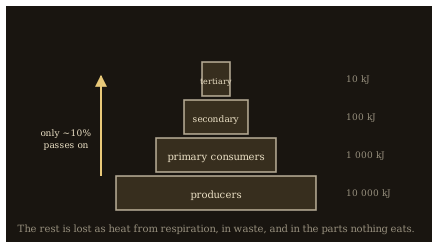
- PYRAMID OF ENERGY TRANSFER — the bar shows the ENERGY available at each level, usually in kilojoules per square metre per year.
- Pyramids of biomass and of energy are ALWAYS the right way up, widest at the producer, because mass and energy are lost at every transfer and a level cannot contain more than the level below it supplied.
- A pyramid of NUMBERS can be inverted, because it takes no account of size.
Think of it like counting a delivery by parcels or by weight
A lorry brings one crate; a van brings four hundred envelopes. Counted by item, the van delivered four hundred times as much. Weighed, the lorry delivered far more. Neither count is wrong — they are answering different questions, and only one of them tells you how much material actually arrived. A pyramid of numbers counts items. A pyramid of biomass weighs them. That is the whole reason one can come out upside down and the other cannot.
The two classic inverted pyramids of number, and why each inverts
- ONE OAK TREE supporting thousands of insects. The producer level is a single enormous organism, so the bar for producers is narrower than the bar for primary consumers — one bar, one tree.
- But by BIOMASS the same community is a normal pyramid: the tree's mass vastly exceeds the total mass of the insects.
- A ROSE BUSH with hundreds of aphids, each carrying several parasites, gives a pyramid that widens at every level.
- In both cases nothing unusual is happening biologically. The inversion is an artefact of counting organisms rather than measuring how much living material is present.
It is worth being careful about how biomass is actually measured, because it is the one honest difficulty with these pyramids. Biomass means the mass of living material, and it is measured as DRY mass — the organism dried until its mass stops falling — because water content varies enormously and would otherwise swamp the comparison. That has an obvious consequence: measuring biomass means killing and drying the organisms, so the figures are always estimates from samples rather than a survey of the whole community.
2 · Grade 9 Notes
A different job from the section above. You have already understood it; this is the precise set of things to LEARN — definitions to reproduce word for word, processes in order, equations with units, and the answers that score full marks.
Statement 4.6 — the trophic levels, each defined by what it eats
- Producer
- A green plant or alga that makes its own food by photosynthesis. Every food chain starts with one.
- Primary consumer
- An organism that eats producers — a herbivore.
- Secondary consumer
- An organism that eats primary consumers — a carnivore.
- Tertiary consumer
- An organism that eats secondary consumers.
- Decomposer
- A bacterium or fungus that feeds on dead organisms and waste, releasing mineral ions back into the soil.
- Trophic level
- The position an organism occupies in a food chain. The same species may occupy different levels in different chains.
Statement 4.7 — the three pyramids, told apart by what each bar measures
| Pyramid of numbers | Pyramid of biomass | Pyramid of energy transfer | |
|---|---|---|---|
| What each bar shows | the NUMBER of organisms at that level | the total dry MASS of living material at that level | the ENERGY available at that level |
| Typical units | none — a count | grams or kilograms per square metre | kilojoules per square metre per year |
| Can it be inverted? | YES — it takes no account of the size of the organisms | no | no |
| Why not | one large producer can support many small consumers | mass is lost at every transfer, so a level cannot exceed the one below | energy is lost at every transfer, so a level cannot exceed the one below |
| Main difficulty in measuring it | deciding what counts as one organism, for example one grass plant | organisms must be killed and dried, so figures are estimates from samples | requires measurements over a whole year, so it is rarely done directly |
Drawing a food chain — the rules that are worth marks
- An ARROW means 'IS EATEN BY' and points from the organism eaten towards the organism eating it
- The arrows therefore show the direction in which ENERGY and materials flow through the chain
- Every chain begins with a PRODUCER, because only a producer brings energy into the community
- Name the organisms, not the group — 'grass → rabbit → fox', not 'plant → herbivore → carnivore', unless the question asks for levels
- A food WEB is several interlinked chains, and shows what a single chain cannot: the consequences of removing one species
Why only a pyramid of numbers can be inverted
A. NUMBERS count organisms and ignore their size, so one oak tree supporting thousands of insects gives a narrow base and a wide second bar.
B. BIOMASS and ENERGY measure how much material or energy is present, and both are lost at every transfer — so no level can hold more than the level below it supplied.
Not this: The arrows in a food chain show what each organism eats, so they point towards the food.
This: An arrow means IS EATEN BY and points from the organism eaten to the one eating it, following the direction energy travels. Grass → rabbit → fox.
Model answer [2 marks]
In the food chain lettuce → slug → thrush → hawk, identify the trophic level of each organism. [2]
The lettuce is the producer, because it makes its own food by photosynthesis. The slug is the primary consumer, the thrush is the secondary consumer, and the hawk is the tertiary consumer.
Model answer [4 marks]
Explain why a pyramid of numbers for an oak tree and the insects feeding on it is inverted, while the pyramid of biomass for the same community is not. [4]
A pyramid of numbers counts organisms without taking account of their size. There is only one oak tree but there are thousands of insects, so the producer bar is narrower than the primary consumer bar and the pyramid is inverted. A pyramid of biomass measures the total mass of living material at each level instead. The mass of the single oak tree is far greater than the total mass of the insects feeding on it, so that pyramid is the normal shape.
Model answer [3 marks]
Explain the role of decomposers in a community. [3]
Decomposers are bacteria and fungi that feed on dead organisms and waste material. They break down the complex compounds in that material, and in doing so release mineral ions into the soil. Producers can then absorb those mineral ions and use them to make new compounds, so the materials are recycled rather than being lost from the community.
Predicting the effect of removing a species from a web — what to say at each step
- Its predators
- Lose one of their food sources. Their population may fall — but say whether they have an alternative food in the web before predicting they die out.
- Its food
- Is eaten less, so that population is likely to increase, at least at first.
- Its competitors
- Face less competition for shared food, so their population may increase.
- Species with no direct link
- Can still be affected, through competition with a predator that has switched food, or through a change further down the web. This is what a web shows and a single chain cannot.
- How to phrase it
- Say 'is likely to' rather than 'will'. Two routes through a web often push a population in opposite directions.
Mark-losing trap. Arrows mean IS EATEN BY and point towards the eater — never towards the food.
Mark-losing trap. Only a pyramid of NUMBERS can be inverted. Biomass and energy pyramids never are.
Mark-losing trap. A trophic level is a POSITION, not a species. The same fox can be a secondary or a tertiary consumer.
Mark-losing trap. A producer makes FOOD, not energy. The energy came from sunlight and was captured, not created.
Mark-losing trap. Biomass is DRY mass, because water content varies too much between organisms to compare.
3 · Prove it — the five questions
The five questions climb Grade 6 → Grade 7 → Grade 8 → Grade 9 → Grade 9 challenge, and are marked inside Incandio on your own device, by rule, with an authored diagnosis of the mistake you actually made. The mark schemes stay in the app so that the practice is worth doing; the questions themselves are here.
- Grade 6 · State [1 mark] — In the food chain grass → rabbit → fox, what does the arrow between grass and rabbit mean?
- Grade 7 · Identify [1 mark] — In the food chain algae → water flea → small fish → pike, what is the trophic level of the small fish?
- Grade 8 · Explain [5 marks] — Explain why a pyramid of numbers for a single oak tree and the insects living on it is inverted, but the pyramid of biomass for the same community is not. Select every statement that belongs in a full-mark explanation.
- Grade 9 · Calculate [3 marks] — In a grassland, the producers have a biomass of 25 000 g/m². The primary consumers have a biomass of 2000 g/m², and the secondary consumers 150 g/m². Calculate the percentage of the producers' biomass that is present in the secondary consumers.
- 9+ · Analyse [5 marks] — In a food web, foxes eat rabbits and voles; owls eat voles and shrews; rabbits and voles eat grass; shrews eat insects; and insects eat grass. A disease kills almost all the rabbits. Select every statement that belongs in a full-mark prediction of what happens next.
The people behind this science
Two ways into the same idea — the one who traced a poison up a food chain, and the one who followed a web to its unlikely end. Inside Incandio each of them answers knowing exactly which lesson you have just finished.
Rachel Carson — the one who traced a poison up a food chain
A food chain is not only a route for energy — anything that does not break down travels along it too, and becomes more concentrated at each level because a consumer eats many of the level below. Carson assembled the evidence that DDT sprayed on crops was concentrating up chains into birds of prey, thinning their eggshells until the eggs broke under the weight of the parent. The mechanism is the chain on this page, read in reverse, and it is why the arrows matter.
- “How does a chemical sprayed on a field end up inside an eagle?”
- “Why does it become more concentrated at each level of the chain?”
- “What made you certain the birds' decline was caused by the spraying?”
- “Which organisms are most at risk in a long food chain, and why?”
- “What did the chemical companies say about your evidence?”
Charles Darwin — the one who followed a web to its unlikely end
Darwin used a food web argument in the Origin of Species that has been quoted ever since: red clover is pollinated by bumblebees, bumblebee nests are destroyed by field mice, and field mice are hunted by cats — so more cats in a village means more clover. It is a chain of biotic effects with no direct connection at either end, and it is exactly what a food web is for: showing that a change in one species propagates to others that never encounter it.
- “How can the number of cats in a village affect the clover?”
- “Why is a single food chain a misleading picture of a real community?”
- “What happens to the rest of a web when one species is removed?”
- “How far along a web can an effect travel before it fades out?”
Think you understand it?
Reading is the start. On Incandio a topic counts as mastered only once you have taught it and defended it — the two things a revision guide cannot ask of you.
Incandio this topic → Prove it. Teach it. Defend it. What does “Incandio it” mean?
- Prove it — five questions on Food Chains, Webs and Pyramids, marked on the spot, that tell you what was missing rather than just what was wrong.
- Teach it — Explain Food Chains, Webs and Pyramids in your own words to Ember, an AI pupil who does not have it yet and asks the awkward question. Understanding is credited; wording is not required.
- Defend it — Argue Food Chains, Webs and Pyramids against Aristotle — three rounds, marked against descriptors you can read before you begin.
- Then the exam — read all 10 authored exam-style questions on this unit, each with its command word and its tariff, then have them marked on Incandio with the mistake you actually made named.
Completely free. No subscriptions, no paywalls, no account needed to start.
Carry on through the course
- Previous lesson: Biodiversity, Distribution and Limiting Factors
- Next lesson: Energy Transfer Along a Food Chain
- Populations, Ecosystems and Sampling with Quadrats — Four nested words for where organisms live — and how to count a population you could never count in full.
- Biodiversity, Distribution and Limiting Factors — Why organisms are where they are and not somewhere else — and how to measure the variety of life in a place rather than just its quantity.
- Energy Transfer Along a Food Chain — About nine tenths of the energy disappears at every step. Here is exactly where it goes — and what that means for how the world is fed.
- The Carbon and Nitrogen Cycles — The same atoms, used again and again — and the four bacteria that do the work nothing else can.
- Air Pollution and the Greenhouse Gases — Two entirely different problems that both begin with burning — one that poisons what it touches, and one that changes the energy balance of the planet.
- All of Biology · Biology key terms · required practicals · Incandio Science · The 4BI1 specification