Pearson Edexcel International GCSE in Biology · 4BI1 · Free · no account needed
Levels of Organisation
From organelle to organism — the five-step ladder that every later topic in biology is built on.
On the specification this is cell structures — 4BI1 statements 2.1–2.3.
Topic 2 · Structures and functions in living organisms — one of 34 lessons in this topic, and one of 68 in Biology.
This lesson ends with Robert Hooke. Learn Levels of Organisation, teach it, then defend it against Robert Hooke.
The definition this lesson teaches, word for word — every Biology definition.
- Organ
- A group of different tissues working together to perform a particular function. The number of DIFFERENT tissues is what makes it an organ — never its size or its importance.
What this lesson covers in the specification
Incandio is aligned to this specification. It is not published by, endorsed by or affiliated with Pearson, and it reproduces none of Pearson's wording — the statement numbers are given so you can check every lesson against your own copy.
- 2.1 — Levels of organisation: organelles, cells, tissues, organs and systems
- 2.2 — Cell structures: nucleus, cytoplasm, cell membrane, cell wall, mitochondria, chloroplasts, ribosomes, vacuole
- 2.3 — The function of each of those cell structures
1 · Understand it
No exam language yet. The only question this section answers is: do I actually understand what is happening?
Biology is organised in layers, each built from the one below. Organelles are the working parts inside a cell. Many identical cells doing one job make a tissue. Several tissues working together make an organ. Several organs make a system. Systems make an organism.
Think of it like a hospital
One nurse is a cell. A ward full of nurses doing the same job is a tissue. A ward plus its beds, its equipment and its cleaners — several different kinds of thing co-operating — is an organ. The whole surgical department, several wards working to one purpose, is a system. The hospital is the organism. Notice the jump that matters: a tissue is many of the SAME thing; an organ is several DIFFERENT things co-operating. That is the distinction examiners test.
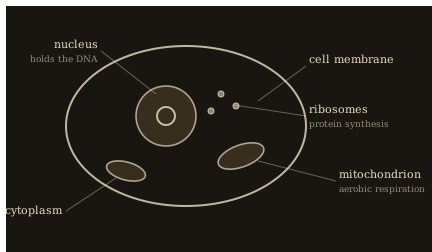
What each organelle actually does
- Nucleus — contains the chromosomes, so it controls the cell's activities and holds the instructions for making proteins.
- Cytoplasm — the jelly where most chemical reactions happen.
- Cell membrane — controls what enters and leaves the cell (partially permeable).
- Mitochondria — where aerobic respiration happens, releasing energy.
- Ribosomes — where proteins are made.
- Cell wall (plants) — made of cellulose, supports the cell and stops it bursting.
- Chloroplasts (plants) — contain chlorophyll and carry out photosynthesis.
- Permanent vacuole (plants) — filled with cell sap, keeps the cell firm (turgid).
One shortcut worth having: cells that need a lot of energy have a lot of mitochondria, and cells that make a lot of protein have a lot of ribosomes. If a question tells you a cell is packed with mitochondria, it is telling you the cell works hard — muscle, sperm, or the cells lining the small intestine doing active transport. Be careful how far you take it, though. A high count tells you the SCALE of an activity and never its purpose: muscle, sperm and kidney tubules are all crammed with mitochondria and do three completely different jobs.
Where the ladder actually breaks — the two boundaries examiners test
- Cell → tissue. A tissue is many cells of a SIMILAR type. One muscle cell is a cell; a sheet of them contracting together is muscle tissue.
- Tissue → organ. This is the jump. An organ is several DIFFERENT tissues working together for one function. The stomach has muscle tissue to churn, glandular tissue to make enzymes and acid, and epithelial tissue to line it — three different kinds, one job.
- So the test is never 'is it big?' or 'does it do something important?'. It is: how many DIFFERENT kinds of tissue are in it?
- Organ → system. Several organs whose functions are related. The digestive system is mouth, oesophagus, stomach, intestines, pancreas and liver — each an organ in its own right.
- Watch the awkward cases. Blood is a TISSUE, even though it is liquid and contains several cell types, because it is not several tissues combined. A leaf is an ORGAN, because it contains epidermis, palisade, spongy mesophyll and vascular tissue.
Why does any of this matter? Because every later topic in the course is an answer at one of these levels, and knowing which level you are being asked about tells you what kind of answer will score. 'Why does the small intestine absorb glucose so well?' is an organ question, answered with villi. 'Why can it absorb glucose against a gradient?' is a cell question, answered with mitochondria and carrier proteins. Same organ, two levels, two completely different answers.
2 · Grade 9 Notes
A different job from the section above. You have already understood it; this is the precise set of things to LEARN — definitions to reproduce word for word, processes in order, equations with units, and the answers that score full marks.
The five levels, in order — learn these definitions
- Organelle
- a specialised structure inside a cell
- Cell
- the basic unit of a living organism
- Tissue
- a group of cells with similar structure and function working together
- Organ
- a group of different tissues working together to perform a function
- System
- a group of organs with related functions working together
Model answer [3 marks]
Explain the difference between a tissue and an organ, using the stomach as an example. [3]
A tissue is a group of cells of similar structure and function working together. An organ is several different tissues working together to perform a function. The stomach contains muscle, glandular and epithelial tissue, so it is an organ.
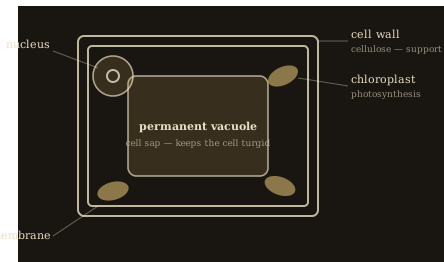
Organelle functions — the exact wording to use
- Nucleus
- contains the chromosomes and controls the cell's activities
- Cytoplasm
- site of most chemical reactions
- Cell membrane
- partially permeable; controls what enters and leaves
- Mitochondria
- site of aerobic respiration, releasing energy
- Ribosomes
- site of protein synthesis
- Cell wall
- cellulose; supports the cell and stops it bursting
- Chloroplasts
- contain chlorophyll; absorb light for photosynthesis
- Permanent vacuole
- contains cell sap; keeps the cell turgid
Tissue vs organ
A. A tissue is many cells of a SIMILAR type working together.
B. An organ is several DIFFERENT tissues working together for one function.
Not this: 'The cell wall controls what enters and leaves the cell.'
This: The cell MEMBRANE controls entry and exit. The cell wall is fully permeable and only provides support.
Learn this definition · Organ
A group of different tissues working together to perform a particular function. The number of DIFFERENT tissues is what makes it an organ — never its size or its importance.
Placing an unfamiliar structure on the ladder — the routine that scores
- Ask first: is it one cell, or many? One microscopic cell is an organism in its own right, and the ladder does not apply above it.
- Count the KINDS of tissue described. One kind of cell doing one job is a tissue, however large it is.
- Two or more different tissues working together for one function is an organ. This is the boundary that carries the marks.
- Several organs whose functions are related is a system. Check the functions really are related before you say so.
- State the level AND the evidence that put it there — 'an organ, because three different tissues are named' scores; 'an organ' on its own does not.
Reading a cell from its organelle counts — what each abundance licenses you to say
- Many mitochondria
- a high rate of aerobic respiration, so a high energy demand — muscle, sperm, kidney tubule, small-intestine lining
- Many ribosomes
- a high rate of protein synthesis, so the cell builds or secretes a lot of protein — glandular and enzyme-secreting cells
- Many chloroplasts
- a high rate of photosynthesis — palisade mesophyll near the upper leaf surface
- A large permanent vacuole
- the cell is kept turgid by cell sap, which is how non-woody plants stand up
- THE LIMIT ON ALL OF THESE
- an abundance gives you the SCALE of an activity, never its purpose. Three unrelated cell types are all packed with mitochondria.
Tissue vs organ vs system — the two boundaries, with the awkward cases that are examined
| Tissue | Organ | System | |
|---|---|---|---|
| Definition | a group of cells of SIMILAR structure and function working together | several DIFFERENT tissues working together to perform a function | several organs with related functions working together |
| The test to apply | one kind of cell, doing one job | how many DIFFERENT tissues are in it? | how many organs, and are their jobs related? |
| Straightforward example | muscle tissue; xylem | the stomach; the heart | the digestive system; the circulatory system |
| The case students get wrong | BLOOD is a tissue — liquid, and several cell types, but not several tissues combined | A LEAF is an organ — epidermis, palisade, spongy mesophyll and vascular tissue | A PLANT's transport system — roots, stem and leaves working together |
Model answer [3 marks]
A student says the stomach is a tissue because all of it is working on digestion. Explain why the student is wrong. [3]
A tissue is a group of cells of similar structure and function working together. The stomach contains several different tissues — muscle tissue that churns, glandular tissue that makes enzymes and acid, and epithelial tissue that lines it. Several different tissues working together for one function is an organ, so the stomach is an organ.
Model answer [3 marks]
A cell is found to contain very large numbers of mitochondria. State what this tells you about the cell, and what it does not. [3]
Mitochondria are the site of aerobic respiration, so a large number means the cell releases energy at a high rate and therefore has a high energy demand. It does not tell you what the cell does with that energy: muscle cells, sperm cells and the cells lining the small intestine all contain very many mitochondria and carry out completely different functions.
Mark-losing trap. An organ needs several DIFFERENT tissues. Many cells of one type doing an important job is still only a tissue.
Mark-losing trap. Blood is a tissue. A leaf is an organ. Both are examined, and both catch people out.
Mark-losing trap. The cell WALL supports; the cell MEMBRANE controls what enters and leaves. The wall is fully permeable.
Mark-losing trap. Mitochondria RELEASE energy from glucose; chloroplasts TRAP light to make it. Plant cells have both.
Mark-losing trap. Chloroplasts are not in every plant cell — root cells have none, because there is no light underground.
Mark-losing trap. Lots of mitochondria tells you the cell works hard. It never tells you what the work is.
3 · Prove it — the five questions
The five questions climb Grade 6 → Grade 7 → Grade 8 → Grade 9 → Grade 9 challenge, and are marked inside Incandio on your own device, by rule, with an authored diagnosis of the mistake you actually made. The mark schemes stay in the app so that the practice is worth doing; the questions themselves are here.
- Grade 6 · State [1 mark] — Which organelle is the site of aerobic respiration?
- Grade 7 · Explain [3 marks] — Explain the difference between a tissue and an organ, using the stomach as your example.
- Grade 8 · Suggest [3 marks] — A cell viewed under an electron microscope contains an unusually large number of mitochondria and many ribosomes, but no chloroplasts and no cell wall. Suggest what kind of cell it is likely to be and justify your answer.
- Grade 9 · Explain [3 marks] — A plant cell and an animal cell are both left in pure water, and water moves into both of them. Explain why the animal cell bursts and the plant cell does not.
- 9+ · Analyse [5 marks] — A biologist examines an unfamiliar organism and finds a structure she calls the pyriform body. It contains three visibly different kinds of tissue. Its cells have no chloroplasts, no cell wall, and are packed with mitochondria and ribosomes. Select every statement the evidence supports.
The people behind this science
Three ways into the same idea — the one who saw the bottom rung and named it, and the one who saw them alive, and the one who mapped the top of the ladder. Inside Incandio each of them answers knowing exactly which lesson you have just finished.
Robert Hooke — the one who saw the bottom rung and named it
The bottom rung of this ladder is the cell, and Hooke put it there. Cutting a thin slice of cork and holding it under his microscope in 1665, he found it divided into tiny boxes, counted more than a thousand million to the cubic inch, and called them cells because they looked like the bare rooms of a monastery. Every level above it on this page is built on that word.
- “What did the cork actually look like through your microscope?”
- “Why did you choose the word 'cell' for what you saw?”
- “The cork was dead — did you know there was anything inside a living one?”
- “How did you convince people that something too small to see was really there?”
- “You counted them. Why did the number matter to you?”
Antonie van Leeuwenhoek — the one who saw them alive
Hooke saw empty boxes in dead cork. Leeuwenhoek, a draper in Delft with lenses ten times better than anyone else's, looked into pond water in 1674 and found things moving in it — and later found red blood corpuscles, and the tiny vessels joining arteries to veins. He saw the living contents this page describes, two centuries before anyone could say what they were.
- “What did you see the first time you looked into a drop of lake water?”
- “How could a draper make better lenses than the scholars of Europe?”
- “You found creatures in the scrapings from your own teeth — what did you make of that?”
- “Why did nobody believe you for so long?”
- “What did you think all these things were, if you had to guess?”
Leonardo da Vinci — the one who mapped the top of the ladder
The top two rungs — organs and systems — were established by dissection, and Leonardo's anatomical drawings are among the first accurate records of them. He worked out the heart's structure and valves centuries before anyone could explain what they were for.
- “What did you learn about the heart by dissecting one that a diagram could not teach?”
- “How did you decide where one organ ended and another began?”
- “Why did you draw the same structure from several different angles?”
- “What did you get wrong, and what convinced you it was wrong?”
- “How do separate organs end up working together as one system?”
Think you understand it?
Reading is the start. On Incandio a topic counts as mastered only once you have taught it and defended it — the two things a revision guide cannot ask of you.
Incandio this topic → Prove it. Teach it. Defend it. What does “Incandio it” mean?
- Prove it — five questions on Levels of Organisation, marked on the spot, that tell you what was missing rather than just what was wrong.
- Teach it — Explain Levels of Organisation in your own words to Ember, an AI pupil who does not have it yet and asks the awkward question. Understanding is credited; wording is not required.
- Defend it — Argue Levels of Organisation against Robert Hooke — three rounds, marked against descriptors you can read before you begin.
- Then the exam — read all 11 authored exam-style questions on this unit, each with its command word and its tariff, then have them marked on Incandio with the mistake you actually made named.
Completely free. No subscriptions, no paywalls, no account needed to start.
Carry on through the course
- Previous lesson: Bacteria, Viruses and Pathogens
- Next lesson: Comparing Cells, and Stem Cells
- Comparing Cells, and Stem Cells — What plant and animal cells share and where they differ — then why a cell specialising is one of the most powerful ideas in biology.
- Carbohydrates, Proteins and Lipids — The three big food molecules — what they are made of, what they are built from, and how to test for them.
- Enzymes: Catalysts With a Shape — Why a protein with a hole in it speeds up a reaction, and why heat destroys that ability permanently.
- Enzymes and pH — Why acid ruins one enzyme and is the only condition another will work in — and how to find an enzyme's best pH by experiment.
- Diffusion, Osmosis and Active Transport — The three ways anything gets into or out of a cell — which need energy, which do not, and what makes each one fast or slow.
- All of Biology · Biology key terms · required practicals · Incandio Science · The 4BI1 specification