Pearson Edexcel International GCSE in Biology · 4BI1 · Free · no account needed
Enzymes: Catalysts With a Shape
Why a protein with a hole in it speeds up a reaction, and why heat destroys that ability permanently.
Topic 2 · Structures and functions in living organisms — one of 34 lessons in this topic, and one of 68 in Biology.
This lesson ends with Emil Fischer. Learn Enzymes: Catalysts With a Shape, teach it, then defend it against Emil Fischer.
The 2 definitions this lesson teaches, word for word — every Biology definition.
- Enzyme
- A biological catalyst: a protein that speeds up the rate of a reaction without being changed or used up itself.
- Denaturation
- A change in the shape of an enzyme's active site, so the substrate is no longer complementary and can no longer bind. Denaturation by heat is not reversed by cooling.
One of the 16 Biology required practicals.
What this lesson covers in the specification
Incandio is aligned to this specification. It is not published by, endorsed by or affiliated with Pearson, and it reproduces none of Pearson's wording — the statement numbers are given so you can check every lesson against your own copy.
- 2.10 — Enzymes as biological catalysts in metabolic reactions
- 2.11 — How temperature affects enzyme function, including the shape of the active site
- 2.12 — Practical: investigate the effect of temperature on enzyme activity (required practical)
Specification section 2(c) Biological molecules — also taught in Comparing Cells, and Stem Cells, Carbohydrates, Proteins and Lipids.
1 · Understand it
No exam language yet. The only question this section answers is: do I actually understand what is happening?
Your body needs thousands of chemical reactions to happen, at 37 °C, fast enough to keep you alive. Left alone, most of them would take years. Enzymes are the reason they take milliseconds.
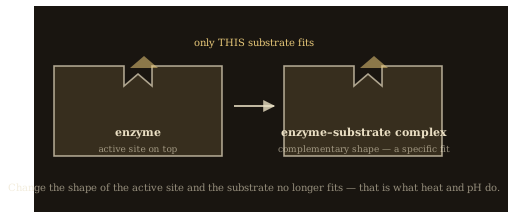
Think of it like a specially shaped nutcracker
A walnut is hard to break with your hands. A nutcracker shaped exactly to hold a walnut makes it easy. It does not become part of the walnut, and it is not used up — crack one, and it is ready for the next. That is a catalyst. But shape it for a walnut and it will not hold a peanut: an enzyme is SPECIFIC because its active site fits only one substrate.
Why heat first helps and then destroys
- Below the optimum: raising temperature gives molecules more kinetic energy, so enzyme and substrate collide more often and with more energy. Rate rises. Note that the enzyme is undamaged here — a cold enzyme is idle, not broken, and it works perfectly again as soon as you warm it.
- At the optimum: collisions are frequent and the enzyme is still intact. Rate is maximum — about 37 °C for human enzymes.
- Above the optimum: the vibration becomes violent enough to break the weak bonds holding the protein in its folded shape.
- The active site changes shape. The substrate no longer fits, no enzyme–substrate complex forms, and the rate collapses.
- This is DENATURING, and cooling does not undo it. That is the whole difference between the two halves of the graph: on the way up nothing is lost, on the way down the enzyme itself is being destroyed.
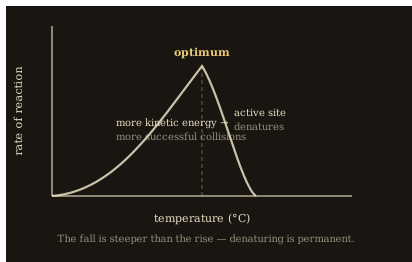
One thing worth being clear about, because it is where the reasoning usually goes wrong. Temperature is doing TWO separate things to the reaction at the same time, and they pull in opposite directions. It is speeding the molecules up, which helps, all the way from 0 °C to boiling. And above the optimum it is also destroying the enzyme, which does not help at all. The curve you see is the sum of the two: rising while only the first is happening, and collapsing once the second overtakes it. Ask which of the two a question is about and the answer usually writes itself.
2 · Grade 9 Notes
A different job from the section above. You have already understood it; this is the precise set of things to LEARN — definitions to reproduce word for word, processes in order, equations with units, and the answers that score full marks.
Learn this definition · Enzyme
A biological catalyst: a protein that speeds up the rate of a reaction without being changed or used up itself.
Learn this definition · Denaturation
A change in the shape of an enzyme's active site, so the substrate is no longer complementary and can no longer bind. Denaturation by heat is not reversed by cooling.
The vocabulary a full-mark answer uses
- Metabolic reactions
- the chemical reactions taking place inside a living organism; 'metabolism' is all of them together
- Active site
- the region of the enzyme the substrate binds to
- Substrate
- the molecule the enzyme acts on
- Complementary
- the substrate shape fits the active site exactly
- Enzyme–substrate complex
- what exists while the substrate is bound
- Specific
- one enzyme acts on one substrate, because of the shape fit
- Optimum
- the temperature or pH at which the rate is maximum
- Catalyst
- speeds up a reaction and is unchanged and not used up by it, so one molecule works over and over
Where the shape comes from — the link most answers are missing
- An enzyme is a protein
- a chain of amino acids, folded into one particular three-dimensional shape
- The sequence decides the fold
- the order of the amino acids determines how the chain folds, and therefore the shape of the active site
- So shape decides function
- change the shape and the substrate no longer fits — which is exactly what heat and pH do
Slow below the optimum vs destroyed above it — the difference examiners test
A. BELOW the optimum the enzyme is undamaged. There are simply fewer, less energetic collisions, so fewer enzyme–substrate complexes form per second. Warm it back up and the rate returns: nothing has been lost. An enzyme at 5 °C is inactive, not denatured.
B. ABOVE the optimum the enzyme itself is destroyed. Bonds holding its folded shape break, the active site is no longer complementary, and cooling does not bring the activity back. This is why the graph falls far more steeply than it rose.
The lock and key model
- The substrate has a shape complementary to the active site.
- It binds, forming an enzyme–substrate complex.
- The reaction occurs and the products leave.
- The enzyme is unchanged and binds another substrate.
Model answer [6 marks]
Explain the effect of increasing temperature on the rate of an enzyme reaction. [6]
Below the optimum, molecules gain kinetic energy, so enzyme and substrate collide more frequently and with more energy. More collisions form enzyme–substrate complexes, so the rate rises. The rate is maximum at the optimum. Above the optimum, the bonds holding the enzyme in its folded shape are broken, so the active site changes shape and is no longer complementary to the substrate. Fewer complexes form and the rate falls rapidly. The enzyme is denatured, so cooling does not restore activity.
Model answer [4 marks]
A student cools an enzyme to 5 °C and the reaction almost stops. They conclude that the enzyme has been denatured. Explain why the student is wrong. [4]
At 5 °C the enzyme and substrate molecules have little kinetic energy, so they collide less often and with less energy. Fewer enzyme–substrate complexes form per second, so the rate is very low. The enzyme itself is undamaged: its active site is still complementary to the substrate. Warming it back to the optimum restores the rate completely, which denaturation would not, so the enzyme is inactive rather than denatured.
The enzymes this specification names
- Amylase
- starch → maltose (mouth, pancreas)
- Maltase
- maltose → glucose (small intestine)
- Protease
- protein → amino acids (stomach, pancreas)
- Lipase
- lipid → fatty acids + glycerol (pancreas)
- Catalase
- hydrogen peroxide → water + oxygen
Reading the temperature graph
- It rises to a peak and then falls MUCH more steeply — the rise is faster collisions, the fall is denaturation, and they are different processes
- That asymmetry is the evidence: a curve produced by one process would be roughly symmetrical
- The optimum is read off the x-axis directly below the highest point
- Where the curve reaches zero, no enzyme–substrate complexes are forming at all
- Rate is plotted as 1 ÷ time, in s⁻¹ — so a shorter time is a HIGHER point on the graph
Required practical 2.12 — the effect of TEMPERATURE on enzyme activity
- Place starch solution and amylase in separate tubes in the water bath for five minutes before mixing, so both reach the set temperature.
- Mix, start the stopwatch, and return the tube to the bath.
- Every 10 s, remove a drop and add it to iodine solution on a spotting tile.
- The end point is the first drop that stays orange-brown: all the starch has been digested.
- Repeat at each temperature across the range, and calculate rate = 1 ÷ time.
- Control: a tube of BOILED amylase should show no colour change at all, proving the starch is broken down by the enzyme and not by the heat or the water.
Variables
Independent (changed) — temperature of the water bath
Dependent (measured) — time for the starch to disappear, converted to rate = 1 ÷ time
| Control variable | Why it must be held constant |
|---|---|
| pH — use a buffer | pH independently changes the rate, so letting it vary would make the result invalid |
| Enzyme concentration and volume | more enzyme means more active sites, so a faster rate at every temperature |
| Starch concentration and volume | more starch takes longer to digest whatever the temperature |
| Sampling interval | a longer interval adds uncertainty to every reading equally, but changing it mid-run makes readings incomparable |
| Five minutes in the bath before mixing | if the solutions have not reached the set temperature, the recorded temperature is not the one the reaction ran at |
Sources of error
| Type | What goes wrong | What to do |
|---|---|---|
| Judgement | The end point — the first drop that stays orange-brown — is a matter of opinion. | One person judges every tube, against a white tile in the same light. Repeat and take a mean. |
| Systematic | Sampling only every 10 s means the true end point can be up to 10 s before the one recorded, and always in that direction. | Sample every 5 s, or use a colorimeter and data logger. |
| Random | Water baths drift by a degree or two during a run. | Monitor with a thermometer throughout and quote the mean temperature rather than the dial setting. |
| Systematic | Without the boiled-amylase control, starch breaking down for some other reason would be read as enzyme activity. | Run the boiled tube alongside. If it shows no colour change, the digestion in the others is the enzyme's. |
Mark-losing trap. Never write that an enzyme is 'killed'. It is a molecule, not an organism: use denatured.
Mark-losing trap. Cooling does not undo heat denaturation. Cooling an enzyme that was never overheated is a different thing entirely — that one recovers.
Mark-losing trap. A cold enzyme is inactive, not denatured. Only heat above the optimum, and extremes of pH, denature.
Mark-losing trap. Say the active site is no longer COMPLEMENTARY; 'the enzyme stops working' describes without explaining and does not score.
Mark-losing trap. Rate = 1 ÷ time. Halving the time doubles the rate.
Mark-losing trap. Heat denatures the enzyme, not the substrate — starch and hydrogen peroxide are both heat-stable.
3 · Prove it — the five questions
The five questions climb Grade 6 → Grade 7 → Grade 8 → Grade 9 → Grade 9 challenge, and are marked inside Incandio on your own device, by rule, with an authored diagnosis of the mistake you actually made. The mark schemes stay in the app so that the practice is worth doing; the questions themselves are here.
- Grade 6 · State [1 mark] — What name is given to the part of an enzyme where the substrate binds?
- Grade 7 · Explain [3 marks] — Explain why raising the temperature from 20 °C to 35 °C increases the rate of an enzyme-controlled reaction.
- Grade 8 · Explain [4 marks] — A student heats a solution of amylase to 80 °C, then cools it back to 37 °C and adds starch. No starch is digested, even after an hour. Explain this result.
- Grade 9 · Analyse [3 marks] — A student investigating amylase records that starch disappears after 40 s at 30 °C and after 20 s at 40 °C. Calculate the rate of reaction at 40 °C, as 1 ÷ time.
- 9+ · Evaluate [5 marks] — A student investigating amylase gets faster and faster digestion from 20 °C up to 40 °C, then nothing at all at 50 °C and nothing at 60 °C. Their partner, running the identical method, gets a clear peak at 40 °C and slow but measurable digestion at 50 °C. Select every statement that could explain the difference.
The people behind this science
Three ways into the same idea — the one who worked out that it is a matter of shape, and the one who found the effect and got the cause wrong, and the one who found an enzyme by accident. Inside Incandio each of them answers knowing exactly which lesson you have just finished.
Emil Fischer — the one who worked out that it is a matter of shape
The lock-and-key picture on this page is Fischer's, proposed in 1894. Working with two sugars built from exactly the same atoms, he found that an enzyme would act on one and completely ignore the other — so the difference between them could only be one of shape, and he concluded that enzyme and substrate must fit each other like a lock and its key. Every explanation on this page rests on that one idea.
- “How did two sugars with the same formula show you that shape was the answer?”
- “Why did you choose a lock and a key to describe it?”
- “What did you think an enzyme actually WAS, if you could not see one?”
- “If shape is everything, what happens to an enzyme that loses its shape?”
- “Why does one enzyme refuse to act on a substance almost identical to its own?”
Louis Pasteur — the one who found the effect and got the cause wrong
Pasteur showed that gentle heating stops fermentation for good while leaving the sugar untouched — the exact observation this lesson explains as denaturation. He insisted only a living cell could do it. He was wrong, and the search for why he was wrong is how enzymes were found.
- “Why does gentle heating stop fermentation for good, when the sugar is unharmed?”
- “You were certain fermentation needed living cells — what convinced you, and where did it go wrong?”
- “How did you show that one specific process requires one specific agent?”
- “Why does pasteurisation use gentle heat rather than boiling?”
- “What would you have made of a dead extract of yeast that still ferments sugar?”
Alexander Fleming — the one who found an enzyme by accident
Six years before penicillin, Fleming discovered lysozyme — an enzyme in tears and mucus that breaks down bacterial cell walls. It is a working example of enzyme specificity doing a job in the body, and of how an accident becomes a discovery only if someone notices.
- “How did you discover an enzyme in your own tears, and what does it destroy?”
- “Why does lysozyme attack bacteria but leave your own cells unharmed?”
- “What does it mean to say an enzyme is specific to one substrate?”
- “Why is an enzyme still working after it has caused a reaction?”
- “How do you tell an accident from a discovery?”
Think you understand it?
Reading is the start. On Incandio a topic counts as mastered only once you have taught it and defended it — the two things a revision guide cannot ask of you.
Incandio this topic → Prove it. Teach it. Defend it. What does “Incandio it” mean?
- Prove it — five questions on Enzymes: Catalysts With a Shape, marked on the spot, that tell you what was missing rather than just what was wrong.
- Teach it — Explain Enzymes: Catalysts With a Shape in your own words to Ember, an AI pupil who does not have it yet and asks the awkward question. Understanding is credited; wording is not required.
- Defend it — Argue Enzymes: Catalysts With a Shape against Emil Fischer — three rounds, marked against descriptors you can read before you begin.
- Then the exam — read all 13 authored exam-style questions on this unit, each with its command word and its tariff, then have them marked on Incandio with the mistake you actually made named.
Completely free. No subscriptions, no paywalls, no account needed to start.
Carry on through the course
- Previous lesson: Carbohydrates, Proteins and Lipids
- Next lesson: Enzymes and pH
- Levels of Organisation — From organelle to organism — the five-step ladder that every later topic in biology is built on.
- Comparing Cells, and Stem Cells — What plant and animal cells share and where they differ — then why a cell specialising is one of the most powerful ideas in biology.
- Carbohydrates, Proteins and Lipids — The three big food molecules — what they are made of, what they are built from, and how to test for them.
- Enzymes and pH — Why acid ruins one enzyme and is the only condition another will work in — and how to find an enzyme's best pH by experiment.
- Diffusion, Osmosis and Active Transport — The three ways anything gets into or out of a cell — which need energy, which do not, and what makes each one fast or slow.
- All of Biology · Biology key terms · required practicals · Incandio Science · The 4BI1 specification