Pearson Edexcel International GCSE in Chemistry · 4CH1 · Free · no account needed
Cracking
Breaking long molecules nobody wants into short ones everybody does — and the reason a refinery has to.
Topic 4 · Organic chemistry — one of 16 lessons in this topic, and one of 61 in Chemistry.
This lesson ends with Vladimir Shukhov. Learn cracking, teach it, then defend it against Vladimir Shukhov.
The definition this lesson teaches, word for word — every Chemistry definition.
- Cracking
- The breaking down of long-chain alkanes into shorter, more useful alkanes and alkenes, using heat and a catalyst.
What this lesson covers in the specification
Incandio is aligned to this specification. It is not published by, endorsed by or affiliated with Pearson, and it reproduces none of Pearson's wording — the statement numbers are given so you can check every lesson against your own copy.
- 4.17 — Catalytic cracking of long-chain alkanes, with catalyst and temperature range
- 4.18 — Why cracking is necessary, in terms of supply and demand
Specification section 4(c) Alkanes and (d) alkenes — also taught in Pollutants And Acid Rain, Alkanes, Alkenes.
1 · Understand it
No exam language yet. The only question this section answers is: do I actually understand what is happening?
The fractionating column has one serious limitation, and it is not a technical one. The column can only hand you what the crude oil happened to contain. It cannot make more petrol, because the proportions were fixed millions of years before anyone drilled the well.
Statement 4.18 — the supply-and-demand problem, in numbers
- Crude oil is rich in long-chain hydrocarbons: fuel oil, and the heavy residues at the bottom of the column.
- Demand for those long fractions is comparatively small — a limited number of ships and power stations burn them.
- Demand for SHORT chains is enormous: petrol for cars is the single largest use of oil in most countries.
- But crude oil contains far less of the short-chain material than is wanted.
- So the refinery ends up with a surplus of long chains it cannot sell and a shortage of short ones it cannot supply.
- Cracking resolves this by BREAKING the surplus long molecules into shorter ones that are in demand.
Think of it like a bakery that can only buy whole loaves
Suppose a café can buy only uncut loaves, but almost every customer wants a single slice. No matter how many loaves are delivered, the shelves are wrong: too much of what nobody orders, not enough of what everybody does. The café cannot change what the supplier sends, so the only useful thing it can do is cut. Cracking is that cut. The refinery cannot alter what the oil field produces, so it takes the long molecules it has too many of and breaks them into the short ones it has too few of.
There is a second reason, and it is the one that connects this topic to the polymer lessons at the end of it. Cracking does not only produce shorter alkanes. It also produces ALKENES — hydrocarbons containing a carbon-to-carbon double bond, which barely occur in crude oil at all. Alkenes are far more reactive than alkanes, and they are the starting material for plastics. Without cracking there would be no poly(ethene), because there would be no ethene to make it from.
How cracking works, and what the conditions must be
- The long-chain alkane is heated until it vaporises.
- The vapour is passed over a CATALYST of silica or alumina at a temperature of about 600–700 °C.
- The heat supplies enough energy to break carbon-to-carbon bonds within the molecule, and the catalyst allows this to happen at a lower temperature than would otherwise be needed.
- The long molecule splits into a shorter ALKANE and one or more ALKENES.
- There are not enough hydrogen atoms in the original molecule for every fragment to be a saturated alkane, so at least one product must contain a double bond.
- The equation must balance like any other: C₁₀H₂₂ → C₈H₁₈ + C₂H₄ uses ten carbons and twenty-two hydrogens on each side.
That fifth step is the one worth pausing on, because it explains why alkenes are unavoidable rather than a lucky by-product. An alkane with n carbons has 2n+2 hydrogens. Split it in two and you would need 2n+4 hydrogens to make two alkanes — two more than the molecule ever had. Something has to do without, and what does without a pair of hydrogens forms a double bond instead.
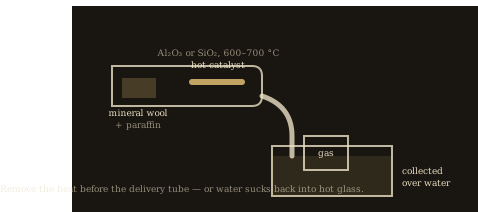
Cracking is a THERMAL DECOMPOSITION: one substance is broken down by heat into more than one product. It is not a reaction with oxygen, nothing is added to the molecule, and no second reactant is involved. Describing it as a reaction between the alkane and the catalyst is a common and costly error — a catalyst is not a reactant and is unchanged at the end.
2 · Grade 9 Notes
A different job from the section above. You have already understood it; this is the precise set of things to LEARN — definitions to reproduce word for word, processes in order, equations with units, and the answers that score full marks.
Learn this definition · Cracking
The breaking down of long-chain alkanes into shorter, more useful alkanes and alkenes, using heat and a catalyst.
The conditions — learn these exactly
- Catalyst: silica (SiO₂) or alumina (Al₂O₃)
- Temperature: about 600–700 °C
- The alkane must be vaporised before it passes over the catalyst
- Products: one shorter alkane plus one or more alkenes
C₁₀H₂₂ → C₈H₁₈ + C₂H₄
Conditions: Silica or alumina catalyst, 600–700 °C. Decane cracks to octane and ethene. Ten carbons and twenty-two hydrogens on each side.
C₈H₁₈ → C₆H₁₄ + C₂H₄
Conditions: A second example. Any split is possible provided the equation balances and at least one product is an alkene.
The words an answer on this page needs
- Thermal decomposition
- The breaking down of one substance into two or more others by heating.
- Catalyst
- A substance that speeds up a reaction and is unchanged at the end. It is not a reactant.
- Alkene
- A hydrocarbon containing a carbon-to-carbon double bond. Barely present in crude oil, and produced by cracking.
- Feedstock
- A raw material fed into an industrial process to make something else — here, alkenes for making plastics.
Model answer [4 marks]
Explain why an oil refinery needs to crack some of the fractions it produces. [4]
The fractions obtained from crude oil are in proportions fixed by the oil itself, and these do not match demand. Crude oil yields a large amount of long-chain material such as fuel oil, for which demand is comparatively small, and much less short-chain material such as petrol, for which demand is very large. Cracking breaks the surplus long-chain alkanes into shorter chains that can be sold, matching supply to demand. It also produces alkenes, which are scarcely present in crude oil and are needed as the starting material for making polymers.
Model answer [3 marks]
Explain why at least one of the products of cracking an alkane must be an alkene. [3]
An alkane with n carbon atoms contains 2n+2 hydrogen atoms. If the molecule were split into two alkanes, those two would together require 2n+4 hydrogen atoms, which is two more than the original molecule contained. There are therefore not enough hydrogen atoms available for both products to be saturated. One fragment must instead form a carbon-to-carbon double bond between two of its carbons, which is what makes it an alkene.
Cracking against fractional distillation
A. CRACKING is a chemical reaction. Bonds within molecules are broken and new substances are formed, so what comes out was not there before.
B. FRACTIONAL DISTILLATION is a physical separation. No bonds are broken and no new substances are made; the molecules are only sorted by boiling point.
Balancing a cracking equation
- Write the long alkane on the left, using its molecular formula.
- Choose the shorter alkane you want on the right and write its formula.
- Subtract its carbons and hydrogens from the original to find what is left over.
- Write the remainder as one or more alkenes, which will fit the general formula CₙH₂ₙ.
- Check that carbon and hydrogen each balance across the arrow.
Not this: The catalyst reacts with the alkane, and that is what breaks it apart.
This: A catalyst takes no part as a reactant and is unchanged at the end. What breaks the carbon-to-carbon bonds is the heat; the catalyst only allows it to happen at a lower temperature than would otherwise be required.
Mark-losing trap. Cracking is thermal decomposition, so it is a CHEMICAL change. Fractional distillation is a physical one.
Mark-losing trap. Quote the conditions: silica or alumina catalyst, 600–700 °C. A vague "high temperature" scores nothing.
Mark-losing trap. A cracking equation must balance. Count carbon and hydrogen on both sides before writing the answer down.
3 · Prove it — the five questions
The five questions climb Grade 6 → Grade 7 → Grade 8 → Grade 9 → Grade 9 challenge, and are marked inside Incandio on your own device, by rule, with an authored diagnosis of the mistake you actually made. The mark schemes stay in the app so that the practice is worth doing; the questions themselves are here.
- Grade 6 · State [1 mark] — Which catalyst and temperature range are used for the catalytic cracking of long-chain alkanes?
- Grade 7 · Complete [2 marks] — Decane, C₁₀H₂₂, is cracked to give octane, C₈H₁₈, and one other product. Give the formula of that product.
- Grade 8 · Explain [3 marks] — Explain why cracking is described as a chemical change, while fractional distillation is not.
- Grade 9 · Explain [4 marks] — Select every statement that belongs in a full answer explaining why a refinery cracks some of its long-chain fractions.
- 9+ · Deduce [5 marks] — A molecule of C₁₂H₂₆ is cracked to give one molecule of C₃H₆ and one other product. Give the number of hydrogen atoms in that other product.
The people behind this science
Two ways into the same idea — the one who first saw a hot metal make a reaction happen without being consumed, and the one who explains the half of this statement that is not chemistry at all. Inside Incandio each of them answers knowing exactly which lesson you have just finished.
Humphry Davy — the one who first saw a hot metal make a reaction happen without being consumed
The strange thing about the conditions on this page is the catalyst: silica and alumina make cracking possible at 600–700 °C and come out unchanged. Davy met that behaviour before anyone had a word for it. Working on the miner's safety lamp in 1817, he found that a piece of platinum gauze held above a flame would keep glowing and go on burning the mine gas after the flame itself had gone out — a solid making a reaction proceed without being consumed by it. He is the right person to ask what it means for something to cause a change and remain unchanged.
- “What did the platinum do above the flame that surprised you?”
- “How can a solid cause a reaction and not be used up?”
- “Did you think the metal was taking part or just helping?”
- “What experiment would show a substance is unchanged at the end?”
- “Why does heating something make a reaction possible at all?”
Adam Smith — the one who explains the half of this statement that is not chemistry at all
Statement 4.18 is unusual: it sits in a chemistry specification but is an economic argument, and answering it well means reasoning about supply and demand rather than about bonds. Smith is the person who made that reasoning systematic — that when the quantity of something available does not match the quantity wanted, prices move, and that pressure is what drives producers to change what they make. Cracking exists because of exactly that mismatch, and he is the right figure to ask why a refinery would spend energy converting one product into another at all.
- “What happens when supply and demand do not match?”
- “Why would a producer spend money converting one good into another?”
- “Does the price of something tell you how much people want it?”
- “How does a market decide what gets made from a raw material?”
- “Can a producer ever simply refuse to meet a demand?”
Think you understand it?
Reading is the start. On Incandio a topic counts as mastered only once you have taught it and defended it — the two things a revision guide cannot ask of you.
Incandio this topic → Prove it. Teach it. Defend it. What does “Incandio it” mean?
- Prove it — five questions on cracking, marked on the spot, that tell you what was missing rather than just what was wrong.
- Teach it — Explain cracking in your own words to Ember, an AI pupil who does not have it yet and asks the awkward question. Understanding is credited; wording is not required.
- Defend it — Argue cracking against Vladimir Shukhov — three rounds, marked against descriptors you can read before you begin.
- Then the exam — read all 12 authored exam-style questions on this unit, each with its command word and its tariff, then have them marked on Incandio with the mistake you actually made named.
Completely free. No subscriptions, no paywalls, no account needed to start.
Carry on through the course
- Previous lesson: Pollutants And Acid Rain
- Next lesson: Alkanes
- What Organic Chemistry Is — Two facts about carbon generate several million compounds — and three words keep them in order.
- Naming, Drawing And Classifying — A name that tells you the structure, a method that finds every isomer, and three words that cover every organic reaction here.
- Crude Oil And Its Fractions — One mixture, separated by boiling point into six useful materials — and one causal chain that explains every trend down the column.
- Burning Fuels — Two ways a hydrocarbon can burn, and why one of them fills a room with a gas you cannot smell.
- Pollutants And Acid Rain — One pollutant comes out of the fuel and one comes out of the air — and telling them apart decides which fix works.
- All of Chemistry · Chemistry key terms · required practicals · equations · Incandio Science · The 4CH1 specification