Pearson Edexcel International GCSE in Chemistry · 4CH1 · Free · no account needed
Rates of Reaction
Four things that make a reaction faster, and two ways of measuring whether they did.
Topic 3 · Physical chemistry — one of 8 lessons in this topic, and one of 61 in Chemistry.
One of the 12 Chemistry required practicals · Its equation is on the Chemistry equations page with the other 16.
This lesson ends with Marcellin Berthelot. Learn Rates of Reaction, teach it, then defend it against Marcellin Berthelot.
What this lesson covers in the specification
Incandio is aligned to this specification. It is not published by, endorsed by or affiliated with Pearson, and it reproduces none of Pearson's wording — the statement numbers are given so you can check every lesson against your own copy.
- 3.9 — Experiments to investigate the effect of surface area, concentration, temperature and catalyst on rate
- 3.10 — The effects of surface area, concentration, pressure, temperature and catalyst on rate
- 3.15 — Practical: investigate the effect of surface area and concentration on the rate of the marble chip–hydrochloric acid reaction (required practical)
Specification section 3(b) Rates of reaction — also taught in Collision Theory, Catalysts, Reversible Reactions, Dynamic Equilibrium.
1 · Understand it
No exam language yet. The only question this section answers is: do I actually understand what is happening?
The RATE of a reaction is how quickly reactants are used up or products are formed. Some reactions are over in a fraction of a second and others take years, and five factors change the rate of any of them.
Statement 3.10 — the five factors, and which way each goes
- SURFACE AREA — a solid broken into smaller pieces or powdered reacts FASTER.
- CONCENTRATION — a more concentrated solution reacts FASTER.
- PRESSURE — for reactions involving GASES, a higher pressure reacts FASTER.
- TEMPERATURE — a higher temperature reacts FASTER, and the effect is large: for many reactions a rise of only ten degrees roughly doubles the rate.
- CATALYST — adding a catalyst makes the reaction FASTER without the catalyst being used up.
- All five increase the rate, which makes them easy to remember; the interesting part is that one explanation covers all of them, and that is the next lesson.
Pressure is worth a note because it applies only where a GAS is involved. Squeezing a solution has essentially no effect, because liquids barely compress. This is why pressure appears in statement 3.10 alongside concentration rather than instead of it: they are the same idea applied to two different states.
Now measuring rate, and there are two general approaches. Either watch something the reaction PRODUCES and time how quickly it appears, or watch something the reaction CONSUMES and time how quickly it goes.
Statement 3.9 — the two ways of measuring rate
- MEASURE THE GAS PRODUCED. Collect it in a gas syringe or over water and record the volume at fixed intervals. Suits any reaction giving off a gas.
- MEASURE THE MASS LOST. Stand the flask on a balance; as gas escapes the mass falls, and readings are taken at fixed intervals. Also for gas-producing reactions.
- MEASURE A COLOUR CHANGE OR CLOUDINESS. Time how long a cross marked under the flask takes to disappear as a precipitate forms.
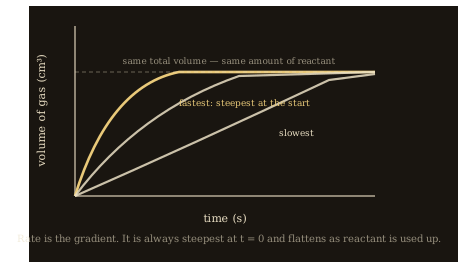
- A steeper GRADIENT on a graph of product against time means a faster rate.
- The reaction is FINISHED when the graph LEVELS OFF, because nothing more is being produced.
Think of it like a bath emptying rather than a car journey
A car travelling at a steady speed covers equal distances in equal times, and its speed-time graph is flat. A bath emptying is quite different: it drains fastest at the start when the water is deepest, and slows as it goes, so a graph of water lost against time is steep at first and gradually flattens. Reactions behave like the bath. The rate is greatest at the very beginning, when the reactants are at their most concentrated, and falls continuously as they are used up. This is why the curve is a curve, and why 'the rate' of a reaction really means the rate at a particular moment.
That curve shape explains something a learner should be able to read off any rate graph. If two experiments start with the same amount of the limiting reactant, both graphs end at the SAME HEIGHT however different their steepness — because the same quantity of product is eventually made either way. A faster reaction gets there sooner; it does not get further.
Reading two curves on one set of axes
Two experiments use the same mass of marble chips and the same volume of acid. Experiment A uses large chips, experiment B uses powder. Describe how the two curves compare.
- B is STEEPER at the start, because the powder has a much greater surface area and reacts faster.
- B LEVELS OFF SOONER, because it reaches completion in less time.
- Both curves level off at the SAME HEIGHT, because the same mass of marble and the same volume of acid produce the same total volume of carbon dioxide.
- So surface area changed the rate but not the yield.
- That final point is the one exam questions test, and drawing B finishing higher than A is the standard error.
Answer: B steeper and finishing sooner, but at the same final height as A.
Calculating a rate from the results
Magnesium reacts with dilute acid and the hydrogen is collected in a gas syringe. 30 cm³ is collected in the first 60 s. (a) Calculate the mean rate over the first 60 s. (b) A tangent drawn to the volume–time curve at 20 s passes through (0 s, 4 cm³) and (40 s, 32 cm³). Calculate the rate at 20 s.
- (a) MEAN RATE = quantity of product formed ÷ time taken = 30 cm³ ÷ 60 s = 0.50 cm³/s.
- The unit is the quantity's unit divided by the time's unit: cm³/s for a gas volume, g/s for a mass lost, mol/s when the amount is in moles.
- (b) A mean rate hides the slowing down. The rate at ONE moment is the GRADIENT of the curve there, found by drawing a TANGENT — a straight line that just touches the curve at that point.
- Gradient = change in volume ÷ change in time = (32 − 4) ÷ (40 − 0) = 28 ÷ 40 = 0.70 cm³/s.
- Check it makes sense: 0.70 cm³/s at 20 s is faster than the 0.50 cm³/s mean over the whole minute, as it must be — the reaction is fastest early on.
Answer: (a) 0.50 cm³/s. (b) 0.70 cm³/s at 20 s, from the gradient of the tangent.
Sometimes the measurement is a TIME rather than an amount — for example, how long a cross drawn under the flask takes to disappear as sodium thiosulfate reacts with hydrochloric acid and a cloudy precipitate of sulfur forms. Then the rate is taken as 1 ÷ time. A shorter time means a faster reaction, so a run that hides the cross in 20 s has twice the rate of one that takes 40 s.
The required practical is marble chips with hydrochloric acid, investigating surface area and concentration. Marble is calcium carbonate, so the reaction gives carbon dioxide, which makes both measurement methods available — collect the gas, or stand the flask on a balance and watch the mass fall.
2 · Grade 9 Notes
A different job from the section above. You have already understood it; this is the precise set of things to LEARN — definitions to reproduce word for word, processes in order, equations with units, and the answers that score full marks.
The vocabulary of rates
- Rate of reaction
- How quickly reactants are used up or products formed. Measured as an amount per unit time.
- Surface area
- The area of solid exposed to the other reactant. Powdering a solid greatly increases it.
- Catalyst
- A substance that speeds up a reaction without being used up in it.
- Limiting reactant
- The reactant that runs out first, which is what decides the total amount of product and where the graph levels off.
Statement 3.10 — the five factors
- SURFACE AREA — smaller pieces or powder react FASTER
- CONCENTRATION — more concentrated solutions react FASTER
- PRESSURE — higher pressure reacts FASTER, but only for reactions involving GASES
- TEMPERATURE — higher temperature reacts FASTER; even a small rise has a large effect
- CATALYST — speeds the reaction up and is not used up itself
Statement 3.9 — measuring a rate
- Decide what to follow: a gas produced, a mass lost, or a colour or cloudiness appearing.
- Take readings at FIXED time intervals from the moment the reactants are mixed.
- Plot the measured quantity on the vertical axis against time on the horizontal axis.
- The GRADIENT at any point gives the rate at that moment — steepest at the start.
- The graph LEVELS OFF when the reaction has finished, because a reactant has run out.
mean rate of reaction = quantity of product formed ÷ time taken
quantity as a volume of gas, a mass, or an amount in moles; the rate at one instant is the gradient of a tangent to the curve; for a timed end point, rate = 1 ÷ time
Units: cm³/s, g/s or mol/s; 1/s (s⁻¹) for 1 ÷ time
Required practical 3.15 — marble chips and hydrochloric acid
- Measure a fixed volume of dilute hydrochloric acid, such as 50 cm³, into a conical flask.
- Weigh out a fixed mass of marble chips of a known size.
- Add the chips to the acid, immediately stopper the flask with a delivery tube leading to a gas syringe, and start a stopwatch.
- Record the volume of carbon dioxide collected every 15 or 30 seconds until no more gas is produced.
- Repeat using the same mass of marble but in smaller pieces or as a powder, keeping the acid volume and concentration the same.
- Repeat again using acid of a different concentration, keeping the chip size the same.
- Plot volume of gas against time for each run on the same axes and compare the steepness of the curves.
Variables
Independent (changed) — The size of the marble chips, or the concentration of the acid
Dependent (measured) — The volume of carbon dioxide collected in a given time
| Control variable | Why it must be held constant |
|---|---|
| Mass of marble used | a greater mass produces more gas in total, which would be mistaken for a faster reaction |
| Volume of acid | a larger volume of acid contains more of it, so more gas is produced before it runs out |
| Temperature | a warmer mixture reacts faster whatever the chip size, so the comparison would be unfair |
Sources of error
| Type | What goes wrong | What to do |
|---|---|---|
| Systematic | Gas escapes before the stopper is in place, so early readings are too low. | Have the stopper ready and fit it immediately. |
| Random | Chips described as the same size vary considerably in surface area. | Sieve the chips to a narrow size range before use. |
| Judgement | Readings are taken at slightly irregular intervals, distorting the curve. | Read the syringe on a fixed timer signal. |
Reading a rate graph
- STEEPER means FASTER at that moment
- The graph is STEEPEST AT THE START, when the reactants are most concentrated
- It curves and flattens as the reactants are used up
- LEVELLING OFF means the reaction has FINISHED
- Two runs with the same amount of limiting reactant finish at the SAME HEIGHT, however different their steepness
Model answer [4 marks]
Describe two different methods for measuring the rate of the reaction between marble chips and hydrochloric acid. [4]
The first method is to collect the carbon dioxide produced. The flask is stoppered with a delivery tube leading to a gas syringe, and the volume of gas collected is recorded at fixed time intervals from the moment the reactants are mixed. The second method is to measure the loss in mass. The flask is stood on a balance with a loose plug of cotton wool in the neck, and as carbon dioxide escapes the total mass falls, so the mass is recorded at fixed time intervals. In both cases the results are plotted against time and the steepness of the curve gives the rate.
Model answer [3 marks]
Two experiments use the same mass of marble and the same acid, one with large chips and one with powder. Describe how the two curves of gas volume against time differ. [3]
The curve for the powder is steeper at the start, because the powder has a much larger surface area and so reacts faster. The powder's curve also levels off sooner, because the reaction reaches completion in a shorter time. Both curves level off at the same final volume, however, because the same mass of marble and the same volume of acid produce the same total amount of carbon dioxide.
Not this: A faster reaction produces more product, so its curve finishes higher.
This: The final height is fixed by how much LIMITING REACTANT there was, not by how fast it reacted. A faster reaction reaches the same height SOONER — same destination, less time.
Mark-losing trap. Same amount of limiting reactant means the SAME FINAL HEIGHT, however different the steepness.
Mark-losing trap. PRESSURE only affects reactions involving GASES — squeezing a solution does nothing.
Mark-losing trap. The rate is greatest AT THE START and falls throughout, which is why the graph is a curve.
3 · Prove it — the five questions
The five questions climb Grade 6 → Grade 7 → Grade 8 → Grade 9 → Grade 9 challenge, and are marked inside Incandio on your own device, by rule, with an authored diagnosis of the mistake you actually made. The mark schemes stay in the app so that the practice is worth doing; the questions themselves are here.
- Grade 6 · State [1 mark] — What happens to the rate of a reaction if the temperature is increased?
- Grade 7 · Interpret [2 marks] — On a graph of gas volume against time, what does the graph levelling off show?
- Grade 8 · Predict [3 marks] — The same mass of marble is used as large chips in one experiment and as powder in another, with identical acid. Compare the final volumes of gas collected.
- Grade 9 · Describe [6 marks] — Select every statement that belongs in a full-mark description of how to investigate the effect of acid concentration on the rate of reaction between marble chips and hydrochloric acid.
- 9+ · Analyse [6 marks] — A student investigating surface area uses 5.0 g of large chips in one run and 5.0 g of powder in another, and finds the powder run finishes at a higher final gas volume. Select every statement that belongs in a full-mark analysis.
The people behind this science
Two ways into the same idea — the one whose safety lamp depended on controlling a reaction rate, and the one who established what pressure does to a gas. Inside Incandio each of them answers knowing exactly which lesson you have just finished.
Humphry Davy — the one whose safety lamp depended on controlling a reaction rate
The miners' safety lamp is a rate problem solved by engineering. A flame inside a fine iron gauze does not ignite the methane outside it, because the metal conducts heat away from the burning gas faster than the reaction can spread through the mesh — the reaction cannot go fast enough on the far side to sustain itself. Davy tested it by building lamps and taking them into gas-filled chambers himself. He is the right person to ask how a rate can be deliberately limited rather than increased, which is the less obvious half of this topic.
- “How does a gauze stop a flame passing through it?”
- “What is happening to the heat at the mesh?”
- “How did you test whether the lamp was safe?”
- “Can a reaction be slowed deliberately as well as sped up?”
- “Why did you refuse to patent it?”
Robert Boyle — the one who established what pressure does to a gas
Statement 3.10 includes pressure as a factor for gas reactions, and that only makes sense if compressing a gas genuinely brings its particles closer together — which is Boyle's result. His J-shaped tube showed that a gas's volume falls as the pressure upon it rises, in inverse proportion, and his air-pump work established that a gas is mostly empty space. Together those make pressure and concentration the same idea in two different states, which is exactly how this page presents them.
- “What happens to a gas when you squeeze it?”
- “Why can a gas be compressed when a liquid cannot?”
- “How did the J-shaped tube measure it?”
- “What did the air pump tell you about what a gas is?”
- “Would squeezing change how readily a gas reacts?”
Think you understand it?
Reading is the start. On Incandio a topic counts as mastered only once you have taught it and defended it — the two things a revision guide cannot ask of you.
Incandio this topic → Prove it. Teach it. Defend it. What does “Incandio it” mean?
- Prove it — five questions on Rates of Reaction, marked on the spot, that tell you what was missing rather than just what was wrong.
- Teach it — Explain Rates of Reaction in your own words to Ember, an AI pupil who does not have it yet and asks the awkward question. Understanding is credited; wording is not required.
- Defend it — Argue Rates of Reaction against Marcellin Berthelot — three rounds, marked against descriptors you can read before you begin.
- Then the exam — read all 10 authored exam-style questions on this unit, each with its command word and its tariff, then have them marked on Incandio with the mistake you actually made named.
Completely free. No subscriptions, no paywalls, no account needed to start.
Carry on through the course
- Previous lesson: Energy Diagrams and Bond Energies
- Next lesson: Collision Theory
- Exothermic and Endothermic Reactions — Reactions that warm their surroundings and reactions that chill them — and why the thermometer tells you which.
- Calorimetry Calculations — Turning a temperature rise into an energy in joules, and then into a value per mole.
- Energy Diagrams and Bond Energies — Why breaking bonds costs energy, why making them repays it, and why the balance decides everything.
- Collision Theory — One explanation that accounts for every factor on the previous page.
- Catalysts — A substance that speeds a reaction up, takes part in it, and is there unchanged at the end.
- All of Chemistry · Chemistry key terms · required practicals · equations · Incandio Science · The 4CH1 specification