Pearson Edexcel International GCSE in Chemistry · 4CH1 · Free · no account needed
Ionic Structures and Their Properties
Why salt melts at 800 °C, why it will not conduct until it does, and why both facts come from the same lattice.
Topic 1 · Principles of chemistry — one of 18 lessons in this topic, and one of 61 in Chemistry.
This lesson ends with Michael Faraday. Learn Ionic Structures and Their Properties, teach it, then defend it against Michael Faraday.
The 2 definitions this lesson teaches, word for word — every Chemistry definition.
- Ionic bond
- The strong electrostatic force of attraction between oppositely charged ions. It acts in all directions, which is why ions form a giant lattice rather than molecules.
- Giant ionic lattice
- A regular repeating three-dimensional arrangement in which each ion is surrounded by ions of the opposite charge. The formula gives the ratio of ions, not the contents of a molecule.
What this lesson covers in the specification
Incandio is aligned to this specification. It is not published by, endorsed by or affiliated with Pearson, and it reproduces none of Pearson's wording — the statement numbers are given so you can check every lesson against your own copy.
- 1.41 — Ionic bonding in terms of electrostatic attraction
- 1.42 — Why giant ionic lattices have high melting and boiling points
- 1.43 — Why ionic compounds conduct only when molten or in aqueous solution
Specification section 1(e) Chemical formulae, equations and calculations — also taught in The Mole, Reacting Masses and Percentage Yield, Empirical and Molecular Formulae, Concentration and Gas Volumes.
1 · Understand it
No exam language yet. The only question this section answers is: do I actually understand what is happening?
The last page made the ions. This one asks what holds them together, and the answer is the plainest force in chemistry: opposite charges attract. IONIC BONDING is the strong ELECTROSTATIC ATTRACTION between oppositely charged ions. That is the whole definition, and the word electrostatic is what earns the mark — 'the ions stick together' describes without explaining.
Now the part that decides every property on this page. That attraction is not directional: a positive ion attracts every negative ion around it, in all directions at once. So ions do not pair off into molecules. They pack into a regular repeating three-dimensional arrangement in which each ion is surrounded by ions of the opposite charge — a GIANT IONIC LATTICE. A grain of salt is one such structure, containing something like a million million million ions, and it has no molecules in it at all.
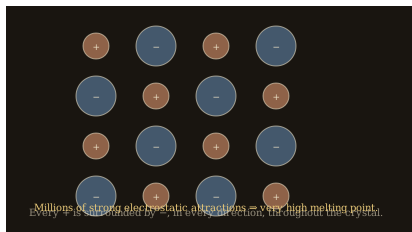
That is why the formula NaCl does not mean a molecule of one sodium and one chlorine. It means the RATIO in the lattice is one to one. There is no such thing as a sodium chloride molecule to point at.
Think of it like a brick wall rather than a bag of paired socks
A bag of socks is made of pairs: pull one out and you have a complete unit, and to empty the bag you only ever separate pairs from each other. A brick wall is not like that. No brick is partnered with one particular brick; each is mortared to every neighbour, and there is no small piece you can remove without breaking many bonds at once. Ionic solids are walls, not bags. This single picture explains the melting point — to melt it you must overcome the attraction of every ion to all its neighbours simultaneously, which takes an enormous amount of energy — and it also explains why the compound is brittle, because a wall shoved sideways does not bend, it shears.
Why the melting point is so high — the chain that earns the marks
- The compound consists of oppositely charged ions held in a giant lattice.
- There are STRONG ELECTROSTATIC FORCES OF ATTRACTION between each ion and all the oppositely charged ions surrounding it.
- To melt the compound, the ions must be able to move past one another, so those attractions must be overcome.
- Because every ion is attracted to many neighbours at once, a very LARGE AMOUNT OF ENERGY is needed.
- So the melting and boiling points are high — sodium chloride melts at about 800 °C.
- The stronger the attraction, the higher the melting point: magnesium oxide, with 2+ and 2− ions, melts at about 2850 °C because doubling both charges multiplies the attraction.
That last step is worth keeping, because it is the difference between knowing a fact and being able to predict one. The attraction is stronger when the charges are LARGER, and stronger when the ions are SMALLER, since smaller ions can sit closer together. Magnesium oxide has both advantages over sodium chloride, and melts about two thousand degrees higher.
Now conductivity, statement 1.43, and it turns on one requirement. To conduct electricity a substance needs CHARGED PARTICLES THAT ARE FREE TO MOVE. An ionic compound has the charged particles — that is what an ion is — but in the solid they are locked in fixed positions in the lattice. They can vibrate; they cannot travel. So a solid ionic compound does not conduct.
The three states, and the same test applied to each
- SOLID — ions present but held in fixed positions in the lattice. Charged particles, not free to move. DOES NOT CONDUCT.
- MOLTEN — heating has overcome the attractions, so the ions can now move throughout the liquid. Charged particles, free to move. CONDUCTS.
- DISSOLVED IN WATER — the lattice is broken up and the ions separate and spread through the solution, free to move. CONDUCTS.
- The ions are present in all three cases. What changes is only whether they can MOVE.
- This also explains why melting or dissolving is required before electrolysis: the current has to be carried by moving ions.
It is worth being explicit about what does NOT explain the conduction, because a very common answer says the ions are 'released' or 'created' when the solid melts. Nothing is created. The ions were there all along — in the solid crystal, in the melt and in the solution — and the only thing melting or dissolving changes is their freedom to travel. A question asking why solid salt does not conduct is asking about mobility, not about existence.
Two further properties follow from the same lattice and are worth having. Ionic compounds are BRITTLE: knock the layers so they shift, and ions of like charge come to face one another, repel, and the crystal splits along a clean plane. And many are SOLUBLE in water, because water molecules are themselves slightly charged at each end and can surround the ions and pull them out of the lattice.
2 · Grade 9 Notes
A different job from the section above. You have already understood it; this is the precise set of things to LEARN — definitions to reproduce word for word, processes in order, equations with units, and the answers that score full marks.
Learn this definition · Ionic bond
The strong electrostatic force of attraction between oppositely charged ions. It acts in all directions, which is why ions form a giant lattice rather than molecules.
Learn this definition · Giant ionic lattice
A regular repeating three-dimensional arrangement in which each ion is surrounded by ions of the opposite charge. The formula gives the ratio of ions, not the contents of a molecule.
The high melting point, as an examiner wants it written
- The compound consists of oppositely charged ions in a giant lattice.
- There are strong ELECTROSTATIC forces of attraction between oppositely charged ions.
- Melting requires these attractions to be overcome so the ions can move past each other.
- Each ion is attracted to many neighbours, so a large amount of energy is needed.
- Therefore the melting and boiling points are high.
Statement 1.43 — conducting in the three states
| Solid | Molten or dissolved | |
|---|---|---|
| Are ions present? | Yes | Yes — the same ions |
| Can they move? | No — fixed in the lattice | Yes — free to move throughout |
| Conducts? | No | Yes |
| What changed | — | Only their freedom to move, not whether they exist |
What makes one ionic compound melt higher than another
- LARGER CHARGES give a stronger attraction — MgO (2+ and 2−) melts at about 2850 °C against NaCl's 800 °C
- SMALLER IONS give a stronger attraction, because they sit closer together
- The rule to apply: stronger attraction means more energy needed, so a higher melting point
- This is what lets you predict a melting point for a compound you have never met
The other properties that follow from the lattice
- BRITTLE — shifting the layers brings like charges together, they repel, and the crystal splits
- Often SOLUBLE in water, because water molecules are charged at each end and can pull ions out of the lattice
- SOLID at room temperature, because the attractions are far too strong to be overcome by ordinary warmth
- The formula is a RATIO, not the contents of a molecule — there is no NaCl molecule
Model answer [4 marks]
Explain why sodium chloride has a high melting point. [4]
Sodium chloride consists of positive sodium ions and negative chloride ions arranged in a giant ionic lattice. There are strong electrostatic forces of attraction between the oppositely charged ions, and each ion is attracted to all of the oppositely charged ions surrounding it. In order to melt the compound these attractions must be overcome so that the ions are free to move past one another. A large amount of energy is therefore required, so the melting point is high.
Model answer [4 marks]
Explain why solid sodium chloride does not conduct electricity but molten sodium chloride does. [4]
To conduct electricity a substance must contain charged particles that are free to move. In solid sodium chloride the ions are charged but are held in fixed positions within the giant lattice, so although they can vibrate they cannot move through the solid and no current flows. When the compound is melted, the electrostatic attractions have been overcome and the ions become free to move throughout the liquid. The same ions are present in both cases; it is only their freedom to move that has changed.
Not this: Melting an ionic solid creates or releases the ions, which is why it starts to conduct.
This: The ions were there the whole time — in the crystal, in the melt and in the solution alike. Melting changes nothing about whether they exist; it changes only whether they can MOVE, and movement is what conduction requires.
Mark-losing trap. Say ELECTROSTATIC. 'The ions stick together' describes the fact and explains nothing.
Mark-losing trap. There is no NaCl molecule. The formula is the RATIO of ions in a giant lattice.
Mark-losing trap. Solid ionic compounds do not conduct because the ions cannot MOVE — not because there are none.
Mark-losing trap. Bigger charges and smaller ions mean a stronger attraction and a higher melting point.
3 · Prove it — the five questions
The five questions climb Grade 6 → Grade 7 → Grade 8 → Grade 9 → Grade 9 challenge, and are marked inside Incandio on your own device, by rule, with an authored diagnosis of the mistake you actually made. The mark schemes stay in the app so that the practice is worth doing; the questions themselves are here.
- Grade 6 · State [1 mark] — What holds the ions together in an ionic compound?
- Grade 7 · Explain [2 marks] — Explain why solid potassium bromide does not conduct electricity.
- Grade 8 · Predict [3 marks] — Sodium chloride contains Na⁺ and Cl⁻ ions and melts at about 800 °C. Magnesium oxide contains Mg²⁺ and O²⁻ ions. Predict how its melting point compares, and explain why.
- Grade 9 · Explain [6 marks] — Select every statement that belongs in a full-mark explanation of why magnesium oxide has a very high melting point and does not conduct electricity when solid.
- 9+ · Analyse [6 marks] — A student tests solid sodium chloride with a conductivity meter and gets no reading, then dissolves it in water and gets a strong reading. They conclude that 'water turns sodium chloride into ions'. Select every statement that belongs in a full-mark analysis.
The people behind this science
Two ways into the same idea — the one who proved a molten salt carries a current, and the one who named the moving particles and measured what they carry. Inside Incandio each of them answers knowing exactly which lesson you have just finished.
Humphry Davy — the one who proved a molten salt carries a current
Statement 1.43 is the principle Davy exploited in 1807 without being able to explain it. He could get nothing out of solid potash, so he melted it, and only then did the current pass and a metal appear at one electrode. That distinction — inert as a solid, decomposed as a liquid — is exactly this page's content, discovered as a practical obstacle rather than derived from theory. He is the right person to ask what it looked like from the inside, and how far you can get by exploiting a rule you do not yet understand.
- “Why did you have to melt the potash before anything happened?”
- “What appeared at each electrode, and why at opposite ends?”
- “Did you know what was carrying the current?”
- “What made you keep trying after the solid gave nothing?”
- “How large did the battery have to be?”
Michael Faraday — the one who named the moving particles and measured what they carry
Davy melted the salt and made it work; Faraday, his assistant, worked out what was happening and gave it the vocabulary this whole topic uses. Ion, anion, cation, electrode, electrolyte and electrolysis are all his coinages, developed with William Whewell — the word ion means 'that which goes', named for the fact that these particles TRAVEL, which is precisely why a molten compound conducts and a solid one does not. He also established that the amount of substance produced at an electrode is proportional to the charge passed, turning a qualitative effect into a measurable law.
- “What is actually moving when a molten salt conducts?”
- “Why did you choose the word ion?”
- “How can you tell how much charge has passed through?”
- “Why do the two kinds of ion travel in opposite directions?”
- “What did Davy's experiments leave unexplained?”
Think you understand it?
Reading is the start. On Incandio a topic counts as mastered only once you have taught it and defended it — the two things a revision guide cannot ask of you.
Incandio this topic → Prove it. Teach it. Defend it. What does “Incandio it” mean?
- Prove it — five questions on Ionic Structures and Their Properties, marked on the spot, that tell you what was missing rather than just what was wrong.
- Teach it — Explain Ionic Structures and Their Properties in your own words to Ember, an AI pupil who does not have it yet and asks the awkward question. Understanding is credited; wording is not required.
- Defend it — Argue Ionic Structures and Their Properties against Michael Faraday — three rounds, marked against descriptors you can read before you begin.
- Then the exam — read all 12 authored exam-style questions on this unit, each with its command word and its tariff, then have them marked on Incandio with the mistake you actually made named.
Completely free. No subscriptions, no paywalls, no account needed to start.
Carry on through the course
- Previous lesson: Ionic Bonding
- Next lesson: Covalent Bonding
- The Three States of Matter — What the particles are doing in a solid, a liquid and a gas — and what really changes when ice melts.
- Pure Substances, Mixtures and How to Separate Them — Why a pure substance melts at one temperature, and which separation technique to reach for when.
- Inside the Atom — Protons, neutrons and electrons — where they are, what they weigh, what they carry, and how isotopes give an element a decimal mass.
- Electronic Configurations and the Periodic Table — Why the table has the shape it has: the group number IS the outer-shell electron count, and everything follows from that.
- Solubility and Solubility Curves — Why a solution can be full, why hot water holds more, and how one curve tells you exactly how many crystals you will get back.
- All of Chemistry · Chemistry key terms · required practicals · equations · Incandio Science · The 4CH1 specification