Pearson Edexcel International GCSE in Chemistry · 4CH1 · Free · no account needed
Covalent Bonding
What two atoms do when neither can afford to give an electron away.
Topic 1 · Principles of chemistry — one of 18 lessons in this topic, and one of 61 in Chemistry.
This lesson ends with August Kekulé. Learn Covalent Bonding, teach it, then defend it against August Kekulé.
The definition this lesson teaches, word for word — every Chemistry definition.
- Covalent bond
- A shared pair of electrons between two atoms, counting towards the outer shell of both. It is held together by the electrostatic attraction of both positive nuclei to the shared negative pair.
What this lesson covers in the specification
Incandio is aligned to this specification. It is not published by, endorsed by or affiliated with Pearson, and it reproduces none of Pearson's wording — the statement numbers are given so you can check every lesson against your own copy.
- 1.44 — A covalent bond as a shared pair of electrons
- 1.45 — Covalent bonds in terms of electrostatic attraction
- 1.46 — Dot-and-cross diagrams for diatomic, inorganic and small organic molecules
Specification section 1(e) Chemical formulae, equations and calculations — also taught in The Mole, Reacting Masses and Percentage Yield, Empirical and Molecular Formulae, Concentration and Gas Volumes.
1 · Understand it
No exam language yet. The only question this section answers is: do I actually understand what is happening?
Ionic bonding works because a metal has one or two electrons it can readily part with and a non-metal has room for them. But what happens when BOTH atoms are non-metals, each needing to gain electrons? Neither will give any up. Two chlorine atoms each want one more electron and neither has one to spare, so transfer is impossible.
The solution is to SHARE. A COVALENT BOND is a shared pair of electrons — one contributed by each atom in the simplest case — and the shared pair counts towards the outer shell of BOTH atoms at once. Each chlorine now has an eighth electron in its outer shell as far as it is concerned, and both are satisfied.
Think of it like two neighbours sharing a boundary hedge
Two houses each want a hedge along the boundary between them. Neither wants to give up land, and neither can plant a hedge in the other's garden. So they plant one hedge ON the boundary, and both count it as theirs — one hedge doing two jobs, and it belongs to neither exclusively. That is a shared pair. Notice what the picture also gets right: the hedge is what holds the arrangement together, because both houses are now attached to the same thing. And the arrangement only makes sense between two parties who both want the same thing — which is exactly why covalent bonding happens between two non-metals and ionic bonding does not.
Statement 1.45 asks what actually holds the two atoms together, and the answer is the same force as before: ELECTROSTATIC ATTRACTION. The shared pair sits between the two nuclei, and both nuclei are positive. Each nucleus is attracted to the shared negative pair of electrons, and that mutual attraction to a common pair is what binds the atoms. It is not glue and it is not the atoms 'holding hands' — it is positive attracted to negative, exactly as in an ionic bond, but arranged differently.
Counting the bonds an atom will form
- Count how many electrons the atom needs to fill its outer shell.
- That number is how many covalent bonds it forms, because each bond supplies one shared electron to its count.
- HYDROGEN needs one → 1 bond. CHLORINE and the other group 7 elements need one → 1 bond.
- OXYGEN needs two → 2 bonds. NITROGEN needs three → 3 bonds. CARBON needs four → 4 bonds.
- So water is H₂O because oxygen forms two bonds and each hydrogen forms one; methane is CH₄ because carbon forms four.
- When two atoms need to share more than one pair, they form a DOUBLE bond (two shared pairs, as in O₂) or a TRIPLE bond (three, as in N₂).
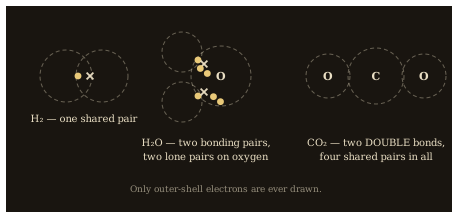
Drawing these is statement 1.46, and there are two accepted styles. The FULL diagram shows every electron shell; the OUTER-SHELL ONLY diagram shows just the outer electrons, which is usually what is wanted and is far quicker. In both, one atom's electrons are dots and the other's are crosses — again only so that a reader can see which atom each came from.
Building three molecules from the bond count
Work out the formula and the bonding in (a) water, (b) methane, (c) nitrogen gas.
- (a) Oxygen has six outer electrons and needs two, so it forms two bonds. Hydrogen needs one and forms one. Two hydrogens are therefore needed: H₂O, with two single bonds.
- Oxygen also keeps two pairs of electrons that are not shared. These are LONE PAIRS, and they must be drawn.
- (b) Carbon has four outer electrons and needs four, so it forms four bonds. Each hydrogen forms one, so four are needed: CH₄, with four single bonds and no lone pairs on carbon.
- (c) Nitrogen has five outer electrons and needs three. Two nitrogen atoms must therefore share THREE pairs between them.
- That is a triple bond: N₂, and each nitrogen also keeps one lone pair.
Answer: (a) H₂O, two single bonds and two lone pairs on oxygen. (b) CH₄, four single bonds. (c) N₂, a triple bond.
Lone pairs are the detail most often dropped, and they cost marks. Any outer electron not used in a bond stays on its atom as part of a pair, and the diagram is incomplete without them. The check to run on every diagram you draw is simple: count each atom's outer electrons, including both electrons of every shared pair, and confirm each atom reaches a full shell — two for hydrogen, eight for everything else on this specification.
One last point, because it prevents a confusion that runs through the next two pages. A covalent BOND is very strong — breaking one requires a great deal of energy. But the forces BETWEEN separate covalent molecules are entirely different and very weak. That distinction is the whole reason water boils at 100 °C while the bonds inside each water molecule survive far hotter, and it is the subject of the next lesson.
2 · Grade 9 Notes
A different job from the section above. You have already understood it; this is the precise set of things to LEARN — definitions to reproduce word for word, processes in order, equations with units, and the answers that score full marks.
Learn this definition · Covalent bond
A shared pair of electrons between two atoms, counting towards the outer shell of both. It is held together by the electrostatic attraction of both positive nuclei to the shared negative pair.
How many bonds each atom forms
- HYDROGEN — needs 1 electron → 1 bond
- GROUP 7 (Cl, Br, I) — need 1 → 1 bond
- OXYGEN and group 6 — need 2 → 2 bonds
- NITROGEN and group 5 — need 3 → 3 bonds
- CARBON and group 4 — need 4 → 4 bonds
- The number of bonds is always the number of electrons short of a full outer shell
Drawing a dot-and-cross diagram for a molecule
- Work out how many electrons each atom has in its outer shell.
- Work out how many bonds each atom must form to fill that shell.
- Draw the atoms overlapping, putting one SHARED PAIR in each overlap — one dot and one cross.
- Add the LONE PAIRS: every outer electron not used in a bond stays on its atom, paired up.
- Check each atom: counting shared electrons for both atoms, hydrogen should reach 2 and everything else 8.
The vocabulary examiners use
- Shared pair
- The two electrons making up one covalent bond, counted by both atoms.
- Lone pair
- A pair of outer electrons on an atom that is not shared. Must be drawn on the diagram.
- Double bond
- Two shared pairs between the same two atoms, as in O₂.
- Triple bond
- Three shared pairs between the same two atoms, as in N₂.
Ionic bonding against covalent bonding
A. IONIC — electrons are TRANSFERRED from a metal to a non-metal, and oppositely charged ions attract.
B. COVALENT — electrons are SHARED between two non-metals, and both nuclei are attracted to the shared pair.
Model answer [3 marks]
Explain what a covalent bond is and what holds the two atoms together. [3]
A covalent bond is a shared pair of electrons between two atoms, with the shared pair counting towards the outer shell of both atoms so that each achieves a full outer shell. The shared pair lies between the two nuclei, which are both positively charged. The bond is held together by the electrostatic attraction between each positive nucleus and the shared negative pair of electrons.
Model answer [3 marks]
Explain why a nitrogen molecule contains a triple bond. [3]
A nitrogen atom has five electrons in its outer shell, so it needs three more to reach a full shell of eight. Neither atom can gain electrons from the other, since both are non-metals needing to gain, so the electrons must be shared. Each nitrogen atom therefore shares three of its electrons with the other, making three shared pairs between them, which is a triple bond. Each atom also retains one lone pair.
Not this: In a covalent bond the atoms just hold on to each other, or the electrons act as a kind of glue.
This: The bond is ELECTROSTATIC, exactly as an ionic bond is. Both nuclei are positive, the shared pair between them is negative, and each nucleus is attracted to that shared pair — which is what holds the two atoms together.
Mark-losing trap. Draw the LONE PAIRS. Any outer electron not in a bond still has to appear on the diagram.
Mark-losing trap. The shared pair counts for BOTH atoms — count it twice when checking the shells are full.
Mark-losing trap. Covalent bonding happens between two NON-METALS. A metal and a non-metal give ionic bonding.
Mark-losing trap. Number of bonds = number of electrons short of a full shell. Carbon 4, nitrogen 3, oxygen 2, hydrogen 1.
3 · Prove it — the five questions
The five questions climb Grade 6 → Grade 7 → Grade 8 → Grade 9 → Grade 9 challenge, and are marked inside Incandio on your own device, by rule, with an authored diagnosis of the mistake you actually made. The mark schemes stay in the app so that the practice is worth doing; the questions themselves are here.
- Grade 6 · Define [1 mark] — What is a covalent bond?
- Grade 7 · Deduce [2 marks] — An oxygen atom has six electrons in its outer shell. How many covalent bonds will it form?
- Grade 8 · Explain [3 marks] — Explain what holds the two atoms together in a covalent bond.
- Grade 9 · Describe [6 marks] — Select every statement that belongs in a full-mark description of the bonding in a molecule of methane, CH₄, and how it would be drawn as a dot-and-cross diagram.
- 9+ · Analyse [6 marks] — A student says: 'Covalent bonds must be weaker than ionic bonds, because water boils at only 100 °C while sodium chloride needs 800 °C to melt.' Select every statement that belongs in a full-mark analysis.
The people behind this science
Two ways into the same idea — the one who gave the shells that make a full outer shell mean anything, and the one who established that a compound holds a fixed number of atoms at all. Inside Incandio each of them answers knowing exactly which lesson you have just finished.
Niels Bohr — the one who gave the shells that make a full outer shell mean anything
Every explanation on this page rests on electrons occupying shells and on a full outer shell being especially stable — and both of those are Bohr's. Before 1913 there was no reason electrons should sit at particular distances rather than spiralling into the nucleus, which classical physics said they must do within a fraction of a second. Bohr's model fixed them into allowed orbits, which made the periodic table's structure follow from electron arrangement rather than being a pattern nobody could account for. He is also worth asking about the model's honesty: he knew it was provisional and said so.
- “Why should electrons sit in shells at all?”
- “What makes a full outer shell so stable?”
- “Why does the number of electrons decide how an atom reacts?”
- “Why do the noble gases do nothing?”
- “How much of your model did you expect to survive?”
John Dalton — the one who established that a compound holds a fixed number of atoms at all
This page assumes that a water molecule contains exactly two hydrogens and one oxygen — a fixed, small, whole number — and that assumption is the law of definite proportions, which Dalton's atomic theory explained, doing quiet work. Before it, a compound could in principle contain any proportion of its elements. He is also instructive about the limits of the idea: he had no way to determine how many atoms were in a molecule, so he assumed the simplest possibility, which made water HO and put his atomic weights out by a factor of two. The bond counting on this page is precisely what he lacked.
- “How do you know a compound has a fixed number of atoms?”
- “Why did you assume water was one hydrogen and one oxygen?”
- “What could you not determine about a molecule?”
- “What made you certain atoms combine in whole numbers?”
- “How would knowing how many bonds an atom forms have helped you?”
Think you understand it?
Reading is the start. On Incandio a topic counts as mastered only once you have taught it and defended it — the two things a revision guide cannot ask of you.
Incandio this topic → Prove it. Teach it. Defend it. What does “Incandio it” mean?
- Prove it — five questions on Covalent Bonding, marked on the spot, that tell you what was missing rather than just what was wrong.
- Teach it — Explain Covalent Bonding in your own words to Ember, an AI pupil who does not have it yet and asks the awkward question. Understanding is credited; wording is not required.
- Defend it — Argue Covalent Bonding against August Kekulé — three rounds, marked against descriptors you can read before you begin.
- Then the exam — read all 12 authored exam-style questions on this unit, each with its command word and its tariff, then have them marked on Incandio with the mistake you actually made named.
Completely free. No subscriptions, no paywalls, no account needed to start.
Carry on through the course
- Previous lesson: Ionic Structures and Their Properties
- Next lesson: Simple Molecular Substances
- The Three States of Matter — What the particles are doing in a solid, a liquid and a gas — and what really changes when ice melts.
- Pure Substances, Mixtures and How to Separate Them — Why a pure substance melts at one temperature, and which separation technique to reach for when.
- Inside the Atom — Protons, neutrons and electrons — where they are, what they weigh, what they carry, and how isotopes give an element a decimal mass.
- Electronic Configurations and the Periodic Table — Why the table has the shape it has: the group number IS the outer-shell electron count, and everything follows from that.
- Solubility and Solubility Curves — Why a solution can be full, why hot water holds more, and how one curve tells you exactly how many crystals you will get back.
- All of Chemistry · Chemistry key terms · required practicals · equations · Incandio Science · The 4CH1 specification