Pearson Edexcel International GCSE in Chemistry · 4CH1 · Free · no account needed
Metallic Bonding
A lattice of positive ions in a sea of electrons that belong to no atom in particular.
Topic 1 · Principles of chemistry — one of 18 lessons in this topic, and one of 61 in Chemistry.
This lesson ends with Paul Drude. Learn Metallic Bonding, teach it, then defend it against Paul Drude.
The 2 definitions this lesson teaches, word for word — every Chemistry definition.
- Metallic bonding
- The strong electrostatic attraction between a lattice of positive metal ions and the delocalised electrons that move freely throughout the structure.
- Delocalised electrons
- Electrons that are not attached to any particular atom and are free to move throughout the whole structure. In a metal they come from the outer shell of every atom.
What this lesson covers in the specification
Incandio is aligned to this specification. It is not published by, endorsed by or affiliated with Pearson, and it reproduces none of Pearson's wording — the statement numbers are given so you can check every lesson against your own copy.
- 1.52 — Representing a metallic lattice by a 2-D diagram (bold C statement — Paper 2 only)
- 1.53 — Metallic bonding in terms of electrostatic attraction (bold C statement — Paper 2 only)
- 1.54 — Explaining typical physical properties of metals, including conductivity and malleability (bold C statement — Paper 2 only)
Specification section 1(f) Ionic bonding — also taught in Simple Molecular Substances, Giant Covalent Structures.
1 · Understand it
No exam language yet. The only question this section answers is: do I actually understand what is happening?
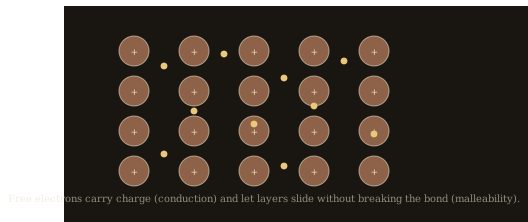
A metal atom has few outer electrons and holds them loosely. Pack a great many metal atoms together and each one releases its outer electrons, which no longer belong to any particular atom but move freely throughout the whole structure. What is left behind is a regular lattice of POSITIVE METAL IONS, sitting in what is usually called a SEA OF DELOCALISED ELECTRONS.
METALLIC BONDING is the strong ELECTROSTATIC ATTRACTION between those positive ions and the delocalised electrons. It is the third time this topic has arrived at electrostatic attraction, and that is worth noticing: ionic, covalent and metallic bonding are all the same force between positive and negative, arranged three different ways.
Think of it like ball bearings in oil rather than bricks in mortar
Bricks set in mortar are rigidly located: shove the wall sideways and it cracks along a line, because each brick is fixed to its particular neighbours. Now picture ball bearings packed in thick oil. Push them sideways and they slide past one another and stay together, because the oil is around all of them and does not care which bearing sits next to which. The delocalised electrons are the oil. Nothing in the structure specifies that THIS ion must sit beside THAT one, so the layers can shift without the attraction being lost — which is malleability, and it is precisely what an ionic crystal cannot do.
Every property of a metal from the same picture — statement 1.54
- CONDUCTS ELECTRICITY, in the solid as well as molten, because the delocalised electrons are charged and free to move through the structure.
- CONDUCTS HEAT WELL, because the moving electrons carry energy rapidly from the hot end to the cold end.
- MALLEABLE and DUCTILE — can be hammered into shape and drawn into wire — because the layers of ions can slide over one another while the delocalised electrons continue to hold them together.
- HIGH MELTING POINT, because the electrostatic attraction between the positive ions and the delocalised electrons is strong and a great deal of energy is needed to overcome it.
- DENSE, because the ions are packed closely in a regular arrangement, and SHINY, because the delocalised electrons reflect light.
The malleability explanation is the one that most often loses marks, because it is easy to say 'the layers slide' and stop. That is only half of it. Layers sliding in an ionic crystal brings like charges together and the crystal shatters — so sliding alone does not give malleability. What makes a metal malleable is that the electrons are delocalised, so after the layers have slid the attraction is exactly as it was and the metal holds together in its new shape.
Melting points vary a great deal across the metals and the reason follows the same logic used for ionic compounds. Mercury is liquid at room temperature; tungsten melts at 3400 °C. A metal whose atoms release MORE electrons each, and whose ions are SMALLER and more highly charged, has a stronger attraction and melts higher. Group 1 metals release only one electron each and are famously soft with low melting points; the transition metals release more and are hard and high-melting.
One further consequence explains ALLOYS, which are worth knowing now because they recur in Topic 2. A pure metal has layers of identical ions that slide easily, which is why pure gold and pure iron are quite soft. Adding atoms of a different size disrupts the regular layers, so they no longer slide past one another so readily — and the alloy is harder than the pure metal. Steel is iron with a little carbon, and it is very much harder than pure iron for exactly this reason.
Explaining two properties from one structure
Copper is used for electrical wiring. Explain, in terms of its structure, why it conducts electricity and why it can be drawn into a wire in the first place.
- Copper consists of a lattice of positive copper ions surrounded by delocalised electrons.
- CONDUCTION: the delocalised electrons are charged particles and are free to move through the structure, so they can carry a current.
- DRAWING INTO WIRE: this requires the metal to be ductile, which means the layers of ions must be able to move past one another.
- The layers can slide because the delocalised electrons are not attached to particular ions.
- After sliding, the attraction between the ions and the electrons is unchanged, so the metal does not break — it simply takes a new shape.
Answer: Both come from the delocalised electrons: they carry the current, and they hold the sliding layers together.
2 · Grade 9 Notes
A different job from the section above. You have already understood it; this is the precise set of things to LEARN — definitions to reproduce word for word, processes in order, equations with units, and the answers that score full marks.
Learn this definition · Metallic bonding
The strong electrostatic attraction between a lattice of positive metal ions and the delocalised electrons that move freely throughout the structure.
Learn this definition · Delocalised electrons
Electrons that are not attached to any particular atom and are free to move throughout the whole structure. In a metal they come from the outer shell of every atom.
Statement 1.52 — drawing the 2-D metallic lattice
- Draw a regular arrangement of circles in rows, representing the metal ions.
- Label each circle with a POSITIVE charge — they are ions, not atoms.
- Draw small negative electrons scattered in the spaces BETWEEN the ions, not attached to any one of them.
- Label them as delocalised electrons.
- State that the bonding is the electrostatic attraction between the positive ions and these electrons.
Statement 1.54 — the properties, each with its reason
- CONDUCTS ELECTRICITY (solid and molten) — delocalised electrons are charged and free to move
- CONDUCTS HEAT — the moving electrons carry energy quickly through the structure
- MALLEABLE and DUCTILE — layers of ions slide, AND the delocalised electrons still hold them together afterwards
- HIGH MELTING POINT — strong electrostatic attraction between ions and electrons takes much energy to overcome
- More electrons released per atom, and smaller ions, means a STRONGER attraction and a HIGHER melting point
Why a metal bends and an ionic crystal shatters
| Metal | Ionic crystal | |
|---|---|---|
| What happens when layers slide | Ions move past one another | Like charges come to face each other |
| Result | Still attracted by the delocalised electrons, so it holds together | They repel, and the crystal splits |
| Property | Malleable and ductile | Brittle |
| Why | The electrons belong to no particular ion | Each ion is held by specific oppositely charged neighbours |
Model answer [4 marks]
Explain why metals are good conductors of electricity and are malleable. [4]
A metal consists of a lattice of positive metal ions surrounded by delocalised electrons. These electrons are charged particles that are free to move throughout the structure, so they can carry an electric current and the metal conducts electricity. The metal is malleable because the layers of positive ions can slide over one another when a force is applied. As the delocalised electrons are not attached to any particular ion, the electrostatic attraction between the ions and the electrons is unchanged after the layers have moved, so the metal takes up a new shape without breaking.
Model answer [3 marks]
Explain why an alloy such as steel is harder than the pure metal it is made from. [3]
In a pure metal the ions are all the same size and are arranged in regular layers, which can slide over one another easily, making the metal relatively soft. In an alloy, atoms of a different element and a different size are present, and these disrupt the regular arrangement of the layers. The layers can therefore no longer slide past one another so easily, so the alloy is harder than the pure metal.
Not this: A metal is malleable simply because its layers of ions can slide over one another.
This: Sliding is only half the explanation — layers slide in an ionic crystal too, and it SHATTERS. What makes a metal malleable is that the electrons are delocalised, so the attraction is unchanged after the layers have moved and the metal holds together.
Mark-losing trap. The particles in the lattice are POSITIVE IONS, not atoms — the outer electrons have left them.
Mark-losing trap. Metals conduct in the SOLID state, unlike ionic compounds, because the electrons move rather than the ions.
Mark-losing trap. For malleability say BOTH: the layers slide AND the delocalised electrons still hold them together.
3 · Prove it — the five questions
The five questions climb Grade 6 → Grade 7 → Grade 8 → Grade 9 → Grade 9 challenge, and are marked inside Incandio on your own device, by rule, with an authored diagnosis of the mistake you actually made. The mark schemes stay in the app so that the practice is worth doing; the questions themselves are here.
- Grade 6 · State [1 mark] — What particles are present in the lattice of a metal?
- Grade 7 · Explain [3 marks] — Explain why metals conduct electricity even when solid, whereas ionic compounds do not.
- Grade 8 · Explain [3 marks] — Sodium is soft and melts at 98 °C. Tungsten is very hard and melts at 3400 °C. Both are metals. Suggest why they differ so much.
- Grade 9 · Explain [6 marks] — Select every statement that belongs in a full-mark explanation of why copper is malleable and conducts electricity, while an ionic solid is brittle and does not.
- 9+ · Analyse [6 marks] — A student says: 'Graphite conducts because of delocalised electrons and metals conduct because of delocalised electrons, so graphite is really a metal.' Select every statement that belongs in a full-mark analysis.
The people behind this science
Two ways into the same idea — the one who saw metals nobody had ever seen, and the one who worked out that a current is charge in motion. Inside Incandio each of them answers knowing exactly which lesson you have just finished.
Humphry Davy — the one who saw metals nobody had ever seen
Potassium and sodium had never been seen by anyone before Davy produced them in 1807, and his description is the best evidence there is that these properties come from structure rather than from anything mystical about metals. They were bright and shiny like other metals and conducted like other metals, and yet they were soft enough to cut with a knife and light enough to float on water — because group 1 atoms release only one electron each, giving a weak attraction. He is the right person to ask what it is like to be the first person to look at an element, and how you know it is a metal at all.
- “What did potassium look like when it first appeared?”
- “How did you know the new substance was a metal?”
- “Why was it soft enough to cut with a knife?”
- “Why did it float, when metals are supposed to be dense?”
- “What did you expect to find inside the potash?”
Michael Faraday — the one who worked out that a current is charge in motion
This page explains conduction by charged particles moving through the metal, and Faraday is the person who established that a current IS moving charge rather than a fluid or a disturbance. His electrolysis work showed that the amount of substance released at an electrode is proportional to the quantity of charge passed, which only makes sense if a definite amount of charge is carried by a definite amount of matter. He is also the right figure for the contrast at the heart of this topic: in a metal the moving charges are electrons, and in a molten salt they are ions.
- “What is actually moving when a current flows through a wire?”
- “How did you show that charge comes in definite amounts?”
- “What is the difference between a metal conducting and a solution conducting?”
- “Why does a metal conduct when it is still solid?”
- “How did you measure how much charge had passed?”
Think you understand it?
Reading is the start. On Incandio a topic counts as mastered only once you have taught it and defended it — the two things a revision guide cannot ask of you.
Incandio this topic → Prove it. Teach it. Defend it. What does “Incandio it” mean?
- Prove it — five questions on Metallic Bonding, marked on the spot, that tell you what was missing rather than just what was wrong.
- Teach it — Explain Metallic Bonding in your own words to Ember, an AI pupil who does not have it yet and asks the awkward question. Understanding is credited; wording is not required.
- Defend it — Argue Metallic Bonding against Paul Drude — three rounds, marked against descriptors you can read before you begin.
- Then the exam — read all 12 authored exam-style questions on this unit, each with its command word and its tariff, then have them marked on Incandio with the mistake you actually made named.
Completely free. No subscriptions, no paywalls, no account needed to start.
Carry on through the course
- Previous lesson: Giant Covalent Structures
- Next lesson: Why Substances Conduct — the Four Structures Compared
- The Three States of Matter — What the particles are doing in a solid, a liquid and a gas — and what really changes when ice melts.
- Pure Substances, Mixtures and How to Separate Them — Why a pure substance melts at one temperature, and which separation technique to reach for when.
- Inside the Atom — Protons, neutrons and electrons — where they are, what they weigh, what they carry, and how isotopes give an element a decimal mass.
- Electronic Configurations and the Periodic Table — Why the table has the shape it has: the group number IS the outer-shell electron count, and everything follows from that.
- Solubility and Solubility Curves — Why a solution can be full, why hot water holds more, and how one curve tells you exactly how many crystals you will get back.
- All of Chemistry · Chemistry key terms · required practicals · equations · Incandio Science · The 4CH1 specification