Pearson Edexcel International GCSE in Physics · 4PH1 · Free · no account needed
What a Wave Is
Something crosses the room and nothing gets to the other side — the idea that makes the rest of the topic possible.
Topic 3 · Waves — one of 10 lessons in this topic, and one of 65 in Physics.
This lesson ends with Christiaan Huygens. Learn what a Wave Is, teach it, then defend it against Christiaan Huygens.
The definition this lesson teaches, word for word — every Physics definition.
- Wave
- A disturbance that transfers energy and information from one place to another without transferring matter. The particles of the medium vibrate about fixed positions and do not travel with the wave.
What this lesson covers in the specification
Incandio is aligned to this specification. It is not published by, endorsed by or affiliated with Pearson, and it reproduces none of Pearson's wording — the statement numbers are given so you can check every lesson against your own copy.
- 3.1 — Use the units degree, hertz, metre, metre/second and second
- 3.2 — The difference between longitudinal and transverse waves
- 3.3 — Definitions of amplitude, wavefront, frequency, wavelength and period
- 3.4 — Waves transfer energy and information without transferring matter
Specification section 3(b) Properties of waves — also taught in The Wave Equation, The Doppler Effect, The Electromagnetic Spectrum, Uses and Dangers of Electromagnetic Radiation.
1 · Understand it
No exam language yet. The only question this section answers is: do I actually understand what is happening?
Drop a stone in a pond and something spreads outwards. Put a leaf on the surface and watch what it does: it bobs up and down and stays where it was. The wave crossed the pond; the water did not. That is the single most important fact in this topic — a WAVE TRANSFERS ENERGY AND INFORMATION WITHOUT TRANSFERRING MATTER — and everything else on the page is a consequence of it.
It sounds like a technicality and it is not. When you shout across a room, no air travels from your mouth to the listener's ear; the air molecules jostle their neighbours and return to where they started. When light reaches you from the Sun, nothing material arrives from the Sun. And when an earthquake destroys a building two hundred miles from its epicentre, no rock made that journey. What arrived, in each case, was energy — and often a pattern carrying information.
Think of it like a rumour crossing a crowded room
A rumour can travel the length of a crowded party in seconds while nobody moves more than a step. Each person turns to the next, passes it on, and turns back to where they were. Afterwards everyone is standing roughly where they began, and yet something has definitely crossed the room and arrived at the far side. That is exactly what a wave does: the medium passes the disturbance along and returns to its original position, while the energy and the message keep going. It also shows why waves need something to pass through — except light and the other electromagnetic waves, which manage it with no crowd at all, and that is genuinely strange.

The two kinds of wave, and how to tell them apart
- In a TRANSVERSE wave the particles vibrate at RIGHT ANGLES to the direction the wave travels. Picture a rope flicked up and down: the wave goes along the rope, the rope goes up and down.
- Transverse waves include water waves, all electromagnetic waves — light, radio, X-rays — and secondary seismic waves.
- In a LONGITUDINAL wave the particles vibrate ALONG the direction the wave travels — parallel to it. Picture a spring pushed and pulled at one end: a compression runs along the spring in the same direction the coils move.
- Longitudinal waves include sound and primary seismic waves. Sound is the one you will be asked about.
- The test is always the same question: what is the angle between the particle's vibration and the wave's travel? Ninety degrees means transverse; zero means longitudinal.
A longitudinal wave has its own vocabulary because it has no crests or troughs. Where the particles are bunched together it is a COMPRESSION; where they are spread apart it is a RAREFACTION. A sound wave is a moving pattern of compressions and rarefactions, which is to say a moving pattern of slightly higher and slightly lower pressure — and that is what your eardrum responds to.
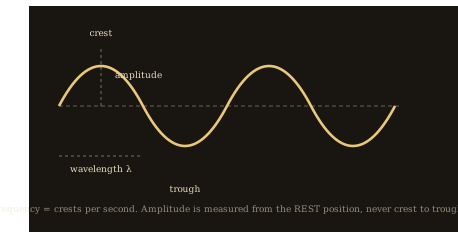
The measurements have exact meanings and the marks come from being exact. AMPLITUDE is the maximum displacement from the undisturbed position — the middle line to a crest, not the full height of the wave. WAVELENGTH, symbol λ, is the distance between two adjacent points in step with each other, so crest to crest or trough to trough, measured in metres. FREQUENCY is the number of complete waves passing a point each second, measured in HERTZ; one hertz is one wave per second. The PERIOD is the time for one complete wave to pass, in seconds — so period and frequency are simply reciprocals of each other. A WAVEFRONT is a line joining all the points on a wave that are in step, such as the line along the top of one crest, and it is always at right angles to the direction the wave is travelling.
The units of the topic are worth collecting, because statement 3.1 asks for them: the metre for wavelength and amplitude, the second for period, the hertz for frequency, the metre per second for wave speed, and the degree for the angles that appear later when waves are reflected and refracted.
2 · Grade 9 Notes
A different job from the section above. You have already understood it; this is the precise set of things to LEARN — definitions to reproduce word for word, processes in order, equations with units, and the answers that score full marks.
Statement 3.3 — the five definitions (learn the key ideas; the exact wording can vary)
- Amplitude
- The maximum displacement of a point on the wave from its undisturbed position. Measured in metres.
- Wavelength (λ)
- The distance between two adjacent points on the wave that are in phase, such as crest to crest. Measured in metres.
- Frequency (f)
- The number of complete waves passing a point each second. Measured in hertz (Hz); one hertz is one wave per second.
- Period (T)
- The time taken for one complete wave to pass a point. Measured in seconds.
- Wavefront
- A line joining all points on a wave that are in phase, such as the line along one crest. It is at right angles to the direction of travel.
Learn this definition · Wave
A disturbance that transfers energy and information from one place to another without transferring matter. The particles of the medium vibrate about fixed positions and do not travel with the wave.
Statement 3.2 — transverse against longitudinal
| Transverse | Longitudinal | |
|---|---|---|
| Direction of vibration | at RIGHT ANGLES to the direction of travel | ALONG the direction of travel — parallel to it |
| What it looks like | crests and troughs | compressions and rarefactions |
| Examples | water waves, all electromagnetic waves, secondary seismic waves | sound waves, primary seismic waves |
| Needs a medium? | water waves do; electromagnetic waves do not | yes — sound cannot travel through a vacuum |
Statement 3.1 — the units of this topic
- Metre (m)
- Wavelength and amplitude.
- Second (s)
- Period.
- Hertz (Hz)
- Frequency: one hertz is one complete wave per second.
- Metre per second (m/s)
- Wave speed.
- Degree (°)
- The angles of incidence, reflection and refraction, met later in this topic.
Statement 3.4 — the evidence that matter is not transferred
- A floating object BOBS UP AND DOWN as a water wave passes and stays where it was — it is not carried along
- SOUND crossing a room moves no air from the speaker to the listener; the molecules vibrate and return
- The particles of the medium vibrate about FIXED POSITIONS
- What IS transferred is ENERGY, and often a pattern carrying INFORMATION
- ELECTROMAGNETIC waves need no medium at all, which is how light reaches us from the Sun
Amplitude — where it is measured from
A. CORRECT: from the undisturbed middle position to a crest (or to a trough). That is the maximum displacement.
B. WRONG: from a trough up to a crest. That distance is TWICE the amplitude, and it is the commonest error in the topic.
Model answer [3 marks]
Explain what is meant by saying that a wave transfers energy without transferring matter, using a water wave as an example. [3]
As a water wave passes, each particle of water vibrates up and down about a fixed position and then returns to where it started, so the water itself does not travel along with the wave. This can be seen by watching a floating object, which bobs up and down as the wave passes but stays in the same place. What moves from one place to another is the energy of the wave, which is why a distant wave can move a boat or erode a shore.
Model answer [4 marks]
State two differences between a longitudinal wave and a transverse wave, and give one example of each. [4]
In a longitudinal wave the particles vibrate along the direction in which the wave travels, whereas in a transverse wave they vibrate at right angles to it. A longitudinal wave consists of compressions and rarefactions, whereas a transverse wave has crests and troughs. Sound is an example of a longitudinal wave, and light is an example of a transverse wave.
Not this: A wave carries the medium along with it, which is why waves can knock you over at the beach.
This: The particles vibrate about fixed positions and return to where they started, which is why a floating object bobs rather than being carried away. What reaches you is the energy — and enough energy will certainly knock you over.
Mark-losing trap. Amplitude is measured from the MIDDLE to a crest, never from trough to crest.
Mark-losing trap. Transverse: vibration at RIGHT ANGLES to travel. Longitudinal: vibration ALONG it. Name both directions.
Mark-losing trap. One hertz is one complete wave PER SECOND — say 'per second' or the definition is incomplete.
Mark-losing trap. Sound is LONGITUDINAL and cannot travel through a vacuum. Light is transverse and can.
3 · Prove it — the five questions
The five questions climb Grade 6 → Grade 7 → Grade 8 → Grade 9 → Grade 9 challenge, and are marked inside Incandio on your own device, by rule, with an authored diagnosis of the mistake you actually made. The mark schemes stay in the app so that the practice is worth doing; the questions themselves are here.
- Grade 6 · State [1 mark] — What does a wave transfer from one place to another?
- Grade 7 · State [2 marks] — In which type of wave do the particles vibrate along the same direction that the wave travels?
- Grade 8 · State [2 marks] — A wave on a rope has crests 0.8 m above the undisturbed position and troughs 0.8 m below it. State the amplitude of the wave.
- Grade 9 · Explain [5 marks] — A duck floating on a lake bobs up and down as waves pass, but does not move towards the shore. Select every statement that belongs in a full-mark explanation.
- 9+ · Analyse [6 marks] — A student says: 'Sound must carry air from the speaker to my ear, otherwise how would the sound get here?' Select every statement that belongs in a full-mark analysis.
The people behind this science
Two ways into the same idea — the one who found that vibration and pitch are the same subject, and the one who found a wave that needs nothing to travel through. Inside Incandio each of them answers knowing exactly which lesson you have just finished.
Galileo Galilei — the one who found that vibration and pitch are the same subject
Galileo noticed that running a chisel across a brass plate sometimes produced a shriek and left a row of fine ridges on the metal — and that the closer together the ridges, the higher the note. He had connected a frequency of vibration with a pitch, using nothing but a plate and a careful eye, and he went on to relate the pitch of a string to its length and tension. It is the first clear statement that sound is vibration and that its properties are countable.
- “What did the marks on the brass plate tell you about the sound?”
- “How can a note be counted rather than just heard?”
- “What decides whether a plucked string sounds high or low?”
- “Does sound need something to travel through?”
- “How would you measure how fast a sound travels?”
James Clerk Maxwell — the one who found a wave that needs nothing to travel through
Every wave on this page except one needs a medium: sound needs air, water waves need water, and the whole idea of a wave seems to require something to do the waving. Maxwell's equations predicted a wave made of nothing but changing electric and magnetic fields, which needs no medium at all and travels at a speed his own equations fixed — a speed that turned out to be the speed of light. That is why the comparison table on this page has an awkward row in it, and he is the reason for the awkwardness.
- “How can there be a wave with nothing doing the waving?”
- “What is actually oscillating in a light wave?”
- “How did your equations predict the speed of light before anyone measured it?”
- “Why did you conclude that light must be an electromagnetic wave?”
- “Did you believe there had to be an aether for light to travel through?”
Think you understand it?
Reading is the start. On Incandio a topic counts as mastered only once you have taught it and defended it — the two things a revision guide cannot ask of you.
Incandio this topic → Prove it. Teach it. Defend it. What does “Incandio it” mean?
- Prove it — five questions on what a Wave Is, marked on the spot, that tell you what was missing rather than just what was wrong.
- Teach it — Explain what a Wave Is in your own words to Ember, an AI pupil who does not have it yet and asks the awkward question. Understanding is credited; wording is not required.
- Defend it — Argue what a Wave Is against Christiaan Huygens — three rounds, marked against descriptors you can read before you begin.
- Then the exam — read all 12 authored exam-style questions on this unit, each with its command word and its tariff, then have them marked on Incandio with the mistake you actually made named.
Completely free. No subscriptions, no paywalls, no account needed to start.
Carry on through the course
- Previous lesson: Uses and Dangers of Static Electricity
- Next lesson: The Wave Equation
- The Wave Equation — Two equations that connect everything on the previous page — and one of them you could have worked out yourself.
- The Doppler Effect — Why an ambulance changes note as it passes — and why the siren itself never does.
- The Electromagnetic Spectrum — Seven names for one thing — and the two properties that change as you go along it.
- Uses and Dangers of Electromagnetic Radiation — Seven bands, seven jobs — and why the danger rises steadily as you move along the spectrum.
- Reflection and Ray Diagrams — One rule, drawn correctly — and why the image in a mirror is behind it.
- All of Physics · Physics key terms · required practicals · equations · Incandio Science · The 4PH1 specification