Pearson Edexcel International GCSE in Physics · 4PH1 · Free · no account needed
Refraction and Refractive Index
Why light bends entering glass, why it sometimes does not, and how to put a number on it.
Topic 3 · Waves — one of 10 lessons in this topic, and one of 65 in Physics.
This lesson ends with Ibn al-Haytham. Learn Refraction and Refractive Index, teach it, then defend it against Ibn al-Haytham.
The definition this lesson teaches, word for word — every Physics definition.
- Refraction
- The change in direction of a wave as it crosses a boundary between two media, caused by the change in its speed. A wave meeting the boundary along the normal changes speed but does not change direction.
One of the 17 Physics required practicals · Its equation is on the Physics equations page with the other 37.
What this lesson covers in the specification
Incandio is aligned to this specification. It is not published by, endorsed by or affiliated with Pearson, and it reproduces none of Pearson's wording — the statement numbers are given so you can check every lesson against your own copy.
- 3.17 — Practical: investigate the refraction of light using rectangular, semi-circular and triangular blocks (required practical)
- 3.18 — Use n = sin i ÷ sin r
- 3.19 — Practical: investigate the refractive index of glass using a glass block (required practical)
Specification section 3(c) The electromagnetic spectrum — also taught in Reflection and Ray Diagrams, Total Internal Reflection.
1 · Understand it
No exam language yet. The only question this section answers is: do I actually understand what is happening?
Light travels at 3.0 × 10⁸ m/s in a vacuum and more slowly in any material — about a quarter slower in water, and about a third slower in glass. REFRACTION is what happens at the boundary because of that change of speed, and getting the causation the right way round is the whole of this page. Light does not bend and thereby slow down. It slows down, and bending is the consequence.
Think of it like a car driving off tarmac onto sand at an angle
A car crosses from a smooth road onto soft sand. If it meets the edge square on, both front wheels reach the sand together, both slow together, and the car carries straight on — slower, but in the same direction. Now let it meet the edge at an angle. One front wheel reaches the sand first and slows while the other is still on tarmac and still going fast, so the car SLEWS ROUND towards the slow side. Nothing steered it. The turn happened because one side was held up before the other. A wavefront entering glass at an angle does exactly this: the edge that arrives first is slowed first, and the wavefront pivots. It also explains the case people find puzzling — meet the boundary square on and there is no turn at all, because there is no side that gets there first.
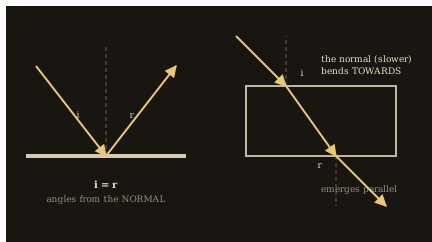
Which way does it bend, and when does it not?
- Entering a DENSER medium — air into glass or water — the light SLOWS DOWN and the ray bends TOWARDS the normal. The angle of refraction is smaller than the angle of incidence.
- Leaving a denser medium — glass or water into air — the light SPEEDS UP and the ray bends AWAY from the normal. The angle of refraction is larger.
- A ray travelling ALONG THE NORMAL, striking the surface at 90°, does NOT bend at all. It still changes speed, but every part of the wavefront reaches the boundary at the same instant, so there is nothing to pivot about.
- Through a RECTANGULAR block, a ray bends one way going in and the opposite way coming out, so it emerges PARALLEL to its original direction — displaced sideways, but not turned.
- The FREQUENCY never changes at a boundary. The speed changes and the wavelength changes with it, because v = f × λ and f is fixed by the source.
The REFRACTIVE INDEX, n, is the number that measures how much a material slows light and therefore how strongly it refracts. It is found from the two angles: n = sin i ÷ sin r, where i is the angle in the air and r the angle in the material, both measured from the normal. Glass is about 1.5 and water about 1.33, and n is always greater than 1 for light entering a material from air — which is a useful check, because an answer below 1 means the angles have been used the wrong way round.
Using n = sin i ÷ sin r in both directions
(a) A ray enters glass from air with an angle of incidence of 50°, and the angle of refraction is 30°. Find the refractive index. (b) The same glass is used with an angle of incidence of 40°. Find the angle of refraction.
- (a) n = sin i ÷ sin r = sin 50° ÷ sin 30° = 0.766 ÷ 0.500 = 1.53.
- (b) Rearrange: sin r = sin i ÷ n = sin 40° ÷ 1.53 = 0.643 ÷ 1.53 = 0.420.
- r = sin⁻¹(0.420) = 24.8°, so about 25°.
- Check: the ray is entering the denser medium, so r should be smaller than i — and 25° is less than 40°.
Answer: n = 1.53, and an angle of refraction of about 25°.
That last check is worth making every time. Entering a denser medium the refracted angle must be the SMALLER one, and if your answer has it the larger way round you have divided the wrong way. It takes two seconds and it catches the most common error in the topic.
One more consequence, because it explains something you have seen. Different colours travel at slightly different speeds in glass, so they have slightly different refractive indices and are refracted through slightly different angles. Violet is slowed most and bends most; red is slowed least and bends least. Send white light through a triangular prism, where the two refractions add rather than cancel, and the colours separate into a spectrum. That is DISPERSION, and it is why the specification asks for a triangular block as well as a rectangular one.
2 · Grade 9 Notes
A different job from the section above. You have already understood it; this is the precise set of things to LEARN — definitions to reproduce word for word, processes in order, equations with units, and the answers that score full marks.
n = sin i ÷ sin r
n is the refractive index (no units), i is the angle of incidence in the air, r is the angle of refraction in the material — both measured from the NORMAL
Units: None; n is a ratio. Rearranged: sin r = sin i ÷ n and sin i = n × sin r. For light entering a material from air, n is always greater than 1.
Learn this definition · Refraction
The change in direction of a wave as it crosses a boundary between two media, caused by the change in its speed. A wave meeting the boundary along the normal changes speed but does not change direction.
The rules that decide which way a ray bends
- Into a DENSER medium: light SLOWS, and the ray bends TOWARDS the normal, so r is SMALLER than i
- Into a LESS DENSE medium: light SPEEDS UP, and the ray bends AWAY from the normal, so r is LARGER than i
- Along the NORMAL: the speed changes but there is NO bending, because no part of the wavefront arrives first
- Through a RECTANGULAR block the emerging ray is PARALLEL to the original, displaced sideways
- The FREQUENCY is unchanged at a boundary; the speed and the wavelength both change
Required practical 3.17 — refraction through rectangular, semi-circular and triangular blocks
- Place the block on a sheet of paper and draw round its outline in pencil.
- Use a ray box with a single slit to send a narrow ray into one face of the block.
- Mark the path of the incoming ray with two pencil crosses well apart, and the emerging ray with two more.
- Remove the block and join the crosses with a ruler to reconstruct the ray paths, including the path inside the block.
- Draw the normal at each point where a ray meets a surface, and measure the angles with a protractor.
- Repeat with the semi-circular and triangular blocks, and describe how the emerging ray differs in each case.
Variables
Independent (changed) — The shape of the block, and the angle of incidence
Dependent (measured) — The angle of refraction, and the direction of the emerging ray
| Control variable | Why it must be held constant |
|---|---|
| The same glass block material | a different material has a different refractive index |
| Width of the ray | a broad ray cannot be marked accurately |
| Position of the block outline | moving the block after drawing loses the geometry |
Sources of error
| Type | What goes wrong | What to do |
|---|---|---|
| Judgement | The ray has a visible width, so the exact centre of the line is a matter of opinion. | Mark the centre of the ray consistently each time. |
| Systematic | The block is nudged after its outline is drawn, so every measured angle is shifted. | Draw round the block and do not move it. |
| Random | Reading the protractor to the nearest degree scatters repeated measurements. | Repeat each angle and take a mean. |
Required practical 3.19 — measuring the refractive index of glass
- Draw round a rectangular glass block on paper and mark the point where the ray will enter one long face.
- Draw the normal at that point, at right angles to the face.
- Direct a single ray at the marked point at an angle of incidence of about 20°, and mark the incoming and emerging rays with pencil crosses.
- Remove the block, join the crosses, and draw the path of the ray inside the glass between entry and exit.
- Measure the angle of incidence and the angle of refraction from the normal with a protractor.
- Repeat for angles of incidence of about 30°, 40°, 50°, 60° and 70°.
- Calculate n = sin i ÷ sin r for each pair and take a mean, or plot sin i against sin r and take the gradient.
Variables
Independent (changed) — The angle of incidence, in degrees
Dependent (measured) — The angle of refraction, in degrees
| Control variable | Why it must be held constant |
|---|---|
| The same glass block | the refractive index is a property of the material |
| The same face of the block | a chipped or uneven face changes the geometry |
| Temperature | refractive index varies slightly with temperature |
Sources of error
| Type | What goes wrong | What to do |
|---|---|---|
| Systematic | The normal is drawn slightly off the perpendicular, so every angle pair is biased the same way. | Construct the normal with a set square. |
| Judgement | At very small angles of incidence the refracted angle is hard to distinguish from the incident one. | Use angles of incidence above about 20°. |
| Random | Marking the emerging ray with crosses too close together makes its direction uncertain. | Place the two crosses as far apart as possible. |
Statement 3.18 — using the equation without going wrong
- Identify which angle is in the AIR — that is i — and which is in the MATERIAL — that is r.
- Check both are measured from the NORMAL, converting if the question gives an angle from the surface.
- For n: divide sin i by sin r.
- For a missing angle: rearrange first, find the SINE of the unknown angle, then use the inverse sine.
- Check the answer: entering a denser medium, r must be smaller than i, and n must be greater than 1.
What changes at a boundary and what does not
A. CHANGES: the speed of the wave, its wavelength, and — unless it meets the boundary along the normal — its direction.
B. DOES NOT CHANGE: the frequency, which is fixed by the source. This is why v = f × λ forces the wavelength to change when the speed does.
Model answer [3 marks]
A ray of light passes from air into glass. The angle of incidence is 45° and the angle of refraction is 28°. Calculate the refractive index of the glass. [3]
Using n = sin i ÷ sin r, with i = 45° in the air and r = 28° in the glass: n = sin 45° ÷ sin 28° = 0.707 ÷ 0.469 = 1.51.
Model answer [3 marks]
Explain why a ray of light travelling along the normal into a glass block does not change direction. [3]
Refraction is caused by the change in the speed of the light as it crosses the boundary, and the direction changes only because one part of the wavefront enters the new medium before another and is slowed first. A ray travelling along the normal meets the surface at right angles, so every part of the wavefront reaches the boundary at the same instant and is slowed at the same instant. There is therefore nothing to make the wavefront pivot, and the ray carries on in the same direction, although it does travel more slowly inside the glass.
Not this: Light bends when it enters glass, and that is why it travels more slowly.
This: The causation runs the other way. The light slows down because it is in a different medium, and the bending is a CONSEQUENCE of one side of the wavefront slowing before the other. That is why a ray along the normal slows without bending at all.
Mark-losing trap. i is the angle in the AIR and r the angle in the MATERIAL. Swapping them gives n below 1.
Mark-losing trap. Into a denser medium the ray bends TOWARDS the normal, so r is smaller. Check this every time.
Mark-losing trap. A ray along the normal does NOT bend — it changes speed only. This is the standard discriminating question.
Mark-losing trap. Frequency is unchanged at a boundary. It is the speed and the wavelength that change.
3 · Prove it — the five questions
The five questions climb Grade 6 → Grade 7 → Grade 8 → Grade 9 → Grade 9 challenge, and are marked inside Incandio on your own device, by rule, with an authored diagnosis of the mistake you actually made. The mark schemes stay in the app so that the practice is worth doing; the questions themselves are here.
- Grade 6 · State [1 mark] — A ray of light passes from air into a glass block, striking the surface at an angle. Which way does it bend?
- Grade 7 · Explain [2 marks] — Explain why a ray of light travelling along the normal into a glass block does not change direction.
- Grade 8 · Calculate [3 marks] — A ray passes from air into a transparent block. The angle of incidence is 60° and the angle of refraction is 35°. Calculate the refractive index of the block.
- Grade 9 · Describe [6 marks] — Select every statement that belongs in a full-mark description of how to measure the refractive index of a rectangular glass block.
- 9+ · Calculate [5 marks] — Light travels from air into a block of refractive index 1.60 with an angle of incidence of 42°. Calculate the angle of refraction.
The people behind this science
Two ways into the same idea — the one who measured the bending and knew the accepted law was wrong, and the one who found that refraction sorts light by colour. Inside Incandio each of them answers knowing exactly which lesson you have just finished.
Ibn al-Haytham — the one who measured the bending and knew the accepted law was wrong
Ptolemy had published tables claiming that the angle of refraction was simply proportional to the angle of incidence, and it had stood for eight centuries. Ibn al-Haytham measured the bending of light entering water and glass carefully enough to establish that it is not — the ratio drifts as the angle grows. He could not supply the correct relationship, and said so; the sine law came six hundred years later. He is the right figure for a page about a law, because he shows what it looks like to be certain that the received rule is wrong while being unable to replace it.
- “What was wrong with Ptolemy's table of refractions?”
- “How did you measure the bending of a ray entering water?”
- “What does it feel like to know a rule is wrong without having a better one?”
- “Why does a rod in water look broken at the surface?”
- “Does light travel differently in water than in air?”
Isaac Newton — the one who found that refraction sorts light by colour
Newton's prism work is refraction's most famous consequence and it belongs on this page rather than on a page about colour. Different colours are slowed by slightly different amounts in glass, so each has its own refractive index and is refracted through its own angle; in a triangular prism the two refractions add instead of cancelling, and the colours fan out. His crucial experiment was the second prism, which recombined the spectrum into white light and proved that the glass was separating something already present rather than adding anything.
- “Why does a prism spread white light into a band of colours?”
- “What did the second prism prove that the first could not?”
- “Why does a rectangular block not produce a spectrum?”
- “Which colour is bent most, and why?”
- “How did you decide the glass was not adding the colours itself?”
Think you understand it?
Reading is the start. On Incandio a topic counts as mastered only once you have taught it and defended it — the two things a revision guide cannot ask of you.
Incandio this topic → Prove it. Teach it. Defend it. What does “Incandio it” mean?
- Prove it — five questions on Refraction and Refractive Index, marked on the spot, that tell you what was missing rather than just what was wrong.
- Teach it — Explain Refraction and Refractive Index in your own words to Ember, an AI pupil who does not have it yet and asks the awkward question. Understanding is credited; wording is not required.
- Defend it — Argue Refraction and Refractive Index against Ibn al-Haytham — three rounds, marked against descriptors you can read before you begin.
- Then the exam — read all 11 authored exam-style questions on this unit, each with its command word and its tariff, then have them marked on Incandio with the mistake you actually made named.
Completely free. No subscriptions, no paywalls, no account needed to start.
Carry on through the course
- Previous lesson: Reflection and Ray Diagrams
- Next lesson: Total Internal Reflection
- What a Wave Is — Something crosses the room and nothing gets to the other side — the idea that makes the rest of the topic possible.
- The Wave Equation — Two equations that connect everything on the previous page — and one of them you could have worked out yourself.
- The Doppler Effect — Why an ambulance changes note as it passes — and why the siren itself never does.
- The Electromagnetic Spectrum — Seven names for one thing — and the two properties that change as you go along it.
- Uses and Dangers of Electromagnetic Radiation — Seven bands, seven jobs — and why the danger rises steadily as you move along the spectrum.
- All of Physics · Physics key terms · required practicals · equations · Incandio Science · The 4PH1 specification