Pearson Edexcel International GCSE in Physics · 4PH1 · Free · no account needed
Reflection and Ray Diagrams
One rule, drawn correctly — and why the image in a mirror is behind it.
Topic 3 · Waves — one of 10 lessons in this topic, and one of 65 in Physics.
This lesson ends with Ibn al-Haytham. Learn Reflection and Ray Diagrams, teach it, then defend it against Ibn al-Haytham.
The 2 definitions this lesson teaches, word for word — every Physics definition.
- The law of reflection
- The angle of incidence is equal to the angle of reflection, both measured from the normal — the line drawn at right angles to the surface at the point where the ray strikes it.
- Ray
- A straight line drawn along the direction in which a wave's energy travels, at right angles to the wavefronts, with an arrow showing which way it goes. It is a construction, not a physical object.
What this lesson covers in the specification
Incandio is aligned to this specification. It is not published by, endorsed by or affiliated with Pearson, and it reproduces none of Pearson's wording — the statement numbers are given so you can check every lesson against your own copy.
- 3.14 — Light waves as transverse waves that can be reflected and refracted
- 3.15 — Use the law of reflection
- 3.16 — Draw ray diagrams to illustrate reflection and refraction
Specification section 3(c) The electromagnetic spectrum — also taught in Refraction and Refractive Index, Total Internal Reflection.
1 · Understand it
No exam language yet. The only question this section answers is: do I actually understand what is happening?
Light is a transverse wave — an electromagnetic wave, with its oscillations at right angles to its direction of travel — and like every wave it can be reflected and refracted. But for most of this topic it is easier to draw light as RAYS: straight lines with arrows showing which way the energy is going. A ray is not a physical thing; it is a line drawn along the direction the wave travels, at right angles to the wavefronts.
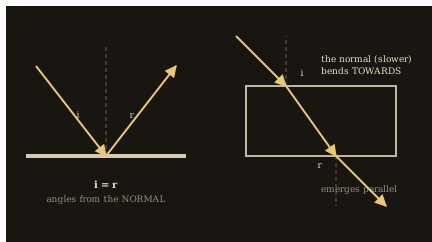
The law of reflection, and the words it needs
- Draw the NORMAL: a construction line at right angles to the surface, at the point where the ray strikes it. It is always drawn dashed, because it is not a ray.
- The ANGLE OF INCIDENCE, i, is the angle between the INCOMING ray and the normal.
- The ANGLE OF REFLECTION, r, is the angle between the REFLECTED ray and the normal.
- THE LAW OF REFLECTION: the angle of incidence equals the angle of reflection. That is the whole of statement 3.15.
- Both rays and the normal lie in the same plane, so a ray arriving in a horizontal plane leaves in one.
The insistence on the normal is not fussiness. If a ray strikes a mirror at 30° to the SURFACE, the angle of incidence is 60°, because the normal is at right angles to the surface. Examiners write questions in exactly that form, and a learner who measures from the surface will produce 30° with complete confidence and be wrong. Whenever a question gives you an angle, check which line it is measured from before doing anything else.
Think of it like a ball bouncing off a wall
A ball thrown straight at a wall comes straight back at you. Thrown at a shallow angle, it skims away at the same shallow angle on the other side. Nobody has to be taught this — you can catch a ball off a wall before you can read. Reflection of light obeys exactly the same rule, and the only real difficulty is bookkeeping: physicists measure the angles from a line perpendicular to the wall rather than from the wall itself, so the numbers do not match the ones your intuition supplies. The behaviour is the intuition you already have; the convention is what has to be learned.
Now the image in a plane mirror, which is where the ray diagram earns its keep. Light from an object strikes the mirror and reflects, obeying the law at every point. The rays entering your eye are diverging, and your brain traces them back along straight lines — but those lines do not meet in front of the mirror. They meet BEHIND it, and that is where you see the image.
Why the image is behind the mirror, and what kind of image it is
- Two rays leave a point on the object and strike the mirror at different places.
- Each reflects with its angle of reflection equal to its angle of incidence, so the two reflected rays diverge.
- The eye receives the diverging rays and traces them back in straight lines, which is all the eye can do.
- Those traced-back lines are drawn DASHED, because no light actually travels along them. They meet at a point behind the mirror.
- That point is the IMAGE. It is VIRTUAL, because no light actually passes through it and it cannot be caught on a screen; it is UPRIGHT, the SAME SIZE as the object, and as far BEHIND the mirror as the object is in front.
- It is also LATERALLY INVERTED — left and right appear swapped, which is why writing held to a mirror reads backwards.
One last distinction that explains something you see constantly. A smooth surface reflects parallel rays so that they stay parallel, and you get a clear image: that is SPECULAR reflection, from a mirror or still water. A rough surface has normals pointing in many directions, so parallel rays reflect at many different angles and no image forms: that is DIFFUSE reflection, and it is why you can see a sheet of paper from anywhere in the room but can only see yourself in a mirror from certain positions. The law of reflection is obeyed exactly in both cases — the difference is entirely in the surface.
2 · Grade 9 Notes
A different job from the section above. You have already understood it; this is the precise set of things to LEARN — definitions to reproduce word for word, processes in order, equations with units, and the answers that score full marks.
Learn this definition · The law of reflection
The angle of incidence is equal to the angle of reflection, both measured from the normal — the line drawn at right angles to the surface at the point where the ray strikes it.
The words a ray diagram is marked on
- Normal
- The construction line at right angles to the surface at the point of incidence. Always drawn dashed; all angles are measured from it.
- Angle of incidence (i)
- The angle between the incoming ray and the normal.
- Angle of reflection (r)
- The angle between the reflected ray and the normal.
- Virtual image
- An image from which no light actually comes, formed where traced-back rays appear to meet. It cannot be projected onto a screen.
- Laterally inverted
- Left and right appear exchanged, as in the reflection of writing.
Statement 3.16 — drawing a ray diagram that earns the marks
- Draw the surface, and the normal as a DASHED line at right angles to it at the point of incidence.
- Draw the incident ray as a solid line with an ARROW showing the direction of travel.
- Measure the angle of incidence from the NORMAL, not from the surface.
- Draw the reflected ray at an equal angle on the other side of the normal, with an arrow.
- For an image in a plane mirror, continue the reflected rays BACKWARDS as dashed lines until they meet, and mark the image there.
The image in a plane mirror — the four properties to state
- VIRTUAL — no light actually passes through it, so it cannot be caught on a screen
- UPRIGHT — the same way up as the object
- THE SAME SIZE as the object
- AS FAR BEHIND the mirror as the object is in front of it
- LATERALLY INVERTED — left and right appear exchanged
Learn this definition · Ray
A straight line drawn along the direction in which a wave's energy travels, at right angles to the wavefronts, with an arrow showing which way it goes. It is a construction, not a physical object.
Specular against diffuse reflection
A. SPECULAR: a smooth surface, so parallel rays stay parallel after reflecting and a clear image forms — a mirror, or still water.
B. DIFFUSE: a rough surface, so the normals point in many directions and parallel rays reflect at many angles. No image forms, and the object is visible from all around.
Model answer [3 marks]
A ray of light strikes a plane mirror at an angle of 25° to the mirror surface. Calculate the angle of reflection. [3]
The angle given is measured from the surface, but angles of incidence and reflection are measured from the normal, which is at right angles to the surface. The angle of incidence is therefore 90 − 25 = 65°. By the law of reflection the angle of reflection equals the angle of incidence, so the angle of reflection is 65°.
Model answer [4 marks]
Explain why the image in a plane mirror appears to be behind the mirror. [4]
Light from a point on the object strikes the mirror and is reflected, with the angle of reflection equal to the angle of incidence at each point. The reflected rays that enter the eye are diverging. The eye and brain can only trace rays back along straight lines, and those straight lines do not meet in front of the mirror — they meet at a point behind it. The image is seen at that point. It is a virtual image, because no light actually passes through it and it cannot be formed on a screen.
Not this: The angle of incidence is measured between the ray and the mirror surface.
This: It is measured between the ray and the NORMAL, the line at right angles to the surface. A ray at 30° to the surface has an angle of incidence of 60°, and questions are deliberately written to test this.
Mark-losing trap. All angles are measured from the NORMAL. Check what any given angle is measured from before you use it.
Mark-losing trap. Draw the normal DASHED and put ARROWS on the rays — both are marked on a ray-diagram question.
Mark-losing trap. Rays traced back behind a mirror are DASHED, because no light travels along them.
Mark-losing trap. A plane mirror image is virtual, upright, same size, as far behind as the object is in front.
3 · Prove it — the five questions
The five questions climb Grade 6 → Grade 7 → Grade 8 → Grade 9 → Grade 9 challenge, and are marked inside Incandio on your own device, by rule, with an authored diagnosis of the mistake you actually made. The mark schemes stay in the app so that the practice is worth doing; the questions themselves are here.
- Grade 6 · State [1 mark] — A ray of light hits a mirror with an angle of incidence of 40°. What is the angle of reflection?
- Grade 7 · State [2 marks] — In a ray diagram, what is the normal?
- Grade 8 · Calculate [3 marks] — A ray of light strikes a plane mirror at an angle of 32° to the mirror surface. Calculate the angle of reflection.
- Grade 9 · Explain [5 marks] — Select every statement that belongs in a full-mark explanation of why the image in a plane mirror appears to be behind the mirror.
- 9+ · Analyse [6 marks] — A student says: 'A mirror image is laterally inverted, so a mirror swaps left and right. But it does not swap up and down — so mirrors must treat the horizontal direction differently from the vertical.' Select every statement that belongs in a full-mark analysis.
The people behind this science
Two ways into the same idea — the one who established that light travels in straight lines into the eye, and the one who used mirrors and drew what light does. Inside Incandio each of them answers knowing exactly which lesson you have just finished.
Ibn al-Haytham — the one who established that light travels in straight lines into the eye
Every ray diagram on this page assumes two things that had to be discovered: that light travels in straight lines, and that vision happens when light enters the eye rather than when the eye reaches out. Both are his. Working in Cairo around 1021, he argued that if the eye emitted rays it should not hurt to look at the Sun and we should be able to see in the dark, and he demonstrated rectilinear propagation with a darkened room and a small aperture that produced an inverted image of the world outside. He also studied reflection from plane and curved mirrors in detail.
- “How did you show that light travels in straight lines?”
- “What was wrong with the idea that the eye sends out rays?”
- “What did you see in the darkened room with a hole in the shutter?”
- “How does light behave when it strikes a curved mirror?”
- “Why should we test what the ancients wrote rather than trust it?”
Leonardo da Vinci — the one who used mirrors and drew what light does
Leonardo studied light obsessively as a painter needing to render it, and independently described the camera obscura and the behaviour of light in his notebooks, comparing the eye to it. He was preoccupied with reflection in particular — in water, in curved metal, in the eye itself — and he wrote his notes in mirror writing, laterally inverted, which is the very property this page ends on. He is the person here who treated light as something to be watched rather than derived.
- “What did you learn about light by trying to paint it?”
- “Why did you write your notes so that they read only in a mirror?”
- “How does a reflection in water differ from one in a polished metal?”
- “What did you think the eye was doing when it sees?”
- “Can a painter show light truthfully without understanding it?”
Think you understand it?
Reading is the start. On Incandio a topic counts as mastered only once you have taught it and defended it — the two things a revision guide cannot ask of you.
Incandio this topic → Prove it. Teach it. Defend it. What does “Incandio it” mean?
- Prove it — five questions on Reflection and Ray Diagrams, marked on the spot, that tell you what was missing rather than just what was wrong.
- Teach it — Explain Reflection and Ray Diagrams in your own words to Ember, an AI pupil who does not have it yet and asks the awkward question. Understanding is credited; wording is not required.
- Defend it — Argue Reflection and Ray Diagrams against Ibn al-Haytham — three rounds, marked against descriptors you can read before you begin.
- Then the exam — read all 11 authored exam-style questions on this unit, each with its command word and its tariff, then have them marked on Incandio with the mistake you actually made named.
Completely free. No subscriptions, no paywalls, no account needed to start.
Carry on through the course
- Previous lesson: Uses and Dangers of Electromagnetic Radiation
- Next lesson: Refraction and Refractive Index
- What a Wave Is — Something crosses the room and nothing gets to the other side — the idea that makes the rest of the topic possible.
- The Wave Equation — Two equations that connect everything on the previous page — and one of them you could have worked out yourself.
- The Doppler Effect — Why an ambulance changes note as it passes — and why the siren itself never does.
- The Electromagnetic Spectrum — Seven names for one thing — and the two properties that change as you go along it.
- Uses and Dangers of Electromagnetic Radiation — Seven bands, seven jobs — and why the danger rises steadily as you move along the spectrum.
- All of Physics · Physics key terms · required practicals · equations · Incandio Science · The 4PH1 specification