Explore Their Life · Pearson Edexcel International GCSE revision on Incandio
Carl Wilhelm Scheele: A Life in Five Chapters
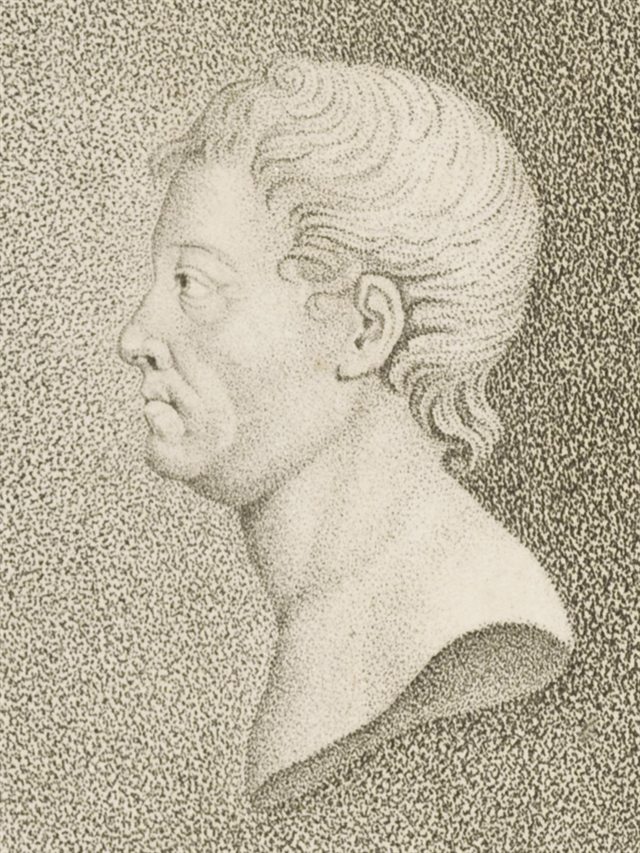
1742–1786
A country apothecary who discovered oxygen, chlorine, four elements and a dozen acids in the back room of a pharmacy, was beaten to publication on nearly all of it, and died at forty-three from tasting what he made.
Scheele never held a university post and never worked anywhere but a shop. His list of discoveries is difficult to believe, and he received credit for almost none of them in his lifetime. He also had the universal habit of his profession — tasting and smelling everything — and it killed him. These five chapters follow the most unlucky great chemist there has been.
The five chapters
- The Back Room of a Pharmacy — An apprenticeship at fourteen, and no university at all
- Fire Air — Oxygen, prepared first and published last
- The Green Choking Air — Chlorine, and four elements
- Acids Out of Ordinary Things — Grapes, sorrel, lemons, milk, apples, oak galls, a bladder stone
- Tasting Everything — The habit that killed him at forty-three
Chapter 1 · The Back Room of a Pharmacy
An apprenticeship at fourteen, and no university at all
1742 – 1770 · Stralsund · Gothenburg · Malmö · Stockholm · Uppsala
Carl Wilhelm Scheele was born at Stralsund in Swedish Pomerania in December 1742, the seventh of eleven children of a merchant. At fourteen he was apprenticed to an apothecary in Gothenburg.
This is where he stayed, in one sense, for the rest of his life. He worked as an apothecary's assistant in Gothenburg, then Malmö, then Stockholm, then Uppsala, and finally as owner of a pharmacy at Köping, a small town on Lake Mälaren.
He had no university education whatever. He read Latin and German, taught himself chemistry from books in the shop, and learned by doing.
The pharmacy is the whole explanation of what followed. An eighteenth-century apothecary's shop was a working chemical laboratory. It held mineral acids, metallic salts, plant extracts, distillation apparatus, furnaces, balances. It supplied raw materials — the tartar deposit in a wine cask, the sorrel in the garden, the galls on an oak, the milk that had soured. And it required a man who could prepare, purify and test substances accurately, because a mistake would poison somebody.
Scheele had all of that available every day, and he used the shop as a research laboratory after hours for thirty years, funding it out of his own wages.
He was noticed. Torbern Bergman, professor of chemistry at Uppsala and the leading chemist in Sweden, became his encourager, corresponded with him, and pressed him to publish.
Why this matters
An eighteenth-century pharmacy was a working chemical laboratory with materials, apparatus and a reason for accuracy — which is why one could be used to make a great chemist.
You have the shop and the man in the back room. What would you ask him?
Ask Scheele
- “What did an apothecary's shop actually contain?”
- “How do you learn chemistry with no teacher?”
- “Why did you never take a university post?”
- “What did Bergman do for you?”
- “Who paid for all these experiments?”
Chapter 2 · Fire Air
Oxygen, prepared first and published last
1771 – 1777 · Uppsala · Köping
Scheele prepared oxygen — probably in 1771 or 1772, and certainly before Priestley's 1 August 1774 experiment.
He made it by several different routes: heating manganese dioxide with sulphuric acid, heating mercuric oxide, heating silver carbonate, heating saltpetre. That variety matters, because it shows he had a *substance* and not a one-off preparation.
He described its properties correctly. A candle burns in it with an intense flame. It supports the breathing of an animal. It is a component of ordinary air, and he showed that air is a mixture of this and something inert — his *fire air* and *foul air* — which is essentially oxygen and nitrogen. He even determined the proportion approximately.
He wrote it up as *Chemische Abhandlung von der Luft und dem Feuer* — the Chemical Treatise on Air and Fire — and gave the manuscript to a publisher in 1775.
It was not printed until 1777.
The reasons were mundane: the publisher was slow, Bergman was slow supplying a promised preface, and nobody was in a hurry.
In the interval Priestley published his own preparation, in 1775. And Lavoisier — who had met Priestley in Paris in October 1774 and been told about the new air, and who had also received a letter from Scheele in September 1774 describing how to make it — published his interpretation, named it oxygen, and built the new chemistry on it.
Scheele's letter to Lavoisier survives. Whether Lavoisier acknowledged it adequately is one of the long-standing arguments in the history of chemistry.
“What they have in common I do not know.”
— Carl Wilhelm Scheele, on the series of organic acids he had isolated
Why this matters
Scheele prepared oxygen by four different routes before either Priestley or Lavoisier, and a three-year printing delay cost him the credit entirely.
You have the treatise sitting with a printer for three years. What is your question?
Ask Scheele
- “How many different ways did you make fire air?”
- “What happened to your book between 1775 and 1777?”
- “Did Lavoisier acknowledge your letter?”
- “How did you work out that air is a mixture?”
- “Does priority actually matter to you?”
Chapter 3 · The Green Choking Air
Chlorine, and four elements
1774 – 1781 · Uppsala · Köping
In 1774 Scheele heated manganese dioxide with spirit of salt — hydrochloric acid — and obtained a dense, yellow-green gas with a suffocating smell that attacked his lungs.
He described its properties with care: it bleaches vegetable colours, dissolves in water, attacks metals, and cannot be got rid of by any means he tried.
He did not think it an element. Working within phlogiston chemistry, he called it *dephlogisticated marine acid air* — spirit of salt with phlogiston taken out. It was Humphry Davy, thirty-six years later in 1810, who showed it is an element and named it *chlorine*, from the Greek for pale green.
Scheele also discovered four elements outright. Manganese, isolated as a metal by his correspondent Gahn from Scheele's identification of the earth. Barium, similarly. Molybdenum, from the mineral molybdenite, which had been confused with graphite. And tungsten, from the mineral he called *tung sten* — Swedish for heavy stone — from which the metal was later obtained.
He also prepared hydrogen sulphide, hydrogen fluoride, arsine, and the compound copper arsenite, which became the pigment *Scheele's green* — an intense colour used in wallpapers, fabrics and confectionery through the nineteenth century, and highly toxic. Its use in Victorian wallpapers has been linked to chronic arsenic poisoning in households, and one long-standing theory about Napoleon's death on St Helena implicates the arsenic in his wallpaper.
He was not a theorist and never claimed to be. He made substances, purified them, and described what they did.
Why this matters
Scheele discovered chlorine and four elements without recognising any of them as elements, because the phlogiston framework he worked in could not accommodate the idea.
You have the green gas and the four metals. What would you ask him?
Ask Scheele
- “What did the green gas do to you when you made it?”
- “Why did you not think chlorine was an element?”
- “How do you know a new mineral contains a new metal?”
- “What became of the green pigment named after you?”
- “Would you rather have had the theory or the substances?”
Chapter 4 · Acids Out of Ordinary Things
Grapes, sorrel, lemons, milk, apples, oak galls, a bladder stone
1770 – 1784 · Köping
Scheele's series of organic acids is his least celebrated and arguably most consequential work.
He isolated *tartaric* acid from the crust in a wine cask, in 1770. *Oxalic* acid from sorrel. *Citric* acid from lemons. *Lactic* acid from sour milk. *Malic* acid from apples. *Gallic* acid from oak galls. *Uric* acid from a stone taken from a bladder. *Mucic*, *pyrogallic* and *prussic* acid — the last being hydrogen cyanide, which is lethal, and which he prepared and described.
The achievement is analytical. Each of these is present in small quantity in a messy biological material, mixed with sugars, proteins, colouring matter and salts. Getting a pure crystalline substance out of apples, with eighteenth-century apparatus, is genuinely difficult work.
What he could not do was say what they had in common. He could see they behaved similarly — sour, reacting with alkalis to form salts — and he could not say why. The idea of a *functional group*, a particular arrangement of atoms conferring particular behaviour on any molecule containing it, did not exist and would not for seventy years.
Asked what these acids shared, he is reported to have said simply that he did not know.
That collection of substances is the raw material from which the carboxylic acids as a family were eventually recognised — by other people, long after he was dead. He supplied the specimens and could not supply the pattern.
Why this matters
Scheele isolated most of the common organic acids and could not say what made them acids, because functional-group theory did not yet exist.
You have the acids and the question he could not answer. What is your question?
Ask Scheele
- “How do you get a pure acid out of an apple?”
- “What do all these acids have in common?”
- “Why isolate an acid from a bladder stone?”
- “Is it enough to make a substance without explaining it?”
- “How careful were you making prussic acid?”
Chapter 5 · Tasting Everything
The habit that killed him at forty-three
1775 – 1786 · Köping
Scheele had a habit universal among chemists of his period: he tasted and smelled everything he made.
This was not recklessness in the way it appears now. Taste and smell were legitimate analytical tools. A chemist described a new substance by its colour, its crystal form, its solubility, its smell and its taste — sour, sweet, bitter, metallic, astringent. It was in the standard vocabulary of description, and every chemist did it.
Scheele made and described hydrogen cyanide, hydrogen fluoride, hydrogen sulphide, arsine, and numerous arsenic, lead and mercury compounds. He recorded the smell and, in a number of cases, the taste.
He described hydrogen cyanide as having a taste that was sweetish and then acrid at the back of the throat, which is a first-hand account of one of the fastest-acting poisons known.
He was in declining health for years — rheumatism, kidney trouble, and symptoms consistent with chronic heavy-metal poisoning.
He declined offers of positions from Britain, from Prussia, and from Frederick the Great personally, preferring the pharmacy at Köping, which he eventually owned.
In May 1786, seriously ill and knowing he was dying, he married Sara Margaretha Pohl, the widow of the previous owner of the pharmacy, who had kept the shop. The marriage was so that the business and his property would pass to her legally. He died two days later, on 21 May 1786, aged forty-three.
He had discovered or co-discovered more substances than almost any chemist before or since, and was credited in his lifetime with very few of them.
Why this matters
Tasting substances was standard analytical practice in eighteenth-century chemistry, and Scheele worked with cyanide, arsenic and mercury compounds for thirty years.
You have the habit, the shop and the deathbed marriage. What would you ask?
Ask Scheele
- “Why did chemists taste what they made?”
- “Did you know what it was doing to you?”
- “Why refuse Frederick the Great and stay in Köping?”
- “Why marry two days before you died?”
- “Which of your discoveries should carry your name?”
What Scheele changed
Scheele found more elements and more compounds than almost anyone before or since: oxygen, chlorine, manganese, barium, molybdenum, tungsten, glycerol, and the whole series of common organic acids from tartaric to uric. He was credited in his lifetime with very little of it. His series of acids is the raw material from which the idea of a family of compounds sharing one group was eventually built — by other people, long after he was dead.
A debate that continues
Whether Lavoisier adequately acknowledged Scheele's 1774 letter describing the preparation of oxygen is a long-standing argument in the history of chemistry, and the three-year delay in printing his treatise cost him the priority he had genuinely earned.
Keep exploring — ask Scheele
- “Which substance would you most like to have understood?”
- “Does it matter who publishes first?”
- “What would you have done with a university laboratory?”
Related lives
- Joseph Priestley — Discoverer of Dephlogisticated Air
- Antoine Lavoisier — Father of Modern Chemistry
- Humphry Davy — Who Prised New Metals Out of Salt
- Jöns Jacob Berzelius — Who Gave Chemistry Its Alphabet
Related themes
Oxygen and combustion · Acids · Discovering the elements
Continue on Incandio
- Talk to Scheele — every question on this page is one tap from being asked, and the same page carries the Historical Brief, the achievements and the timeline
- All 280 figures · Incandio — learn every idea, teach it, then defend it