Explore Their Life · Pearson Edexcel International GCSE revision on Incandio
Jan Ingenhousz: A Life in Five Chapters
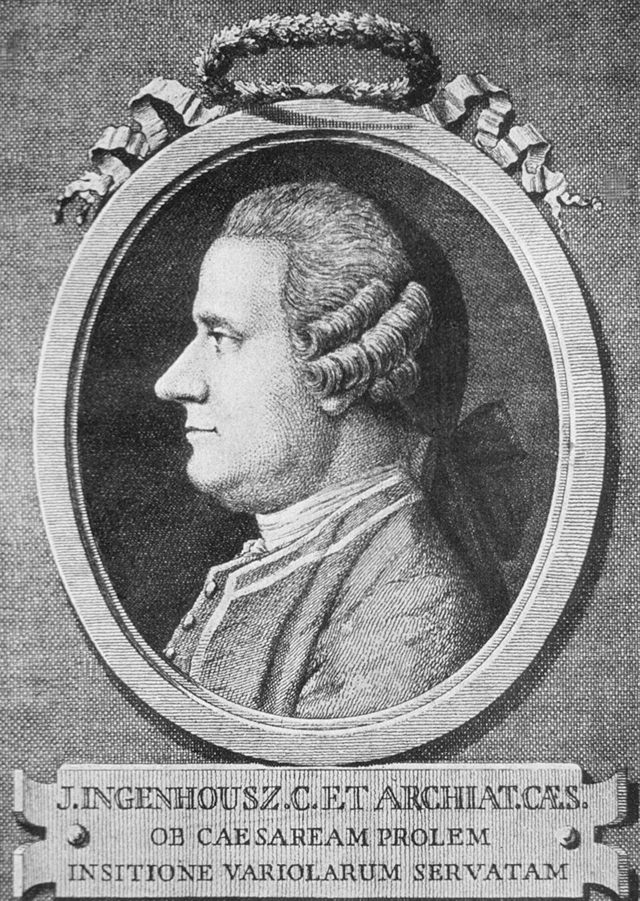
1730–1799
The empress's physician who spent one summer submerging leaves in water, ran five hundred experiments, and found the two conditions that turned a puzzling result into photosynthesis.
Priestley had shown a plant could restore air a candle had spoiled, and could not make it repeat. Ingenhousz found out why: it needs light, and only the green parts do it, and plants respire day and night as animals do. These five chapters follow a court physician who solved someone else's problem in a single English summer.
The five chapters
- Summoned by an Empress — Inoculation, and a pension for life
- The Experiment That Would Not Repeat — Priestley's mint, and why it sometimes failed
- Five Hundred Experiments in One Summer — Leaves under water, and bubbles you can count
- The Chemistry He Could Not Finish — A right result inside a theory that was collapsing
- Less Remembered Than the Man He Corrected — A career of near-misses, and an end in Wiltshire
Chapter 1 · Summoned by an Empress
Inoculation, and a pension for life
1730 – 1770 · Breda · Leuven · Edinburgh · London · Vienna
Jan Ingenhousz was born at Breda in the Dutch Republic in December 1730, the son of a leather merchant and apothecary. He trained in medicine at Leuven, and then studied at Leiden, Paris and Edinburgh — an unusually broad European education.
In London in the 1760s he learned the technique of *variolation*: deliberate inoculation with live smallpox to produce a mild controlled case and lifelong immunity. This was decades before Jenner's cowpox vaccination, and it was genuinely dangerous — a small percentage of those inoculated died — but far safer than catching the disease naturally, which killed roughly a third.
Smallpox struck the Habsburg family in Vienna in 1767, killing one archduchess and disfiguring the Empress Maria Theresa herself. The Empress, having survived it, wanted her surviving children protected, and asked the British court to send someone competent.
Ingenhousz was sent. He inoculated the imperial family successfully, and Maria Theresa made him her court physician with a pension for life.
The pension is the important part. It meant that for the rest of his life Ingenhousz had money, standing and time, and could go where he liked and work on what he chose. He also became a friend and correspondent of Benjamin Franklin for over twenty years, and worked on electricity and on the conduction of heat in metals.
Why this matters
The Habsburg pension bought Ingenhousz the freedom to spend a summer on somebody else's unresolved problem, which is what produced his major work.
You have the inoculation and the pension. What would you ask him?
Ask Ingenhousz
- “What was it like inoculating an imperial family?”
- “How dangerous was variolation, honestly?”
- “What did having a pension for life let you do?”
- “What did you and Franklin write to each other about?”
- “Why study in four countries rather than one?”
Chapter 2 · The Experiment That Would Not Repeat
Priestley's mint, and why it sometimes failed
1771 – 1779 · London · Vienna
In 1771 Joseph Priestley had shown something startling. Burn a candle in a sealed jar until it goes out; the air is now spoiled and will not support flame or a mouse. Put a sprig of mint in the jar and leave it; after some days the air is restored, and a candle will burn in it again.
This was the first evidence that plants and animals do opposite things to the air, and Priestley received the Royal Society's Copley Medal for it.
The trouble was that it did not reliably repeat. Sometimes the plant restored the air. Sometimes nothing happened. Sometimes the air got worse. Priestley himself could not get it to work consistently, and other experimenters failed altogether. By the late 1770s the result was under a cloud, and some regarded it as an artefact.
Ingenhousz, in England in the summer of 1779, took up the problem. His governing principle is stated plainly in his own writing and is worth learning: an experiment that will not repeat means a *condition has been overlooked*. Not that the result is false — that something is varying between the runs which the experimenter has not identified and is not controlling.
So the question is not whether plants purify air. The question is: what is different between the times it works and the times it does not?
Why this matters
An experiment that fails to repeat usually means an uncontrolled variable, not a false result — and acting on that principle is what produced photosynthesis.
You have the mint, the candle and the inconsistency. What is your question?
Ask Ingenhousz
- “What had Priestley actually shown with the mint?”
- “Why does an experiment that will not repeat still matter?”
- “How do you find a condition nobody has noticed?”
- “Why did you take up someone else's failed experiment?”
- “Was Priestley pleased that you were working on it?”
Chapter 3 · Five Hundred Experiments in One Summer
Leaves under water, and bubbles you can count
1779 · Bowood · England
Ingenhousz changed the apparatus, and the change is the whole discovery.
Instead of putting a plant in a jar of air and testing the air days later, he submerged leaves in water and watched what came off them directly. Gas leaving a leaf under water forms bubbles. You can see them appear, count them, collect them in an inverted vessel, and test the gas.
This converts a slow, indirect, all-or-nothing test into a fast, visible, continuous one. He could change a condition and see the effect within minutes.
He ran over five hundred experiments in a single season.
What came out was three findings.
First: the bubbles appear in *sunlight* and stop in shade. Light is the condition Priestley had not controlled — his jars had stood in varying light, which is exactly why the result came and went.
Second: only the *green* parts do it. Leaves and green stems produce the gas; roots, flowers and woody parts do not.
Third, and least expected: in *darkness* a plant spoils the air, exactly as an animal does. Plants respire, continuously, day and night. Across a full day a healthy plant purifies far more than it spoils, which is why the net effect is positive — but the spoiling never stops.
He was also careful to separate light from warmth, showing that it is the light and not the heat that matters.
“Plants have the power of purifying the common air in the sunshine, and of injuring it in the shade and at night.”
— Jan Ingenhousz, Experiments upon Vegetables (1779)
Why this matters
Submerging the leaf turned an indirect, days-long test into a visible, minute-by-minute one — the apparatus change is what made five hundred experiments possible in one summer.
You have the bubbles and the three findings. What would you ask?
Ask Ingenhousz
- “Why put the leaf under water?”
- “How did you separate the effect of light from that of warmth?”
- “Why is it surprising that plants respire at night?”
- “How do you get through five hundred experiments in a season?”
- “What told you it was only the green parts?”
Chapter 4 · The Chemistry He Could Not Finish
A right result inside a theory that was collapsing
1779 – 1796 · London · Vienna · Paris
Ingenhousz published *Experiments upon Vegetables* in London in 1779, in English rather than Latin, which limited its reach on the Continent and probably cost him readers.
His findings were right. His account of what was actually happening chemically was not, and could not be, because the chemistry itself was in the middle of being rebuilt.
In 1779 the standard framework was still phlogiston: the theory that combustible bodies contain a substance released on burning, and that air becomes *phlogisticated* when it has absorbed as much as it can hold. Priestley's purified air was *dephlogisticated air*. Ingenhousz wrote in these terms at first, because there was nothing else to write in.
Lavoisier's oxygen chemistry was published in the 1770s and 1780s and demolished phlogiston. Ingenhousz — unlike Priestley, who defended phlogiston to his death — accepted the new chemistry, and reworked his account accordingly.
By 1796 he was able to state something close to the modern claim: that plants take carbon from the carbon dioxide of the air, use it to build their own substance, and release the oxygen.
What he never had was a *mechanism*. Why light? What does light do to a leaf? Chlorophyll was not isolated until 1817, the role of light energy was not understood for another century, and the biochemical pathway was worked out only in the 1950s.
He had the conditions and the inputs and outputs. The middle of the process was a black box.
Why this matters
Ingenhousz's findings survived the collapse of phlogiston chemistry because they were statements about conditions and results, not about mechanism.
You have the right result inside a wrong chemistry. What is your question?
Ask Ingenhousz
- “What was phlogiston supposed to be?”
- “Why did you accept Lavoisier when Priestley would not?”
- “What does the light actually do to the leaf?”
- “Why publish in English rather than Latin?”
- “Can a result be right inside a theory that is wrong?”
Chapter 5 · Less Remembered Than the Man He Corrected
A career of near-misses, and an end in Wiltshire
1780 – 1799 · Vienna · London · Bowood
Ingenhousz's later life was comfortable and somewhat unsettled. He remained court physician in Vienna, spent long periods in England, and moved between them. He married Agatha Maria Jacquin, from a Viennese scientific family. When the French Revolutionary Wars made the Continent difficult he settled in England for good.
He kept working across a striking range. He investigated the conduction of heat along metal rods coated in wax, measuring how far the melting travelled and ranking metals by conductivity. He worked on electricity, improved electrical machines, and corresponded with Franklin and Volta.
And in 1785 he described, in print, the irregular jiggling motion of powdered charcoal on the surface of alcohol under a microscope — the phenomenon Robert Brown described in 1827 and which carries Brown's name. Ingenhousz saw it forty-two years earlier and did nothing further with it.
That is the shape of his career. He solved Priestley's problem, and Priestley is the name attached to plants and air. He saw Brownian motion, and Brown's name is on it. He accepted Lavoisier's chemistry early and correctly, and is not associated with it.
He died at Bowood in Wiltshire, the seat of the Marquess of Lansdowne, in September 1799, aged sixty-eight.
What he supplied is not a single dramatic result but the two conditions that turn a curiosity into biology: light is required, and respiration never stops. Both are still taught, and the second is still the one students refuse to believe.
Why this matters
Ingenhousz established the conditions that made Priestley's result reliable, and is far less remembered than the man whose experiment he rescued.
You have the near-misses and the two conditions that lasted. What would you ask?
Ask Ingenhousz
- “You saw the jiggling particles before Brown — why let it go?”
- “Does it bother you that Priestley is the name people know?”
- “How did you rank metals by how well they conduct heat?”
- “Why do students find night-time respiration so hard to accept?”
- “Which of your findings would you defend hardest?”
What Ingenhousz changed
Ingenhousz supplied the two conditions that turn Priestley's curiosity into biology: that light is required and that only the green parts do it, and that plants respire continuously, day and night. Both are still taught, and the second remains the harder for students to accept. He also accepted Lavoisier's oxygen chemistry where Priestley would not, and by 1796 could state that plants take carbon from the air and release the oxygen.
A debate that continues
Ingenhousz described the irregular motion of suspended particles in 1785, forty-two years before Robert Brown, and pursued it no further; how much priority that observation earns him is occasionally revisited.
Keep exploring — ask Ingenhousz
- “What would you have needed to see inside the leaf?”
- “How many times should an experiment be repeated?”
- “Which of your contemporaries understood you best?”
Related lives
- Joseph Priestley — Discoverer of Dephlogisticated Air
- Antoine Lavoisier — Father of Modern Chemistry
- Stephen Hales — The Man Who Weighed a Plant's Thirst
- Robert Brown — Who Refused to Explain It
Related themes
Photosynthesis · Respiration · Gas exchange in plants
Where Ingenhousz appears in your course
Jan Ingenhousz has a genuine claim on 7 lessons of the Pearson Edexcel International GCSE science course built into Incandio. Six of them:
- The Leaf: Structure and Gas Exchange — Biology: This lesson teaches one leaf doing two jobs, and Ingenhousz is the person who established that its exchange of gases reverses. In 1779 he submerged leaves in water and watched: in sunlight, bubbles streamed from the green parts; in shade the stream stopped; in darkness the leaf spoiled the air rather than purifying it. He also established that only the green parts do it, which is why the palisade layer described here sits where the light is and the roots do nothing of the kind.
- Gas Exchange in Plants, Day and Night — Biology: Statement 2.44 is Ingenhousz's discovery, almost word for word. Priestley had shown that a plant can restore spoiled air but could not make it happen dependably. In one summer in 1779 Ingenhousz performed over five hundred experiments on submerged leaves and found three things: that only the green parts do it, that they do it only in sunlight, and that in darkness a plant spoils the air exactly as an animal does — while over a whole day it purifies far more than it injures. That is the day-and-night balance this page is built on, and he is the reason anybody knows about it.
- Seeds and Germination — Biology: This page's most counter-intuitive claim is that light is not required for germination, and Ingenhousz is the person who established exactly where the boundary between light and darkness falls in a plant's life. In 1779 he showed that a plant purifies the air only in sunlight, only from its green parts, and that in darkness it spoils the air like an animal. A germinating seed is precisely that case — no green parts, no light, respiring a food store, giving out carbon dioxide. He would recognise the falling dry mass immediately, because it is the same plant doing the same thing his darkened jars measured.
- Global Warming and Deforestation — Biology: The first consequence of deforestation on this page is that the trees stop removing carbon dioxide from the air, and Ingenhousz is the person who established that green plants do that at all — and only in sunlight. His 1779 experiments showed that leaves purify the air by day and spoil it at night, and that only the green parts do it. Every claim on this page about what a forest was doing before it was cleared rests on the distinction he drew.
- Increasing Crop Yield — Biology: Everything a glasshouse does is an attempt to raise the rate of photosynthesis, and Ingenhousz established the conditions under which it happens at all. His 1779 experiments showed that only the green parts of a plant purify air, that they do so only in the light, and that in darkness a plant behaves like an animal. A grower running lamps at night to extend the day is applying his finding directly — and so is one who accepts that the plants go on respiring while the lamps are off.
- Combustion and Carbonates — Chemistry: This page describes carbon dioxide accumulating and mentions deforestation as part of the reason, and Ingenhousz is the person who established what trees are actually doing. In 1779 he showed that plants purify air only in the LIGHT, and that in darkness they do the opposite and spoil it — the green parts, not the whole plant, and only while illuminated. That is the discovery that makes 'deforestation raises carbon dioxide' a mechanism rather than an assertion, and he is the right person to ask how much a forest can really absorb.
Continue on Incandio
- Talk to Ingenhousz — every question on this page is one tap from being asked, and the same page carries the Historical Brief, the achievements and the timeline
- All 280 figures · Incandio — learn every idea, teach it, then defend it