Pearson Edexcel International GCSE in Biology · 4BI1 · Free · no account needed
The Leaf: Structure and Gas Exchange
Every feature of a leaf is a solution to one conflict — letting carbon dioxide in through holes that also let water out.
On the specification this is role of stomata in gas exchange — 4BI1 statements 2.21 · 2.42 · 2.43.
Topic 2 · Structures and functions in living organisms — one of 34 lessons in this topic, and one of 68 in Biology.
This lesson ends with Marcello Malpighi. Learn the Leaf: Structure and Gas Exchange, teach it, then defend it against Marcello Malpighi.
The definition this lesson teaches, word for word — every Biology definition.
- Stoma (plural: stomata)
- A pore in the epidermis of a leaf, usually on the lower surface, surrounded by two guard cells, through which gases diffuse into and out of the leaf.
What this lesson covers in the specification
Incandio is aligned to this specification. It is not published by, endorsed by or affiliated with Pearson, and it reproduces none of Pearson's wording — the statement numbers are given so you can check every lesson against your own copy.
- 2.21 — The structure of the leaf and how it is adapted for photosynthesis
- 2.42 — How the structure of the leaf is adapted for gas exchange (bold B statement — Paper 2 only)
- 2.43 — The role of stomata in gas exchange (bold B statement — Paper 2 only)
Specification section 2(e) Nutrition — also taught in Photosynthesis, What Limits Photosynthesis, A Balanced Diet, The Alimentary Canal.
1 · Understand it
No exam language yet. The only question this section answers is: do I actually understand what is happening?
A leaf has to do two things that work directly against each other. It has to let carbon dioxide in from the air — and gases only get in through holes. But every hole that lets carbon dioxide in also lets water vapour out, and a plant that loses too much water wilts and dies. Almost every feature of a leaf is a solution to that one conflict. Once you see it that way, the list of adaptations stops being a list to memorise and becomes a single argument you can reconstruct.
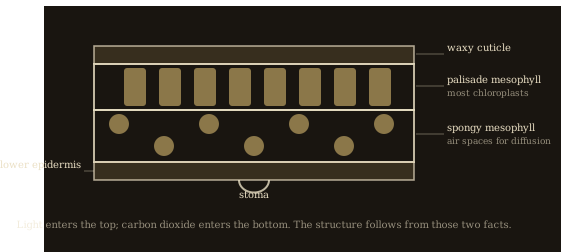
The journey of one carbon dioxide molecule, from the air to a chloroplast
- It reaches the underside of the leaf, which is where almost all the stomata are.
- It diffuses through an open stoma — a pore between two guard cells — into the inside of the leaf.
- Inside it finds the spongy mesophyll: cells loosely packed with large air spaces between them, so gas can travel through the whole leaf instead of only just inside the hole.
- It dissolves in the film of moisture on a mesophyll cell surface, then diffuses across the cell wall and cell membrane.
- It reaches a chloroplast and is used. That last step matters more than it looks: using it up keeps the concentration inside the leaf low, so the gradient from the air inwards stays steep and more carbon dioxide keeps arriving.
Why each feature is the shape it is
- Broad and flat: a large surface area to catch light, and a large area of underside for gas exchange.
- Thin: every cell is a short diffusion distance from the air outside and from the nearest vein.
- Palisade mesophyll at the TOP, tall columns packed with chloroplasts: light arrives from above, so the cells that absorb it are placed first and packed tightly.
- Spongy mesophyll below, loosely packed: the air spaces are the internal roadway for gases, and they hugely increase the moist surface area gas can dissolve into.
- Waxy cuticle on top: waterproof, so water is not simply lost from the surface that is hottest and brightest.
- Stomata mostly on the underside: shaded and cooler, so an open pore there loses far less water than the same pore on top would.
A stoma is not a permanent hole — it is a gap the plant can open and close, which is what makes the whole compromise workable. Two guard cells surround it and they work by changing shape. When water enters them by osmosis they become turgid; because the inner wall facing the pore is thicker and less stretchy than the outer wall, swelling makes each cell curve away from its partner, and the pore opens. Lose water and they go flaccid, straighten out, and the pore closes. So the plant can shut the door when water runs short. The catch is that it shuts carbon dioxide out at exactly the same moment.
The cost of closing the stomata
- In hot, dry conditions the plant closes its stomata to conserve water.
- Carbon dioxide can no longer diffuse into the leaf.
- The mesophyll cells go on using the carbon dioxide already inside, so its concentration in the air spaces falls.
- With little carbon dioxide available, carbon dioxide becomes the limiting factor and the rate of photosynthesis falls.
- That is the trade the plant makes: it protects its water and pays for it in growth.
2 · Grade 9 Notes
A different job from the section above. You have already understood it; this is the precise set of things to LEARN — definitions to reproduce word for word, processes in order, equations with units, and the answers that score full marks.
Learn this definition · Stoma (plural: stomata)
A pore in the epidermis of a leaf, usually on the lower surface, surrounded by two guard cells, through which gases diffuse into and out of the leaf.
The layers of a leaf, top to bottom — the order, and one reason for each
- Waxy cuticle
- a waterproof layer that reduces evaporation of water from the upper surface
- Upper epidermis
- thin and transparent, so light passes through it to the cells below
- Palisade mesophyll
- tall, closely packed cells holding most of the chloroplasts, placed at the top to absorb the most light
- Spongy mesophyll
- loosely packed cells with large air spaces, giving a large moist surface area and letting gases diffuse throughout the leaf
- Lower epidermis
- contains the stomata and their guard cells, where gases enter and leave
- Vascular bundle (vein)
- xylem brings water to the leaf; phloem carries the sugars made there away to the rest of the plant
Upper surface against lower surface — and why they are not the same
| Upper surface | Lower surface | |
|---|---|---|
| Cuticle | thick and waxy | thin or absent |
| Stomata | few or none | almost all of them |
| Conditions there | hotter, brighter, more exposed to wind | shaded and cooler |
| Consequence | water is kept in and light passes through | gases are exchanged with far less water lost |
How a stoma opens
- Water enters the guard cells by osmosis.
- The guard cells become turgid.
- The inner wall beside the pore is thicker and less elastic than the outer wall, so each cell curves as it swells.
- The two guard cells bend away from each other and the pore opens.
- When water leaves, the guard cells become flaccid, straighten, and the pore closes.
The adaptations for gas exchange, each named with the factor it improves
- Large flat underside → a large surface area for diffusion
- Thin leaf, with an epidermis one cell thick → a short diffusion distance
- Air spaces in the spongy mesophyll → gases reach every cell, over a large moist surface to dissolve into
- Stomata that open → a route through a surface that is otherwise sealed against water loss
- Carbon dioxide used up in the chloroplasts → the concentration inside stays low, so the gradient stays steep
Model answer [4 marks]
Explain how the structure of a leaf allows carbon dioxide to reach the chloroplasts of the palisade cells quickly. [4]
Carbon dioxide diffuses in through the stomata on the lower epidermis, which give it a route through the surface. It then moves through the large air spaces of the spongy mesophyll, so it can reach cells throughout the leaf. The leaf is thin, so the diffusion distance to the palisade cells is short. Carbon dioxide is constantly used up in the chloroplasts, so its concentration inside stays low and the concentration gradient into the leaf stays steep.
Model answer [3 marks]
Explain why a plant closes its stomata on a hot, dry day, and what this costs it. [3]
Closing the stomata reduces the loss of water vapour by evaporation, which prevents the plant from wilting when water is scarce. But carbon dioxide can no longer diffuse into the leaf, so its concentration in the air spaces falls as the chloroplasts use it up. Carbon dioxide then becomes the limiting factor and the rate of photosynthesis falls.
Mark-losing trap. Stomata are the pores; guard cells are the two cells that open and close them. The two words are not interchangeable.
Mark-losing trap. Palisade cells go at the TOP, because light comes from above. Drawing them at the bottom is a clear error and will not be credited.
Mark-losing trap. Air spaces are not decoration. Say they increase the moist surface area for gas exchange and let gases reach every cell.
Mark-losing trap. A leaf is adapted for photosynthesis AND for gas exchange. Check which one the question asked about before listing features.
3 · Prove it — the five questions
The five questions climb Grade 6 → Grade 7 → Grade 8 → Grade 9 → Grade 9 challenge, and are marked inside Incandio on your own device, by rule, with an authored diagnosis of the mistake you actually made. The mark schemes stay in the app so that the practice is worth doing; the questions themselves are here.
- Grade 6 · Identify [1 mark] — Which layer of a leaf contains the most chloroplasts?
- Grade 7 · Explain [2 marks] — Most of a leaf's stomata are on its lower surface rather than its upper surface. Give the reason.
- Grade 8 · Explain [4 marks] — Explain how the structure of a leaf allows carbon dioxide to reach the chloroplasts quickly. Select every statement that belongs in a full-mark explanation.
- Grade 9 · Calculate [3 marks] — A student counts 48 stomata in one circular field of view under a microscope. The field of view measures 0.40 mm across. Calculate the number of stomata per square millimetre of leaf surface, to the nearest whole number.
- 9+ · Analyse [5 marks] — On a hot, dry, bright afternoon a scientist finds that a plant's rate of photosynthesis is LOWER at 2 pm than it was at 10 am — even though the light is brighter and the temperature is now closer to the optimum for its enzymes. The soil is dry. Select every statement that belongs in a full-mark explanation.
The people behind this science
Three ways into the same idea — the one who drew what was actually there, and the one who tested what a leaf surface will let through, and the one who found the exchange runs both ways. Inside Incandio each of them answers knowing exactly which lesson you have just finished.
Leonardo da Vinci — the one who drew what was actually there
Leonardo dissected and drew plants as carefully as he drew bodies, and he was the first to record that leaves are set around a stem in a repeating spiral, so that each one shades the leaves below it as little as possible. That is the same argument this lesson makes about the palisade layer, made one level further out: structure arranged so that light is caught rather than wasted.
- “Why are leaves arranged in a spiral around a stem rather than directly in line?”
- “What did drawing a plant show you that simply looking at one did not?”
- “How can you tell that a structure has a purpose rather than being an accident?”
- “When you cut across a leaf, what did you expect to find inside it?”
Charles Darwin — the one who tested what a leaf surface will let through
Darwin spent years placing substances onto living leaves and watching under a microscope to see whether anything actually crossed into the cells — work that filled an entire book on insectivorous plants. That is precisely the question this lesson asks about a leaf surface, and he answered it by experiment rather than by inspecting the structure and guessing.
- “How could you tell that something had crossed into a leaf rather than resting on it?”
- “What is the smallest change in a plant you could actually detect?”
- “Why does a leaf surface let some things through and hold others out?”
- “How do you design an experiment on a plant, which can tell you nothing directly?”
Jan Ingenhousz — the one who found the exchange runs both ways
This lesson teaches one leaf doing two jobs, and Ingenhousz is the person who established that its exchange of gases reverses. In 1779 he submerged leaves in water and watched: in sunlight, bubbles streamed from the green parts; in shade the stream stopped; in darkness the leaf spoiled the air rather than purifying it. He also established that only the green parts do it, which is why the palisade layer described here sits where the light is and the roots do nothing of the kind.
- “What comes off a leaf held under water in the sunshine?”
- “Why do only the green parts of a plant purify the air?”
- “What changes when you move the same leaf into the shade?”
- “How did you separate the effect of light from the effect of warmth?”
Think you understand it?
Reading is the start. On Incandio a topic counts as mastered only once you have taught it and defended it — the two things a revision guide cannot ask of you.
Incandio this topic → Prove it. Teach it. Defend it. What does “Incandio it” mean?
- Prove it — five questions on the Leaf: Structure and Gas Exchange, marked on the spot, that tell you what was missing rather than just what was wrong.
- Teach it — Explain the Leaf: Structure and Gas Exchange in your own words to Ember, an AI pupil who does not have it yet and asks the awkward question. Understanding is credited; wording is not required.
- Defend it — Argue the Leaf: Structure and Gas Exchange against Marcello Malpighi — three rounds, marked against descriptors you can read before you begin.
- Then the exam — read all 10 authored exam-style questions on this unit, each with its command word and its tariff, then have them marked on Incandio with the mistake you actually made named.
Completely free. No subscriptions, no paywalls, no account needed to start.
Carry on through the course
- Previous lesson: What Limits Photosynthesis
- Next lesson: A Balanced Diet
- Levels of Organisation — From organelle to organism — the five-step ladder that every later topic in biology is built on.
- Comparing Cells, and Stem Cells — What plant and animal cells share and where they differ — then why a cell specialising is one of the most powerful ideas in biology.
- Carbohydrates, Proteins and Lipids — The three big food molecules — what they are made of, what they are built from, and how to test for them.
- Enzymes: Catalysts With a Shape — Why a protein with a hole in it speeds up a reaction, and why heat destroys that ability permanently.
- Enzymes and pH — Why acid ruins one enzyme and is the only condition another will work in — and how to find an enzyme's best pH by experiment.
- All of Biology · Biology key terms · required practicals · Incandio Science · The 4BI1 specification