Pearson Edexcel International GCSE in Chemistry · 4CH1 · Free · no account needed
Condensation Polymers
Two reactive ends instead of one, an ester link made over and over, and a molecule of water lost every single time.
On the specification this is biopolyesters as biodegradable polyesters — 4CH1 statements 4.48–4.50.
Topic 4 · Organic chemistry — one of 16 lessons in this topic, and one of 61 in Chemistry.
This lesson ends with Wallace Carothers. Learn Condensation Polymers, teach it, then defend it against Wallace Carothers.
The definition this lesson teaches, word for word — every Chemistry definition.
- Condensation polymerisation
- The joining of many monomers into a chain, in which a small molecule such as water is lost each time a link is formed.
What this lesson covers in the specification
Incandio is aligned to this specification. It is not published by, endorsed by or affiliated with Pearson, and it reproduces none of Pearson's wording — the statement numbers are given so you can check every lesson against your own copy.
- 4.48 — Condensation polymerisation of a dicarboxylic acid with a diol to give a polyester and water (bold C statement — Paper 2 only)
- 4.49 — Writing the structure and repeat unit of a polyester from its monomers (bold C statement — Paper 2 only)
- 4.50 — Biopolyesters as biodegradable polyesters (bold C statement — Paper 2 only)
1 · Understand it
No exam language yet. The only question this section answers is: do I actually understand what is happening?
The previous page built a chain out of alkenes, with nothing given off. This page builds a chain a completely different way, and the difference comes down to one question that is worth carrying through the whole lesson: IS ANYTHING LOST?
Recall what happened when ethanol met ethanoic acid. They joined through a –COO– group and a molecule of water was expelled — and then the reaction stopped, because the resulting ester had nothing reactive left at either end. One alcohol and one acid make one ester and no more.
Statement 4.48 — what changes when each monomer has TWO reactive ends
- Take a DIOL: a molecule with an –OH group at BOTH ends. The prefix di- means two.
- Take a DICARBOXYLIC ACID: a molecule with a –COOH group at BOTH ends.
- One –OH meets one –COOH, they join through a –COO– group, and a molecule of WATER is expelled, exactly as before.
- But now look at what has been made: it still has a free –OH at one end and a free –COOH at the other.
- So it can react again, at both ends, with more monomers.
- And those products can react again, and so on, building a chain of alternating diol and acid units held together by ester links.
- The polymer is called a POLYESTER, and a molecule of water is lost at every single link.
Think of it like the difference between a handshake and a conga line
Two people shaking hands are fully occupied: each has committed their one free hand, and nobody else can join. Now give everyone two free hands and ask them to take hold in both directions, and the same crowd becomes a line of any length. Nothing about the individual grip has changed — it is the number of available hands that decides whether you get a pair or a chain. Ethanol and ethanoic acid have one hand each and make a single ester. A diol and a dicarboxylic acid have two each, and make a polyester.
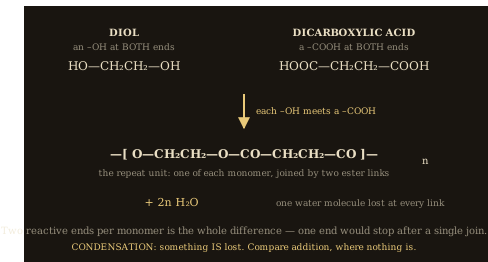
Writing the repeat unit is statement 4.49, and the important thing is that it contains ONE unit of each monomer, joined by ester links. Take a diol HO–CH₂CH₂–OH and a dicarboxylic acid HOOC–CH₂CH₂–COOH. The repeat unit is the diol's chain and the acid's chain linked together, with brackets around them and bonds extending through — and the water that left is not part of it.
That last point is where marks go. In an addition polymer the repeat unit has exactly the atoms of the monomer. In a condensation polymer the repeat unit is LIGHTER than the two monomers that made it, because a molecule of water has gone. If your repeat unit still shows an –OH and a –COOH, you have drawn the monomers side by side rather than joined.
Statement 4.50 is one sentence in the specification and a genuinely important one. A BIOPOLYESTER is a polyester that is BIODEGRADABLE — microorganisms can break it down, so it does not persist the way the polymers on the previous page do. The reason it can be broken down is that an ester link is exactly the kind of bond living things routinely make and break, so enzymes exist that fit it. The unreactive carbon backbone of poly(ethene) offers nothing for an enzyme to work on.
It is worth being careful about two things here. Biodegradable does not mean it vanishes instantly, and it does not mean it will break down in any conditions whatever — many biopolyesters need the warmth and the particular microorganisms of an industrial composting facility, not a domestic bin or the open sea. And not every polyester is a biopolyester: the polyester in clothing is not biodegradable at all. The word describes a property, not a family.
2 · Grade 9 Notes
A different job from the section above. You have already understood it; this is the precise set of things to LEARN — definitions to reproduce word for word, processes in order, equations with units, and the answers that score full marks.
Learn this definition · Condensation polymerisation
The joining of many monomers into a chain, in which a small molecule such as water is lost each time a link is formed.
Addition against condensation polymerisation
A. ADDITION: monomers with a C=C double bond join and NOTHING is lost. One monomer type. The repeat unit has exactly the atoms of the monomer.
B. CONDENSATION: monomers with two reactive ends join and a small molecule such as water is lost at each link. Usually two monomer types. The repeat unit is lighter than the monomers.
The vocabulary that closes this topic
- Diol
- A molecule with an –OH group at both ends. The di- prefix means two.
- Dicarboxylic acid
- A molecule with a –COOH group at both ends.
- Polyester
- A condensation polymer whose monomers are joined by ester links.
- Biopolyester
- A polyester that is biodegradable, meaning microorganisms are able to break it down.
n HO–CH₂CH₂–OH + n HOOC–CH₂CH₂–COOH → –[O–CH₂CH₂–O–CO–CH₂CH₂–CO]ₙ– + 2n H₂O
Conditions: A diol with a dicarboxylic acid. Note the 2n water molecules: two links are formed per repeat unit, and each one loses a water.
Writing the repeat unit of a polyester
- Write the diol and the dicarboxylic acid next to each other, with the reactive ends facing.
- Remove an H from one –OH and the –OH from one –COOH, and join what is left through the resulting –COO– link.
- Do the same at the other end, so the unit has a bond extending from each side.
- Put brackets around the whole unit with both bonds passing through, and write n outside.
- Account for the water separately: two molecules of water leave for every repeat unit formed.
Points on this page that are frequently examined
- TWO reactive ends per monomer is what makes a chain rather than a single molecule
- The link formed is an ESTER link, –COO–, the same one made on the ester page
- A molecule of water is lost at EVERY link, giving 2n per repeat unit
- The repeat unit contains one diol unit and one acid unit
- The repeat unit must NOT still show a free –OH or –COOH
- A biopolyester is biodegradable because enzymes exist that can break an ester link
Model answer [4 marks]
Explain why a diol and a dicarboxylic acid form a polymer, while ethanol and ethanoic acid form only a single ester molecule. [4]
Ethanol has one –OH group and ethanoic acid has one –COOH group, so when they join through an ester link both reactive groups are used up and the resulting ester molecule has nothing left to react with. The reaction therefore stops after one join. A diol has an –OH at both ends and a dicarboxylic acid has a –COOH at both ends, so after the first ester link has formed the product still carries a free –OH at one end and a free –COOH at the other. It can therefore react again at both ends, and repeating this builds a long chain — a polyester.
Model answer [3 marks]
Explain why a biopolyester can be broken down by microorganisms when poly(ethene) cannot. [3]
A biopolyester's chain is held together by ester links, which are the same kind of bond that living organisms routinely make and break, so enzymes already exist that fit them and can break the chain apart. Poly(ethene) has a backbone of carbon-to-carbon single bonds only, which is unreactive and unlike anything found in nature, so no microorganism has an enzyme that will act on it. The polymer therefore persists in the environment for hundreds of years instead of decomposing.
Not this: All polyesters are biodegradable, since biopolyesters are polyesters.
This: Biodegradable describes a property, not the whole family. The polyester used in clothing is not biodegradable. And even a biopolyester often needs the warmth and the particular microorganisms of an industrial composting facility, rather than breaking down in any conditions at all.
Mark-losing trap. Do not leave a free –OH or –COOH in the repeat unit. If they are still there, you have not joined the monomers.
Mark-losing trap. TWO waters leave per repeat unit, so the equation needs 2n H₂O, not n H₂O.
Mark-losing trap. Condensation loses a small molecule; addition loses nothing. That one question separates every polymer on this course.
3 · Prove it — the five questions
The five questions climb Grade 6 → Grade 7 → Grade 8 → Grade 9 → Grade 9 challenge, and are marked inside Incandio on your own device, by rule, with an authored diagnosis of the mistake you actually made. The mark schemes stay in the app so that the practice is worth doing; the questions themselves are here.
- Grade 6 · State [1 mark] — Which small molecule is lost each time a link forms during the condensation polymerisation of a diol with a dicarboxylic acid?
- Grade 7 · State [2 marks] — How many reactive groups must each monomer have if a condensation polymer is to form?
- Grade 8 · Compare [3 marks] — Give the key difference between addition polymerisation and condensation polymerisation.
- Grade 9 · Explain [4 marks] — Select every statement that belongs in a full explanation of how a diol and a dicarboxylic acid form a polyester.
- 9+ · Evaluate [6 marks] — A company replaces its poly(ethene) packaging with a biopolyester and advertises it as solving the plastic waste problem. Evaluate that claim.
The people behind this science
Two ways into the same idea — the one who made the first polyester and turned it into a fibre, and the one who established what breaking down actually is. Inside Incandio each of them answers knowing exactly which lesson you have just finished.
Wallace Carothers — the one who made the first polyester and turned it into a fibre
The polymer on this page is Carothers' own invention. Working at DuPont in 1930 he set out to build a giant molecule deliberately, from a diol and a diacid, precisely so that every product could react again — and his colleague Julian Hill, touching a glass rod to the molten result, found it drew out into a filament that kept stretching far beyond what anyone expected. That accident revealed that the chains were aligning as they were pulled, which is why a synthetic fibre is strong. Nylon followed five years later on the same principle.
- “Why did you choose monomers with a reactive group at both ends?”
- “What happened when the molten polyester was first drawn out?”
- “Why does pulling a fibre make it stronger?”
- “How did you know the water was really leaving at every link?”
- “What made the first polyesters unsuitable, and how did you fix it?”
Louis Pasteur — the one who established what breaking down actually is
Statement 4.50 turns on the word biodegradable, and that word means something quite specific: microorganisms can break the material down. Before Pasteur, decay was widely thought to be a spontaneous chemical process that simply happened to organic matter over time. He showed instead that it is the work of living microorganisms, that they must arrive from somewhere, and that material kept from them does not decay at all. Every claim on this page about what will and will not rot depends on that. He is the right figure to ask what decides whether an organism can break something down.
- “What is actually happening when something rots away?”
- “How did you show decay is not simply a spontaneous change?”
- “What decides whether an organism can break a substance down?”
- “Could an organism learn to digest something entirely new?”
- “What happens to material no microorganism can attack?”
Think you understand it?
Reading is the start. On Incandio a topic counts as mastered only once you have taught it and defended it — the two things a revision guide cannot ask of you.
Incandio this topic → Prove it. Teach it. Defend it. What does “Incandio it” mean?
- Prove it — five questions on Condensation Polymers, marked on the spot, that tell you what was missing rather than just what was wrong.
- Teach it — Explain Condensation Polymers in your own words to Ember, an AI pupil who does not have it yet and asks the awkward question. Understanding is credited; wording is not required.
- Defend it — Argue Condensation Polymers against Wallace Carothers — three rounds, marked against descriptors you can read before you begin.
- Then the exam — read all 12 authored exam-style questions on this unit, each with its command word and its tariff, then have them marked on Incandio with the mistake you actually made named.
Completely free. No subscriptions, no paywalls, no account needed to start.
Carry on through the course
- Previous lesson: Addition Polymers
- What Organic Chemistry Is — Two facts about carbon generate several million compounds — and three words keep them in order.
- Naming, Drawing And Classifying — A name that tells you the structure, a method that finds every isomer, and three words that cover every organic reaction here.
- Crude Oil And Its Fractions — One mixture, separated by boiling point into six useful materials — and one causal chain that explains every trend down the column.
- Burning Fuels — Two ways a hydrocarbon can burn, and why one of them fills a room with a gas you cannot smell.
- Pollutants And Acid Rain — One pollutant comes out of the fuel and one comes out of the air — and telling them apart decides which fix works.
- All of Chemistry · Chemistry key terms · required practicals · equations · Incandio Science · The 4CH1 specification