Pearson Edexcel International GCSE in Chemistry · 4CH1 · Free · no account needed
Addition Polymers
Millions of double bonds opening onto each other, nothing given off — and a material that will not go away afterwards.
Topic 4 · Organic chemistry — one of 16 lessons in this topic, and one of 61 in Chemistry.
This lesson ends with Wallace Carothers. Learn Addition Polymers, teach it, then defend it against Wallace Carothers.
What this lesson covers in the specification
Incandio is aligned to this specification. It is not published by, endorsed by or affiliated with Pearson, and it reproduces none of Pearson's wording — the statement numbers are given so you can check every lesson against your own copy.
- 4.44 — An addition polymer as many monomers joined together
- 4.45 — Drawing the repeat unit of poly(ethene), poly(propene), poly(chloroethene) and PTFE
- 4.46 — Deducing a monomer from a repeat unit and the reverse
- 4.47 — Problems in disposing of addition polymers
1 · Understand it
No exam language yet. The only question this section answers is: do I actually understand what is happening?
A POLYMER is a very large molecule built by joining many small molecules together. The small molecules are called MONOMERS, from the Greek for one part, and the polymer takes its name from them: many ethene molecules give poly(ethene).
The word large is doing serious work here. A poly(ethene) molecule may contain tens of thousands of carbon atoms in one continuous chain. It is a single molecule, not a heap of small ones stuck together, and establishing that was one of the real arguments of twentieth-century chemistry.
How addition polymerisation works
- Start with an ALKENE, which has a carbon-to-carbon double bond.
- Under high pressure and with a catalyst, one of the two bonds holding those carbons together OPENS, leaving a spare bond on each carbon.
- Those spare bonds reach out to neighbouring molecules, whose double bonds have opened in the same way.
- Each monomer therefore joins to the one before it and the one after it, and the chain grows.
- NOTHING IS GIVEN OFF. Every atom that was in the monomers is still in the polymer.
- That is why it is called ADDITION polymerisation, and it is why the repeat unit has the same atoms as the monomer.
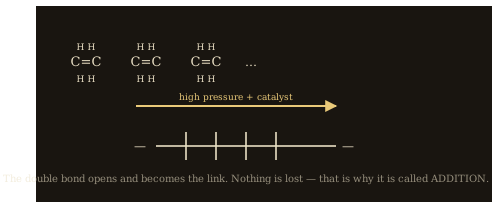
Think of it like people unfolding their crossed arms to link up
A crowd standing with arms folded takes up individual space; nobody is connected to anybody. Ask everyone to unfold their arms and take the hands of the people on either side, and without anybody arriving or leaving, the crowd becomes one continuous line. Not a single person has been added or removed — the same people are simply holding on differently. That is addition polymerisation. Folded arms are the double bond; the line is the polymer; and the reason nothing is given off is that nothing needed to leave for the linking to happen.
The REPEAT UNIT is the piece of the chain that keeps recurring, drawn once with brackets around it and an n outside to mean many. Two details of the drawing are marked and are routinely lost: the double bond must become a SINGLE bond, and the bonds at each end must be drawn extending THROUGH the brackets, because those are the bonds joining this unit to the next one.
Going both ways between monomer and repeat unit
Draw the repeat unit of poly(chloroethene) from its monomer CH₂=CHCl. Then, given the repeat unit of PTFE, work back to its monomer.
- MONOMER TO REPEAT UNIT: take chloroethene, CH₂=CHCl, and change the double bond to a single bond.
- Now draw a bond going out from each of the two carbons, and put the brackets so that both of those bonds pass through them. The repeat unit is –[CH₂–CHCl]–, with n outside.
- Check: the repeat unit has the same atoms as the monomer — two carbons, three hydrogens, one chlorine. Nothing was lost.
- REPEAT UNIT TO MONOMER: PTFE's repeat unit is –[CF₂–CF₂]–.
- Rub out the two bonds sticking out through the brackets, and use them to make a second bond between the two carbons instead.
- That gives CF₂=CF₂, tetrafluoroethene, which is the monomer.
Answer: Forwards: double bond becomes single, bonds extend through the brackets. Backwards: the two extending bonds fold back into a double bond.
The specification names four of these. Poly(ethene) comes from ethene and is used for bags and bottles. Poly(propene) comes from propene and is used for ropes and crates. Poly(chloroethene), usually called PVC, comes from chloroethene and is used for pipes and window frames. And PTFE comes from tetrafluoroethene and is used for non-stick coatings.
Statement 4.47 — why disposal is a genuine problem
- Addition polymers are NON-BIODEGRADABLE: the microorganisms that break down natural materials have no enzymes that fit these chains, because the chains are unreactive and unlike anything found in nature.
- So a discarded object does not rot. It persists, in some cases for hundreds of years, and accumulates.
- Sending it to LANDFILL therefore takes up space permanently rather than temporarily, and suitable land is limited.
- BURNING it releases carbon dioxide, a greenhouse gas, and where combustion is incomplete it also releases toxic carbon monoxide.
- Burning PVC is worse still, because the chlorine in it forms hydrogen chloride, a toxic and acidic gas.
- RECYCLING works, but the different polymers must be sorted from one another first, which is difficult and expensive.
- And the monomers all came from crude oil, a finite resource, so every object thrown away is oil that cannot be recovered.
Notice that the very property that makes these materials useful is the property that makes them a problem. A pipe is worth having because it is unreactive and will not rot in the ground. That is exactly why it is still there in two centuries. Durability and persistence are the same fact seen from two ends, and no amount of chemistry can give you one without the other.
2 · Grade 9 Notes
A different job from the section above. You have already understood it; this is the precise set of things to LEARN — definitions to reproduce word for word, processes in order, equations with units, and the answers that score full marks.
The words this page is marked on
- Monomer
- A small molecule that joins to many others to form a polymer.
- Polymer
- A very large molecule made by joining many monomers together.
- Addition polymerisation
- Many monomers containing a C=C double bond joining together, with nothing else formed.
- Repeat unit
- The section of a polymer chain that recurs, drawn in brackets with n outside and bonds passing through the brackets.
The four addition polymers the specification names
| Monomer | Repeat unit | |
|---|---|---|
| Poly(ethene) | Ethene, CH₂=CH₂ | –[CH₂–CH₂]– |
| Poly(propene) | Propene, CH₂=CHCH₃ | –[CH₂–CH(CH₃)]– |
| Poly(chloroethene), PVC | Chloroethene, CH₂=CHCl | –[CH₂–CHCl]– |
| PTFE | Tetrafluoroethene, CF₂=CF₂ | –[CF₂–CF₂]– |
Drawing a repeat unit from a monomer
- Draw the monomer with its carbon-to-carbon double bond changed to a SINGLE bond.
- Keep every other atom exactly where it was — nothing is added and nothing is removed.
- Draw a bond extending outwards from each of the two carbons that shared the double bond.
- Put brackets around the unit so that both of those bonds pass THROUGH the brackets.
- Write n outside the closing bracket.
Working back from a repeat unit to its monomer
- Take the two bonds that extend through the brackets.
- Remove them, and use them to form a second bond between the two carbons instead.
- The result is the monomer, which will be an alkene with a C=C double bond.
- Check that the monomer has exactly the same atoms as the repeat unit.
Statement 4.47 — the disposal problems, learn several
- NON-BIODEGRADABLE: microorganisms have no enzymes for these unreactive, unnatural chains, so the waste persists
- LANDFILL takes up limited space permanently rather than temporarily
- BURNING releases carbon dioxide, a greenhouse gas, and toxic carbon monoxide if combustion is incomplete
- Burning PVC releases hydrogen chloride, a toxic and acidic gas, because of the chlorine in it
- RECYCLING requires sorting the polymers by type, which is difficult and expensive
- The monomers come from crude oil, a finite resource
Model answer [4 marks]
Explain why addition polymers are difficult to dispose of. [4]
Addition polymers are non-biodegradable, because their chains are unreactive and unlike any natural material, so the microorganisms that break down natural waste have no enzymes able to act on them. Discarded objects therefore persist for hundreds of years rather than rotting away. Sending them to landfill uses up limited space permanently, and burning them releases carbon dioxide, a greenhouse gas, together with toxic carbon monoxide where combustion is incomplete; burning PVC also releases acidic hydrogen chloride. Recycling is possible but requires the different polymers to be sorted by type, which is difficult and expensive.
Model answer [4 marks]
The repeat unit of a polymer is –[CH₂–CHCH₃]–. Deduce the monomer, name the polymer, and explain how you worked it out. [4]
Remove the two bonds extending through the brackets and use them to form a second bond between the two carbon atoms, giving CH₂=CHCH₃. That monomer is propene, so the polymer is poly(propene). The deduction works because addition polymerisation loses nothing: the repeat unit contains exactly the same atoms as the monomer, with the only difference being that the double bond has opened to become the two bonds linking each unit to its neighbours. Checking the atoms confirms it — three carbons and six hydrogens in both.
Not this: Water is given off when addition polymerisation takes place, as it is in other reactions that join molecules.
This: Nothing at all is given off. Every atom of the monomers ends up in the polymer, which is exactly what the word ADDITION means here. Losing a small molecule is condensation polymerisation, and that is a different process.
Mark-losing trap. Draw the bonds extending THROUGH the brackets. A repeat unit drawn as a closed molecule scores nothing.
Mark-losing trap. The double bond becomes a SINGLE bond in the repeat unit. Leaving it double is the commonest drawing error.
Mark-losing trap. Non-biodegradable means microorganisms cannot break it down — not that it is poisonous or that it will not burn.
3 · Prove it — the five questions
The five questions climb Grade 6 → Grade 7 → Grade 8 → Grade 9 → Grade 9 challenge, and are marked inside Incandio on your own device, by rule, with an authored diagnosis of the mistake you actually made. The mark schemes stay in the app so that the practice is worth doing; the questions themselves are here.
- Grade 6 · Name [1 mark] — Which monomer is used to make poly(chloroethene), commonly known as PVC?
- Grade 7 · Deduce [2 marks] — The repeat unit of a polymer is –[CF₂–CF₂]–. How many carbon atoms are there in one molecule of its monomer?
- Grade 8 · Explain [3 marks] — Explain why a repeat unit is drawn with a single bond between the carbons, when the monomer it came from had a double bond.
- Grade 9 · Explain [4 marks] — Select every statement that belongs in a full explanation of why addition polymers cause problems when they are thrown away.
- 9+ · Deduce [6 marks] — A section of an addition polymer chain is –CH₂–CH(CH₃)–CH₂–CH(CH₃)–CH₂–CH(CH₃)–. How many carbon atoms are in one molecule of the monomer?
The people behind this science
Two ways into the same idea — the one who proved a polymer is genuinely one molecule and not a heap of small ones, and the one who made persistence itself the thing to worry about. Inside Incandio each of them answers knowing exactly which lesson you have just finished.
Wallace Carothers — the one who proved a polymer is genuinely one molecule and not a heap of small ones
This page asserts something a learner has no way to check: that a piece of poly(ethene) contains single molecules tens of thousands of atoms long. When Carothers began, that was disputed — many chemists held that polymers were merely clusters of small molecules clinging together, since nothing so large had ever been shown to exist. He settled it by building polymers deliberately, from known starting materials by reactions already understood, and measuring what he had made. He also named the distinction between addition and condensation that the next page depends on.
- “How do you prove a molecule is thousands of atoms long?”
- “Why did chemists doubt that giant molecules existed at all?”
- “What made building one on purpose more convincing than finding one?”
- “How did you decide where to draw the line between the two kinds of joining?”
- “What stops a chain from growing for ever?”
Rachel Carson — the one who made persistence itself the thing to worry about
Statement 4.47 rests on an idea that had to be argued into public life: that a synthetic substance being stable and long-lasting is not simply a virtue but a hazard, because it accumulates faster than anything can remove it. That is the central argument of Silent Spring, made about pesticides rather than plastics, and it is the same argument. Carson also had to answer the objection this page invites — that the materials are useful, so the harm must be acceptable. She is the right figure to ask how you weigh a benefit you can see against a cost that arrives slowly.
- “Why is a substance that lasts a long time a danger?”
- “How do you weigh a clear benefit against a slow, distant cost?”
- “What happens to a material nothing alive can break down?”
- “How did you answer people who said the chemicals were useful?”
- “What evidence changes minds about an invisible problem?”
Think you understand it?
Reading is the start. On Incandio a topic counts as mastered only once you have taught it and defended it — the two things a revision guide cannot ask of you.
Incandio this topic → Prove it. Teach it. Defend it. What does “Incandio it” mean?
- Prove it — five questions on Addition Polymers, marked on the spot, that tell you what was missing rather than just what was wrong.
- Teach it — Explain Addition Polymers in your own words to Ember, an AI pupil who does not have it yet and asks the awkward question. Understanding is credited; wording is not required.
- Defend it — Argue Addition Polymers against Wallace Carothers — three rounds, marked against descriptors you can read before you begin.
- Then the exam — read all 12 authored exam-style questions on this unit, each with its command word and its tariff, then have them marked on Incandio with the mistake you actually made named.
Completely free. No subscriptions, no paywalls, no account needed to start.
Carry on through the course
- Previous lesson: Working Out Esters, And What They Are For
- Next lesson: Condensation Polymers
- What Organic Chemistry Is — Two facts about carbon generate several million compounds — and three words keep them in order.
- Naming, Drawing And Classifying — A name that tells you the structure, a method that finds every isomer, and three words that cover every organic reaction here.
- Crude Oil And Its Fractions — One mixture, separated by boiling point into six useful materials — and one causal chain that explains every trend down the column.
- Burning Fuels — Two ways a hydrocarbon can burn, and why one of them fills a room with a gas you cannot smell.
- Pollutants And Acid Rain — One pollutant comes out of the fuel and one comes out of the air — and telling them apart decides which fix works.
- All of Chemistry · Chemistry key terms · required practicals · equations · Incandio Science · The 4CH1 specification