Pearson Edexcel International GCSE in Physics · 4PH1 · Free · no account needed
Red-Shift
Every distant galaxy is running away from us, the far ones fastest — and why that does not put us at the centre of anything.
Topic 8 · Astrophysics — one of 7 lessons in this topic, and one of 65 in Physics.
This lesson ends with Christian Doppler. Learn red-Shift, teach it, then defend it against Christian Doppler.
The definition this lesson teaches, word for word — every Physics definition.
- Red-shift
- The increase in the observed wavelength of light from a source that is moving away from the observer, which shifts the pattern of lines in its spectrum towards the red end.
Its equation is on the Physics equations page with the other 37.
What this lesson covers in the specification
Incandio is aligned to this specification. It is not published by, endorsed by or affiliated with Pearson, and it reproduces none of Pearson's wording — the statement numbers are given so you can check every lesson against your own copy.
- 8.15 — A moving source changes the observed frequency and wavelength (bold P statement — Paper 2 only)
- 8.16 — Use the red-shift relationship linking change in wavelength, reference wavelength, galaxy velocity and the speed of light (bold P statement — Paper 2 only)
- 8.17 — The red-shift in light from galaxies at different distances (bold P statement — Paper 2 only)
- 8.18 — Why red-shift is evidence for the expansion of the universe (bold P statement — Paper 2 only)
1 · Understand it
No exam language yet. The only question this section answers is: do I actually understand what is happening?
When a source of waves moves relative to an observer, the observed WAVELENGTH and FREQUENCY change. A source approaching crowds its waves together in front of it, so the wavelength observed is shorter and the frequency higher. A source moving away stretches them out behind it, so the wavelength is longer and the frequency lower. Everyone has heard this with an ambulance siren, which drops in pitch the instant the vehicle passes.
The same happens with light, and the effect is named for the end of the spectrum it moves towards. Light from a source moving AWAY has its wavelength stretched towards the RED end — a RED-SHIFT. Light from a source moving TOWARDS the observer is shifted towards the blue — a BLUE-SHIFT. Nothing about the source has changed; only the wavelength that arrives.
The measurement is possible because starlight is not a smooth spread of colours. Each element absorbs particular wavelengths, leaving dark ABSORPTION LINES at fixed positions in the spectrum — a pattern as recognisable as a barcode, and identical whether the element is in a laboratory or in a galaxy. Compare the pattern from a distant galaxy with the same pattern produced on a bench, and the shift can be measured precisely.
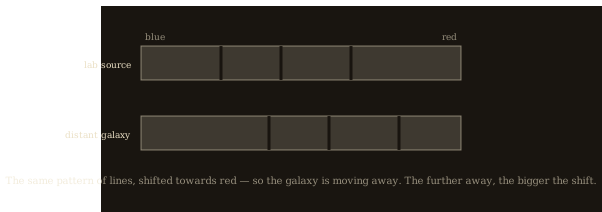
That last point is what makes the method trustworthy. If the lines had rearranged themselves you would suspect the galaxy was made of something else. They have not: the identical pattern, shifted bodily, can only mean the source is moving.
Statement 8.16 puts a number on it. The fraction by which the wavelength has changed equals the fraction of the speed of light at which the galaxy is receding: change in wavelength ÷ reference wavelength = velocity of the galaxy ÷ speed of light. The reference wavelength is the laboratory value — where the line would sit if nothing were moving.
Finding a galaxy's speed from a shifted line
A line measured in a laboratory at 600 nm is observed at 612 nm in the light from a galaxy. Taking the speed of light as 300 000 000 m/s, find the galaxy's speed and state whether it is approaching or receding.
- Change in wavelength = 612 − 600 = 12 nm.
- The observed wavelength is LONGER, so the light is red-shifted and the galaxy is RECEDING.
- Fraction: change ÷ reference = 12 ÷ 600 = 0.020.
- So the galaxy's velocity is 0.020 of the speed of light.
- velocity = 0.020 × 300 000 000 = 6 000 000 m/s.
- Note the units never had to be converted: both wavelengths are in nanometres, and the ratio cancels them.
Answer: 6 000 000 m/s, receding — and the nanometres cancelled in the ratio.
Now the observation that matters, statement 8.17. Measure the red-shift of many galaxies and two things emerge. Almost every galaxy is red-shifted, so almost everything is moving AWAY from us. And the red-shift is GREATER FOR MORE DISTANT GALAXIES — the further away a galaxy is, the faster it is receding, in direct proportion.
Statement 8.18 — the argument from a shift to an expanding universe
- The light from a galaxy is red-shifted, so its wavelength has been stretched, so the galaxy is moving away from us.
- Almost every galaxy is red-shifted, so this is not a few strays — nearly everything is receding.
- The red-shift is greater for more distant galaxies, so the further away a galaxy is, the faster it is going.
- That pattern is not what debris from an explosion at a point would look like from a randomly chosen position within it.
- It IS exactly what SPACE ITSELF EXPANDING produces, because the more space there is between two galaxies, the more of it there is to stretch, so the faster they separate.
- And because the same pattern would be seen from ANY galaxy, the observation does not put us at the centre — which is what makes expansion the only comfortable reading of it.
Think of it like a long elastic band with beads glued along it
Glue beads to a strip of elastic at one-centimetre intervals and stretch the strip so it doubles in length. The bead next to your chosen one moves from 1 cm away to 2 cm — it has travelled 1 cm. The bead that was 5 cm away is now 10 cm away, so it has travelled 5 cm in the same time, and is therefore moving five times faster. Nothing was pushed and no bead is special. The speeds come out proportional to distance simply because there is more elastic between the distant ones, and every centimetre of it is stretching. Sit on any bead you like and you will see exactly the same thing, which is why an observation that everything is running away from us says nothing whatever about our importance.
One clarification worth having, because it is the question that follows immediately. The galaxies are not travelling THROUGH space away from a centre; the space between them is expanding and carrying them apart. Galaxies themselves do not expand — nor do solar systems, planets or people — because gravity and the forces holding matter together are far stronger locally than the expansion. It shows up only over the enormous distances between galaxies, where there is nothing to hold them together.
Finally, one honest exception. A small number of nearby galaxies are BLUE-shifted, including Andromeda, which is approaching us. That is not a failure of the theory. Within a local group of galaxies, gravity dominates over the expansion, so nearby galaxies can be falling towards one another. The expansion is a large-scale effect, and the red-shift pattern is a statement about the universe as a whole rather than about every individual object in it.
2 · Grade 9 Notes
A different job from the section above. You have already understood it; this is the precise set of things to LEARN — definitions to reproduce word for word, processes in order, equations with units, and the answers that score full marks.
change in wavelength ÷ reference wavelength = velocity of galaxy ÷ speed of light
change in wavelength is the observed wavelength minus the laboratory value; reference wavelength is the laboratory value; velocity of the galaxy and the speed of light are both in metres per second (m/s)
Units: The two wavelengths may be in any unit provided both are the same, because the ratio cancels them. Speed of light = 300 000 000 m/s.
Learn this definition · Red-shift
The increase in the observed wavelength of light from a source that is moving away from the observer, which shifts the pattern of lines in its spectrum towards the red end.
The vocabulary of this page
- Blue-shift
- The decrease in observed wavelength from a source moving TOWARDS the observer. Andromeda is blue-shifted.
- Absorption lines
- Dark lines at fixed wavelengths in a spectrum, produced by particular elements. Their pattern is the same in a galaxy as in a laboratory.
- Reference wavelength
- The laboratory value of a line's wavelength — where it would sit if nothing were moving.
Working a red-shift calculation
- Subtract the reference wavelength from the observed wavelength to get the change.
- A LONGER observed wavelength means a red-shift and a receding galaxy; a shorter one means a blue-shift and an approaching one.
- Divide the change by the reference wavelength to get the fraction — both in the same unit, which then cancels.
- Multiply that fraction by the speed of light, 300 000 000 m/s, to get the galaxy's velocity.
- Check the size: the fraction should be small, so the velocity should be a small fraction of the speed of light.
Statement 8.18 — the argument, in order
- Light from a galaxy is RED-SHIFTED, so its wavelength has been stretched, so the galaxy is moving AWAY
- ALMOST EVERY galaxy is red-shifted, so nearly everything is receding from us
- The red-shift is GREATER FOR MORE DISTANT galaxies, so the further away, the faster
- That is exactly what SPACE ITSELF EXPANDING produces — more space between two galaxies means more of it stretching
- The SAME pattern would be seen from any galaxy, so it does NOT put us at the centre
- Galaxies themselves do not expand: gravity holds them together, and the effect shows only over intergalactic distances
Model answer [3 marks]
A line with a laboratory wavelength of 500 nm is observed at 505 nm in light from a galaxy. Calculate the galaxy's speed, taking the speed of light as 300 000 000 m/s. [3]
The change in wavelength is 505 − 500 = 5 nm. Dividing by the reference wavelength gives 5 ÷ 500 = 0.010, so the galaxy is receding at 0.010 of the speed of light. Its velocity is 0.010 × 300 000 000 = 3 000 000 m/s. The observed wavelength is longer than the laboratory value, so the light is red-shifted and the galaxy is moving away.
Model answer [5 marks]
Explain how the red-shift of distant galaxies provides evidence that the universe is expanding. [5]
Light from distant galaxies has a longer wavelength than the same light measured in a laboratory, which shows the galaxies are moving away from us. Almost every galaxy observed is red-shifted, so nearly everything in the universe is receding rather than a few isolated objects. The red-shift is greater for more distant galaxies, which means the further away a galaxy is the faster it is moving away. This is exactly the pattern produced by space itself expanding, because the greater the distance between two galaxies the more space there is between them to stretch, and so the faster they separate. The same pattern would be observed from any galaxy in the universe, so the observation does not imply that we are at the centre.
Not this: Everything is moving away from us, so the Earth must be at the centre of the universe.
This: The SAME observation would be made from any galaxy. Space is expanding everywhere at once, so every observer anywhere sees everything else receding, with the most distant receding fastest. The pattern rules a centre OUT rather than placing us at one.
Mark-losing trap. Red-shift means the wavelength is LONGER and the source is moving AWAY. Blue-shift is the opposite.
Mark-losing trap. The two wavelengths must be in the SAME unit; the ratio then cancels it, so no conversion is needed.
Mark-losing trap. Galaxies do not expand — SPACE between them does. Gravity holds galaxies, stars and people together.
Mark-losing trap. Andromeda is BLUE-shifted. Nearby galaxies are bound by gravity, and the expansion is a large-scale effect.
3 · Prove it — the five questions
The five questions climb Grade 6 → Grade 7 → Grade 8 → Grade 9 → Grade 9 challenge, and are marked inside Incandio on your own device, by rule, with an authored diagnosis of the mistake you actually made. The mark schemes stay in the app so that the practice is worth doing; the questions themselves are here.
- Grade 6 · State [1 mark] — Light from a distant galaxy is red-shifted. What does this tell you about the galaxy?
- Grade 7 · State [2 marks] — How does the red-shift of a galaxy depend on how far away it is?
- Grade 8 · Calculate [4 marks] — A line with a laboratory wavelength of 400 nm is observed at 408 nm in light from a galaxy. Calculate the galaxy's speed. Take the speed of light as 300 000 000 m/s.
- Grade 9 · Explain [6 marks] — Select every statement that belongs in a full-mark explanation of how red-shift provides evidence that the universe is expanding.
- 9+ · Analyse [6 marks] — A student is told that the Andromeda galaxy is blue-shifted, and concludes that the evidence for an expanding universe must be unreliable, 'since one clear counter-example is enough to disprove a rule'. Select every statement that belongs in a full-mark analysis.
The people behind this science
Two ways into the same idea — the one who predicted the effect and got its application spectacularly wrong, and the one who put speed against distance and found a straight line. Inside Incandio each of them answers knowing exactly which lesson you have just finished.
Christian Doppler — the one who predicted the effect and got its application spectacularly wrong
Statement 8.15 is Doppler's 1842 paper, and it is a useful case because he was right about the principle and wrong about the very thing he wrote it to explain. He argued from the geometry of the wavefronts that motion must change the observed frequency, and insisted that since this is geometry rather than a fact about any particular medium it must hold for light as well as sound. He then proposed it as the reason some double stars appear coloured, which is false — stellar velocities are far too small to shift a star's apparent colour. Buys Ballot tested the sound prediction in 1845 with trumpeters on an open railway carriage, confirmed the principle, and rejected the application.
- “Why does motion change the wavelength that arrives?”
- “What happens to the waves in front of a moving source?”
- “Why should the same rule apply to light as to sound?”
- “What were you wrong about with the double stars?”
- “What did Buys Ballot do with a railway carriage and some trumpeters?”
Edwin Hubble — the one who put speed against distance and found a straight line
Statement 8.17 is Hubble's 1929 result and the whole of statement 8.18 rests on it. The individual red-shifts had largely been measured before, by Vesto Slipher, and most of the spectra Hubble used were taken by Milton Humason, who had arrived at Mount Wilson as a mule driver. Hubble's contribution was to pair each red-shift with a DISTANCE, using Cepheid variables, and to plot one against the other — at which point the points fell on a line. He is worth asking here about the plot itself: what it took to trust a straight line drawn through very few points with distances he knew were rough.
- “What made you plot speed against distance in the first place?”
- “How good were the distances you were working with?”
- “How few points was the straight line drawn through?”
- “What did Slipher and Humason each contribute?”
- “Does the line mean we are at the centre of the expansion?”
Think you understand it?
Reading is the start. On Incandio a topic counts as mastered only once you have taught it and defended it — the two things a revision guide cannot ask of you.
Incandio this topic → Prove it. Teach it. Defend it. What does “Incandio it” mean?
- Prove it — five questions on red-Shift, marked on the spot, that tell you what was missing rather than just what was wrong.
- Teach it — Explain red-Shift in your own words to Ember, an AI pupil who does not have it yet and asks the awkward question. Understanding is credited; wording is not required.
- Defend it — Argue red-Shift against Christian Doppler — three rounds, marked against descriptors you can read before you begin.
- Then the exam — read all 10 authored exam-style questions on this unit, each with its command word and its tariff, then have them marked on Incandio with the mistake you actually made named.
Completely free. No subscriptions, no paywalls, no account needed to start.
Carry on through the course
- Previous lesson: The Big Bang and its Evidence
- The Universe and Gravity — From a moon to the whole universe in five steps, and why your weight would change on the way.
- Orbits — Why anything in orbit is falling, why comets speed up as they arrive, and how to find an orbital speed.
- Star Colour and Temperature — Why blue stars are the hot ones, and how a colour tells you a temperature across the whole galaxy.
- The Life Cycle of Stars — Two endings from one beginning — and the mass a star is born with decides which it gets.
- The Hertzsprung–Russell Diagram — Plot every star by colour and true brightness and they do not scatter — they fall into groups.
- All of Physics · Physics key terms · required practicals · equations · Incandio Science · The 4PH1 specification