Pearson Edexcel International GCSE in Physics · 4PH1 · Free · no account needed
Moments and Centre of Gravity
Why a spanner works better when it is longer, where an object's weight can be said to act, and how two supports share a load.
Topic 1 · Forces and motion — one of 10 lessons in this topic, and one of 65 in Physics.
This lesson ends with Archimedes. Learn Moments and Centre of Gravity, teach it, then defend it against Archimedes.
The 3 definitions this lesson teaches, word for word — every Physics definition.
- Moment
- The turning effect of a force about a pivot, equal to the force multiplied by the perpendicular distance from the pivot to the line of action of the force.
- Centre of gravity
- The single point at which the whole weight of a body may be taken to act. For a uniform object of regular shape it is at the object's geometrical centre.
- Principle of moments
- When a body is in equilibrium, the sum of the clockwise moments about any point equals the sum of the anticlockwise moments about that same point.
Its equation is on the Physics equations page with the other 37.
What this lesson covers in the specification
Incandio is aligned to this specification. It is not published by, endorsed by or affiliated with Pearson, and it reproduces none of Pearson's wording — the statement numbers are given so you can check every lesson against your own copy.
- 1.30 — Use moment = force × perpendicular distance from the pivot (bold P statement — Paper 2 only)
- 1.31 — The weight of a body acts through its centre of gravity (bold P statement — Paper 2 only)
- 1.32 — Use the principle of moments for a simple system of parallel forces (bold P statement — Paper 2 only)
- 1.33 — How the upward forces on a supported light beam vary with the position of a heavy object (bold P statement — Paper 2 only)
Specification section 1(c) Forces, movement, shape and momentum — also taught in Forces, Vectors and Scalars, Resultant Force, Friction and F = ma, Weight and Terminal Velocity, Stopping Distance.
1 · Understand it
No exam language yet. The only question this section answers is: do I actually understand what is happening?
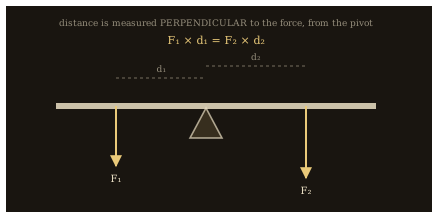
Everyone knows a long spanner undoes a tight nut more easily than a short one, and that a door is hard to push near its hinges. What both facts say is that the turning effect of a force depends not only on how hard you push but on WHERE you push. That turning effect is called a MOMENT, and it is the force multiplied by the perpendicular distance from the pivot.
The word PERPENDICULAR is not decoration and it is where most marks go. The distance required is measured from the pivot to the line along which the force acts, at right angles to that line. Two consequences follow immediately, and both are examined. A force whose line of action passes straight through the pivot has zero perpendicular distance, so it produces no turning effect at all — pushing a door directly towards its hinges does nothing however hard you push. And a force applied at an angle has a smaller perpendicular distance than the same force applied at right angles to the spanner, so it turns the nut less effectively.
Now the idea that makes the rest of the page possible. A real object is not a point — its weight is the sum of the pulls of gravity on every part of it, spread throughout its volume. That would be unmanageable if there were not a simplification available, and there is: for any object there is one point at which all of that weight can be treated as acting. That point is the CENTRE OF GRAVITY, and the whole distributed weight can be replaced by a single downward force there without changing anything about how the object behaves.
Think of it like an average address for the whole crowd
Imagine a crowd of people spread across a field, each holding a rope tied to a single ring, all pulling downwards. To work out how the ring behaves you could track all thousand ropes — or you could find the one place where a single rope pulling with the crowd's total strength would have exactly the same effect. The crowd is still spread out; nothing about them has changed. What you have found is a point that stands in for all of them, and it is the only reason the calculation is possible. The centre of gravity is that point for the weight of an object, and for a uniform beam or ruler it is simply at the middle.
The principle of moments, and how to use it
- When an object is in equilibrium — balanced, not turning — the total CLOCKWISE moment about any point equals the total ANTICLOCKWISE moment about that point.
- Choose the point to take moments about. Any point works, but choosing one where an unknown force acts is by far the cleverest choice, because that force then has zero distance and disappears from the equation.
- For each force, decide whether it turns the object clockwise or anticlockwise about your chosen point, and find its perpendicular distance from that point.
- Write: sum of clockwise moments = sum of anticlockwise moments, with each moment written as force × distance.
- Solve for the unknown. If a uniform beam has weight, remember to include it as a single force acting at its centre — usually its midpoint.
A see-saw, with the pivot chosen for us
A uniform plank is pivoted at its centre. A child of weight 300 N sits 1.2 m from the pivot on the left. Where must a 450 N child sit on the right to balance it?
- The plank is uniform and pivoted at its centre, so its own weight acts at the pivot and has zero perpendicular distance — it produces no moment and can be ignored.
- Anticlockwise moment (left child) = 300 × 1.2 = 360 N m.
- Clockwise moment (right child) = 450 × d.
- For balance: 450 × d = 360.
- d = 360 ÷ 450 = 0.80 m.
Answer: 0.80 m from the pivot — the heavier child sits closer, which is what everyone discovers by experiment in a playground.
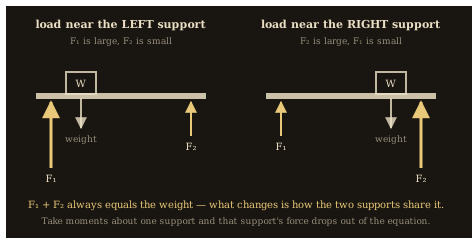
The last statement on this page is that worked example turned round, and it describes a genuinely useful arrangement: a LIGHT beam — light enough for its own weight to be ignored — resting on two supports, with a heavy object somewhere along it. Each support pushes up on the beam, and the two upward forces are not usually equal. Two facts fix them completely.
The two supports — how to find each force
- FIRST FACT: the beam is not accelerating, so the upward forces balance the downward ones. If the beam is light, F₁ + F₂ = the weight of the object.
- SECOND FACT: the beam is not turning, so the principle of moments applies about any point you choose.
- Take moments about ONE of the supports. That support's force acts through the point, so its perpendicular distance is zero and it drops out — leaving one equation with one unknown.
- Solve for the other support's force, then subtract from the total weight to get the first one.
- The pattern to expect: the support NEARER the object carries MORE of the weight. In fact each support's share is proportional to the object's distance from the OTHER support, so an object one quarter of the way along leaves three quarters of the weight on the near support.
- Move the object right up against one support and that support carries almost all of it, while the far one carries almost none.
Sharing a load between two supports
A light beam 4.0 m long rests on supports at each end, A on the left and B on the right. A 600 N crate sits 1.0 m from A. Find the upward force at each support.
- Take moments about A, so the force at A has zero distance and disappears.
- Clockwise about A (the crate): 600 × 1.0 = 600 N m.
- Anticlockwise about A (the force at B): F_B × 4.0.
- So 4.0 × F_B = 600, giving F_B = 150 N.
- Total upward = total downward: F_A + 150 = 600, so F_A = 450 N.
Answer: 450 N at A and 150 N at B — the near support carries three times as much, and the two still add to 600 N.
One last practical point about the centre of gravity, because the specification's phrase 'the weight acts through the centre of gravity' has a consequence you can see. An object topples when its centre of gravity moves outside its base — that is the whole of why a double-decker bus is dangerous on a slope and a racing car is not, and why you widen your stance on a moving train. It is also why the centre of gravity of an irregular object is found by hanging it: suspend it from any point, and it settles with its centre of gravity directly below the point of suspension, because in any other position the weight would produce a moment that turned it.
2 · Grade 9 Notes
A different job from the section above. You have already understood it; this is the precise set of things to LEARN — definitions to reproduce word for word, processes in order, equations with units, and the answers that score full marks.
moment = F × d
moment is in newton metres (N m), F is the force in newtons (N), d is the PERPENDICULAR distance from the pivot to the line of action of the force, in metres (m)
Units: N m, N, m. Rearranged: F = moment ÷ d and d = moment ÷ F. A newton metre is not a joule, even though the units look the same.
Learn this definition · Moment
The turning effect of a force about a pivot, equal to the force multiplied by the perpendicular distance from the pivot to the line of action of the force.
Learn this definition · Centre of gravity
The single point at which the whole weight of a body may be taken to act. For a uniform object of regular shape it is at the object's geometrical centre.
Learn this definition · Principle of moments
When a body is in equilibrium, the sum of the clockwise moments about any point equals the sum of the anticlockwise moments about that same point.
Statements 1.32 and 1.33 — the routine for any beam problem
- Draw every force on the beam, including its own weight at its centre if the beam is not described as light.
- Choose a point to take moments about — ideally where an unknown force acts, so that force drops out.
- Sort the remaining forces into those turning clockwise and those turning anticlockwise about that point.
- Write sum of clockwise moments = sum of anticlockwise moments, using perpendicular distances.
- Solve for the unknown, then use total upward force = total downward force to find any remaining one.
The two supports — what is always true
- The two upward forces ADD UP to the total downward force: F₁ + F₂ = weight, if the beam itself is light
- The support NEARER the load carries MORE of it
- Take moments about one support and that support's force disappears, leaving one unknown
- A load exactly halfway between the supports is shared equally between them
- If the beam has its own weight, include it as a single force acting at its centre
Two quantities with the same units that are not the same thing
| Moment | Work done (energy) | |
|---|---|---|
| Formula | force × perpendicular distance from the pivot | force × distance moved in the direction of the force |
| Direction of the distance | at right angles to the force | along the same line as the force |
| Does anything move? | no — a moment exists on a balanced, stationary beam | yes — no movement means no work is done |
| Unit | newton metre (N m) | joule (J), which is also a newton metre but never written that way |
Model answer [3 marks]
A uniform beam 3.0 m long is pivoted at its centre. A 40 N weight hangs 1.2 m to the left of the pivot. Calculate where a 60 N weight must hang to balance it. [3]
The beam is uniform and pivoted at its centre, so its own weight acts through the pivot and produces no moment. For balance the clockwise moment equals the anticlockwise moment, so 60 × d = 40 × 1.2 = 48 N m. Therefore d = 48 ÷ 60 = 0.80 m, so the 60 N weight must hang 0.80 m to the right of the pivot.
Model answer [3 marks]
Explain why a force applied to a spanner at an angle turns a nut less effectively than the same force applied at right angles. [3]
The moment of a force is the force multiplied by the perpendicular distance from the pivot to the line of action of the force. When the force is applied at right angles to the spanner, that perpendicular distance is the full length of the spanner. When the same force is applied at an angle, the perpendicular distance from the nut to the line of action is smaller than the length of the spanner. The moment is therefore smaller, so the turning effect on the nut is less.
Not this: The distance in a moment is measured from the pivot to the point where the force is applied.
This: It is measured from the pivot to the LINE OF ACTION of the force, at right angles to that line. The two are the same only when the force acts perpendicular to the arm, which is why a force pointing straight at the pivot has no turning effect at all.
Mark-losing trap. PERPENDICULAR distance, measured to the line of action — not simply the length of the arm.
Mark-losing trap. Take moments about an unknown force and it vanishes from the equation. Choose the point deliberately.
Mark-losing trap. A uniform beam's weight acts at its CENTRE. Include it unless the beam is described as light.
Mark-losing trap. A newton metre is not a joule. Same units, different quantity — never write a moment in joules.
3 · Prove it — the five questions
The five questions climb Grade 6 → Grade 7 → Grade 8 → Grade 9 → Grade 9 challenge, and are marked inside Incandio on your own device, by rule, with an authored diagnosis of the mistake you actually made. The mark schemes stay in the app so that the practice is worth doing; the questions themselves are here.
- Grade 6 · Calculate [2 marks] — A force of 25 N is applied to a spanner at a perpendicular distance of 0.20 m from the nut. Calculate the moment.
- Grade 7 · State [2 marks] — An irregular piece of card is hung freely from a pin pushed through a hole near its edge. What can be said about its centre of gravity once it stops swinging?
- Grade 8 · Calculate [3 marks] — A uniform plank is pivoted at its centre. A 250 N weight is placed 1.6 m to the left of the pivot. Calculate how far from the pivot a 400 N weight must be placed on the right to balance the plank.
- Grade 9 · Calculate [4 marks] — A light beam 5.0 m long rests on a support at each end, A on the left and B on the right. A 900 N crate is placed 2.0 m from A. Calculate the upward force at support B.
- 9+ · Analyse [6 marks] — A uniform plank of weight 200 N and length 4.0 m rests on two supports, one at each end. A child of weight 300 N walks slowly from the left support to the right one. Select every statement that belongs in a full-mark analysis of how the upward forces on the two supports change.
The people behind this science
Two ways into the same idea — the one who proved the law rather than noticing it, and the one who looked for the balance point in bodies and machines. Inside Incandio each of them answers knowing exactly which lesson you have just finished.
Archimedes — the one who proved the law rather than noticing it
Levers had been used for thousands of years before Archimedes; what he did was prove why they work. In On the Equilibrium of Planes he starts from a small number of assumptions — chiefly that equal weights at equal distances balance — and derives that weights balance when their distances from the pivot are inversely proportional to them, which is the principle on this page. He also developed the idea of a centre of gravity in order to do it, because a proof about extended shapes needs a single point at which each shape's weight can be treated as acting.
- “How can a small weight balance a much larger one?”
- “What did you have to assume before you could prove the law of the lever?”
- “What do you mean by the point at which a body's weight acts?”
- “Did you really believe you could move the Earth with a lever?”
- “Why prove something that every workman already knew how to use?”
Leonardo da Vinci — the one who looked for the balance point in bodies and machines
Leonardo studied the centre of gravity obsessively and in places that had nothing to do with mathematics: how a person standing on one leg shifts their body over the supporting foot, how a figure carrying a load leans against it, why a man rising from a chair must first move his head forward. His notebooks contain both the mechanics of levers and pulleys and the anatomy of how a body keeps itself over its base. He is the person on this page who treated the centre of gravity as something you can watch rather than something you calculate.
- “Where is the balance point of a person standing still?”
- “Why must someone carrying a heavy load lean the other way?”
- “How did you study balance in a body that will not stay still?”
- “What did you learn about levers and pulleys from building machines?”
- “Why does a person have to lean forward before standing up?”
Think you understand it?
Reading is the start. On Incandio a topic counts as mastered only once you have taught it and defended it — the two things a revision guide cannot ask of you.
Incandio this topic → Prove it. Teach it. Defend it. What does “Incandio it” mean?
- Prove it — five questions on Moments and Centre of Gravity, marked on the spot, that tell you what was missing rather than just what was wrong.
- Teach it — Explain Moments and Centre of Gravity in your own words to Ember, an AI pupil who does not have it yet and asks the awkward question. Understanding is credited; wording is not required.
- Defend it — Argue Moments and Centre of Gravity against Archimedes — three rounds, marked against descriptors you can read before you begin.
- Then the exam — read all 12 authored exam-style questions on this unit, each with its command word and its tariff, then have them marked on Incandio with the mistake you actually made named.
Completely free. No subscriptions, no paywalls, no account needed to start.
Carry on through the course
- Previous lesson: Conservation of Momentum
- Next lesson: Charge and Current
- Speed, and What a Distance–Time Graph Is Telling You — Speed as a rate, the units physics insists on, and how to read a journey straight off a graph.
- Acceleration and the Velocity–Time Graph — What acceleration actually measures, why its unit looks strange, and how one graph gives you both acceleration and distance.
- Forces, Vectors and Scalars — What a force actually does, why some quantities need a direction to mean anything, and why that makes a force one of them.
- Resultant Force, Friction and F = ma — Why a moving object stops, what really happens when you add forces up, and the one equation that connects force to motion.
- Weight and Terminal Velocity — What weight actually is, why it is not the same as mass, and what happens to a falling object once the air starts pushing back.
- All of Physics · Physics key terms · required practicals · equations · Incandio Science · The 4PH1 specification