Pearson Edexcel International GCSE in Physics · 4PH1 · Free · no account needed
Resultant Force, Friction and F = ma
Why a moving object stops, what really happens when you add forces up, and the one equation that connects force to motion.
Topic 1 · Forces and motion — one of 10 lessons in this topic, and one of 65 in Physics.
This lesson ends with Isaac Newton. Learn Resultant Force, Friction and F = ma, teach it, then defend it against Isaac Newton.
The 2 definitions this lesson teaches, word for word — every Physics definition.
- Resultant force
- The single force that has the same effect as all the forces acting on an object combined. For forces along a line it is found by adding those acting in one direction and subtracting those acting in the opposite direction.
- Friction
- A force that acts between two surfaces in contact and always opposes their relative motion, or the tendency to move. Air resistance is friction from a fluid, and it increases as speed increases.
One of the 17 Physics required practicals · Its equation is on the Physics equations page with the other 37.
What this lesson covers in the specification
Incandio is aligned to this specification. It is not published by, endorsed by or affiliated with Pearson, and it reproduces none of Pearson's wording — the statement numbers are given so you can check every lesson against your own copy.
- 1.15 — Calculate the resultant of forces acting along a line
- 1.16 — Friction as a force that opposes motion
- 1.17 — Use F = m × a
Specification section 1(c) Forces, movement, shape and momentum — also taught in Forces, Vectors and Scalars, Weight and Terminal Velocity, Stopping Distance, Hooke's Law and Elasticity.
1 · Understand it
No exam language yet. The only question this section answers is: do I actually understand what is happening?
Slide a book across a table and let go. It slows down and stops. Everything in your daily experience says the same thing: to keep something moving you have to keep pushing it, and when you stop pushing, it stops. This was the accepted physics for about two thousand years, and it is wrong — but you cannot see why it is wrong until you notice what else is touching the book.
What is actually stopping the book
- Every surface, however polished it looks, is rough at a small enough scale. Two surfaces in contact catch on each other.
- This produces friction: a force that acts along the surfaces and always opposes the relative motion. If the book slides right, friction on the book acts left.
- So when you let go, the book is not left with no force on it. It is left with friction, and friction alone.
- Friction is a resultant force acting backwards, so it slows the book down — exactly as a force is supposed to do.
- The book does not stop because the push 'ran out'. It stops because something was pushing it backwards the whole time.
Now run the experiment in your head with less and less friction. On a polished table the book slides further. On ice, further still. On an air-hockey table, where the puck rides on a cushion of air, it will cross the whole table and rebound. In space, with nothing touching it at all, there is nothing left to slow it — and it never stops. Nothing is added as friction is removed; things simply keep going. That is the conclusion Galileo reached by extrapolating exactly this sequence, and it reverses the everyday rule: a force is not needed to keep an object moving. A force is needed to CHANGE how it is moving.
Real situations have several forces at once, so before you can predict anything you have to reduce them to one. Along a straight line this is just arithmetic with signs: choose a positive direction, add forces pointing that way, subtract forces pointing the other way. What is left over is the resultant force, and the resultant is the only thing that decides what happens next — a 500 N drive against 500 N of drag produces exactly the same motion as no forces at all.
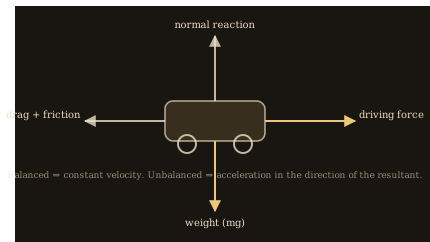
A worked resultant, then the acceleration it produces
A car of mass 900 kg has a driving force of 2400 N and experiences 900 N of resistive forces. Find its acceleration.
- Take forwards as positive. Resultant force = 2400 − 900 = 1500 N forwards.
- The resultant, not the driving force, is what goes into the equation. Using F = m × a, rearrange to a = F ÷ m.
- a = 1500 ÷ 900 = 1.67 m/s² (3 s.f.), forwards.
Answer: 1.67 m/s² forwards
What F = ma is actually telling you — three readings of one equation
- Fix the mass and increase the force: the acceleration rises in proportion. Double the resultant force on the same object and you double its acceleration.
- Fix the force and increase the mass: the acceleration falls. The same 1500 N on a 1800 kg car produces half the acceleration — heavier things are harder to get moving and harder to stop.
- Make the resultant force zero and the acceleration is zero. That does NOT mean the object is stationary; it means its velocity is not changing. It is either at rest or moving at a constant velocity, and physics makes no distinction between those two states.
- That third reading is the one that ties the lesson together: constant velocity and standing still are the same situation as far as forces are concerned, and both are what balanced forces look like.
One more thing about friction, because it matters for what comes next. Air resistance is a friction force from a fluid, and unlike friction between solid surfaces it gets bigger the faster you go. Cycle harder and you go faster; go faster and the air pushes back harder; and at some point the air is pushing back exactly as hard as you are pushing forward. The resultant is then zero, the acceleration is zero, and you stop getting any faster — while still pedalling as hard as ever.
2 · Grade 9 Notes
A different job from the section above. You have already understood it; this is the precise set of things to LEARN — definitions to reproduce word for word, processes in order, equations with units, and the answers that score full marks.
Learn this definition · Resultant force
The single force that has the same effect as all the forces acting on an object combined. For forces along a line it is found by adding those acting in one direction and subtracting those acting in the opposite direction.
Learn this definition · Friction
A force that acts between two surfaces in contact and always opposes their relative motion, or the tendency to move. Air resistance is friction from a fluid, and it increases as speed increases.
F = m × a
F is the RESULTANT force in newtons (N), m is mass in kilograms (kg), a is acceleration in metres per second squared (m/s²)
Units: N, kg, m/s². Rearranged: a = F ÷ m and m = F ÷ a. One newton is the resultant force that gives a 1 kg mass an acceleration of 1 m/s².
Every F = ma question, in the same four steps
- Draw or list every force, with its direction.
- Choose a positive direction and find the resultant: add the forces with it, subtract the forces against it.
- Put the RESULTANT into F = m × a — never a single one of the individual forces.
- Rearrange for the unknown, and state the direction of the answer along with its value.
Balanced against unbalanced forces — what each one looks like
| Resultant force is zero | Resultant force is not zero | |
|---|---|---|
| Acceleration | zero | not zero — the object speeds up, slows down or changes direction |
| Motion | at rest, OR moving at constant velocity | velocity is changing |
| Everyday example | a car at a steady 70 mph on a flat road | a car pulling away from traffic lights |
| What a question calls it | balanced forces, or 'constant velocity' | unbalanced forces, or 'accelerating' |
Model answer [3 marks]
A lorry of mass 7500 kg has a driving force of 12 000 N and experiences resistive forces of 4500 N. Calculate its acceleration. [3]
Resultant force = 12 000 − 4500 = 7500 N forwards. Using F = m × a, rearranged to a = F ÷ m, gives a = 7500 ÷ 7500 = 1.0 m/s² forwards.
Model answer [4 marks]
A cyclist pedalling with a constant force speeds up at first, but eventually travels at a constant velocity. Explain why. [4]
At low speed the forward force is greater than the air resistance, so there is a resultant force forwards and the cyclist accelerates. Air resistance increases as speed increases. Eventually the air resistance becomes equal to the forward force, so the resultant force is zero. With no resultant force there is no acceleration, so the cyclist continues at a constant velocity.
Practical — how the acceleration of a trolley depends on the force on it
- Place a trolley on a runway with a string over a pulley at the end, attached to a hanging mass holder.
- Fix a card of known length to the trolley and set up two light gates along the runway, connected to a data logger.
- Release the trolley from rest; the logger records the speed at each gate and the time between them.
- Calculate acceleration = change in speed ÷ time taken between the gates.
- Increase the force by moving a slotted mass from the trolley to the hanger, so the total mass accelerated stays the same.
- Repeat for at least five forces, three times each, and plot acceleration against force: a straight line through the origin shows a ∝ F.
- To investigate mass instead, keep the hanging mass fixed and add masses to the trolley.
Variables
Independent (changed) — The accelerating force (weight of the hanging masses)
Dependent (measured) — The acceleration of the trolley
| Control variable | Why it must be held constant |
|---|---|
| Total mass accelerated | a = F ÷ m, so changing mass would also change the acceleration |
| The same runway and trolley | a different surface changes friction |
| Angle of the runway | a slope adds part of the trolley's weight to the accelerating force |
Sources of error
| Type | What goes wrong | What to do |
|---|---|---|
| Systematic | Friction opposes the motion, so every acceleration is lower than F ÷ m predicts. | Tilt the runway slightly until the trolley rolls at constant speed. |
| Random | Repeat runs give slightly different accelerations. | Repeat each force three times and calculate a mean. |
Mark-losing trap. Put the RESULTANT force into F = ma, never the driving force on its own. This single slip costs more marks than any other here.
Mark-losing trap. Zero resultant force does not mean stationary. It means constant velocity — and being at rest is just the case where that velocity is zero.
Mark-losing trap. Friction opposes motion; it does not cause it. If an object is speeding up, friction is not the reason.
Mark-losing trap. Mass must be in kilograms and force in newtons before you divide. Grams and tonnes will give an answer wrong by a factor of a thousand.
3 · Prove it — the five questions
The five questions climb Grade 6 → Grade 7 → Grade 8 → Grade 9 → Grade 9 challenge, and are marked inside Incandio on your own device, by rule, with an authored diagnosis of the mistake you actually made. The mark schemes stay in the app so that the practice is worth doing; the questions themselves are here.
- Grade 6 · Calculate [2 marks] — A resultant force of 3600 N acts on a car of mass 1200 kg. Calculate its acceleration.
- Grade 7 · Calculate [2 marks] — A box is pushed to the right with a force of 250 N while friction acts on it with a force of 90 N. Calculate the magnitude of the resultant force.
- Grade 8 · Explain [4 marks] — A book is given a push across a table and then released. It slides a short way and stops. Select every statement that belongs in a full-mark explanation of why it stops.
- Grade 9 · Calculate [3 marks] — A van of mass 2400 kg accelerates at 0.75 m/s². The resistive forces acting on it total 1900 N. Calculate the driving force produced by its engine.
- 9+ · Analyse [5 marks] — Two identical vans set off from rest with the same constant driving force. One is empty; the other carries a heavy load. Both eventually reach a constant top speed, and the loaded van's top speed is almost exactly the same as the empty one's — but it took much longer to get there. Select every statement that belongs in a full-mark explanation.
The people behind this science
Two ways into the same idea — the one who removed friction in his head, and the one who measured friction two centuries early. Inside Incandio each of them answers knowing exactly which lesson you have just finished.
Galileo Galilei — the one who removed friction in his head
Galileo could not build a frictionless surface, so he did the next best thing: he made surfaces smoother and smoother, measured how much further a ball travelled each time, and extrapolated to the case he could never reach. That reasoning — running an experiment towards a limit you cannot actually build — is exactly the argument this lesson uses, and it overturned two thousand years of physics.
- “How can you draw a conclusion about a surface you were never able to make?”
- “What convinced you that a moving object needs no push to keep going?”
- “Why did everyone before you believe that motion had to be maintained?”
- “How did rolling balls down slopes tell you anything about friction?”
Leonardo da Vinci — the one who measured friction two centuries early
Leonardo ran systematic experiments dragging blocks and found two results that were not published again for another two hundred years: friction is proportional to the load pressing the surfaces together, and it does not depend on how large the contact area is. The second is genuinely counter-intuitive, and he got it from measurement rather than argument.
- “Why does a wider block not experience more friction than a narrow one?”
- “How did you measure a force when no instrument existed for it?”
- “What made you weigh down the blocks rather than just pulling harder?”
- “Which of your friction results surprised you most at the time?”
Think you understand it?
Reading is the start. On Incandio a topic counts as mastered only once you have taught it and defended it — the two things a revision guide cannot ask of you.
Incandio this topic → Prove it. Teach it. Defend it. What does “Incandio it” mean?
- Prove it — five questions on Resultant Force, Friction and F = ma, marked on the spot, that tell you what was missing rather than just what was wrong.
- Teach it — Explain Resultant Force, Friction and F = ma in your own words to Ember, an AI pupil who does not have it yet and asks the awkward question. Understanding is credited; wording is not required.
- Defend it — Argue Resultant Force, Friction and F = ma against Isaac Newton — three rounds, marked against descriptors you can read before you begin.
- Then the exam — read all 10 authored exam-style questions on this unit, each with its command word and its tariff, then have them marked on Incandio with the mistake you actually made named.
Completely free. No subscriptions, no paywalls, no account needed to start.
Carry on through the course
- Previous lesson: Forces, Vectors and Scalars
- Next lesson: Weight and Terminal Velocity
- Speed, and What a Distance–Time Graph Is Telling You — Speed as a rate, the units physics insists on, and how to read a journey straight off a graph.
- Acceleration and the Velocity–Time Graph — What acceleration actually measures, why its unit looks strange, and how one graph gives you both acceleration and distance.
- Forces, Vectors and Scalars — What a force actually does, why some quantities need a direction to mean anything, and why that makes a force one of them.
- Weight and Terminal Velocity — What weight actually is, why it is not the same as mass, and what happens to a falling object once the air starts pushing back.
- Stopping Distance — Why a car does not stop when you decide to stop it — and which of the two distances each factor actually lengthens.
- All of Physics · Physics key terms · required practicals · equations · Incandio Science · The 4PH1 specification