Pearson Edexcel International GCSE in Physics · 4PH1 · Free · no account needed
Forces, Vectors and Scalars
What a force actually does, why some quantities need a direction to mean anything, and why that makes a force one of them.
On the specification this is effects of forces between bodies · force is a vector quantity — 4PH1 statements 1.11–1.14.
Topic 1 · Forces and motion — one of 10 lessons in this topic, and one of 65 in Physics.
This lesson ends with Simon Stevin. Learn Forces, Vectors and Scalars, teach it, then defend it against Simon Stevin.
The 2 definitions this lesson teaches, word for word — every Physics definition.
- Scalar quantity
- A quantity that has magnitude (size) only. It is fully described by a number and a unit — for example mass, distance, speed, time, energy and temperature.
- Vector quantity
- A quantity that has both magnitude and direction. The direction is part of the quantity itself — for example force, weight, displacement, velocity, acceleration and momentum.
What this lesson covers in the specification
Incandio is aligned to this specification. It is not published by, endorsed by or affiliated with Pearson, and it reproduces none of Pearson's wording — the statement numbers are given so you can check every lesson against your own copy.
- 1.11 — The effects of forces between bodies: changes in speed, shape or direction
- 1.12 — Identify different types of force, such as gravitational or electrostatic
- 1.13 — How vector quantities differ from scalar quantities
- 1.14 — Force is a vector quantity
Specification section 1(c) Forces, movement, shape and momentum — also taught in Resultant Force, Friction and F = ma, Weight and Terminal Velocity, Stopping Distance, Hooke's Law and Elasticity.
1 · Understand it
No exam language yet. The only question this section answers is: do I actually understand what is happening?
You have never seen a force. You cannot see a newton the way you can see a metre — there is nothing there to look at. What you see are the things forces DO, and that is the only way anyone has ever detected one. So the sensible first question is not 'what is a force?' but 'what changes when one acts?'
The three things a force can do — and there are only three
- Change an object's SPEED. Pushing a trolley makes it speed up; the brakes make a car slow down. Slowing down counts — it is still a change of speed.
- Change an object's DIRECTION. A tennis ball hit back across the net has been turned round; the Moon is pulled into a curve rather than continuing in a straight line.
- Change an object's SHAPE. Stretching a spring, squashing a can, bending a ruler. Nothing has to move anywhere for a force to be doing this.
- If none of those three things is happening to anything, no resultant force is acting. That is a genuinely useful test, and you can apply it to almost any situation a question describes.
Forces come in named types, and it is worth sorting them by one question: does anything have to be touching? Friction, air resistance, tension in a rope, upthrust from a liquid and the normal contact force from a surface all require contact — something is physically pressing on something else. Gravitational, electrostatic and magnetic forces do not. They act across a gap, with nothing in between, which is strange enough that it troubled physicists for centuries and should probably still trouble you a little.
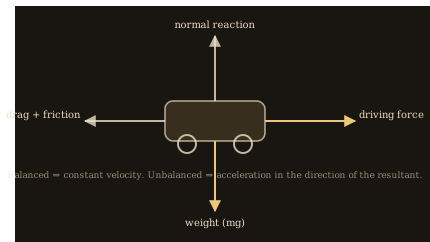
Now the idea that makes the rest of mechanics possible. Some quantities are completely described by a number and a unit. A bag of 5 kg, a wait of 20 s, a temperature of 300 K — say the number, say the unit, and there is nothing left to add. These are called scalars. But suppose I tell you a plane has flown 200 km. You still have no idea where it is. The information that is missing is not extra detail about the quantity; for that quantity, direction is part of what it IS. Those are vectors.
One lap of a running track — where the difference bites
- A runner completes one lap of a 400 m track and finishes exactly where she started.
- How far has she travelled? 400 m. That is DISTANCE, a scalar: it counts every metre covered and takes no notice of direction.
- How far is she from where she began? Zero. That is DISPLACEMENT, a vector: it is the straight-line distance from start to finish, in a stated direction.
- Both answers are correct. They are different numbers because they are answers to different questions — and the difference between the two questions is whether direction is counted.
- The same split runs all the way through: speed is the scalar and velocity is the vector; mass is the scalar and weight is the vector force gravity pulls it with.
Force is a vector, and once you see the running track you can see why it has to be. A 10 N push to the right and a 10 N push to the left are not the same force — apply both at once and you get nothing at all, which would be impossible if the direction were merely a comment. The number alone does not determine what happens. This is exactly why forces have to be added with their directions kept, and it is the reason the next lesson on resultant forces works the way it does.
2 · Grade 9 Notes
A different job from the section above. You have already understood it; this is the precise set of things to LEARN — definitions to reproduce word for word, processes in order, equations with units, and the answers that score full marks.
Learn this definition · Scalar quantity
A quantity that has magnitude (size) only. It is fully described by a number and a unit — for example mass, distance, speed, time, energy and temperature.
Learn this definition · Vector quantity
A quantity that has both magnitude and direction. The direction is part of the quantity itself — for example force, weight, displacement, velocity, acceleration and momentum.
The pairs that are examined against each other — learn them as pairs
| Scalar | Vector | |
|---|---|---|
| How far | distance — every metre travelled | displacement — straight line from start to finish, with a direction |
| How fast | speed — rate of covering distance | velocity — speed in a stated direction |
| How much matter / how heavy | mass, in kg — the same everywhere | weight, in N — the force of gravity, changes with the field |
| Also on the list | time, energy, temperature, work done | acceleration, momentum |
The three effects of a force — a question is always asking about one of these
- A change in SPEED — speeding up or slowing down
- A change in DIRECTION — even at constant speed
- A change in SHAPE — stretching, squashing, bending or twisting
The named forces — sorted by whether contact is needed
- Gravitational
- the attraction between any two masses; acts at a distance, with no contact needed
- Electrostatic
- the attraction or repulsion between charges; acts at a distance
- Magnetic
- the attraction or repulsion between magnetic poles; acts at a distance
- Friction
- opposes the relative motion of two surfaces in contact
- Air resistance (drag)
- the friction force from a fluid on an object moving through it; contact force
- Normal contact force
- the push of a surface on an object resting on it, at right angles to the surface
- Tension
- the pull along a stretched rope, wire or spring
- Upthrust
- the upward push of a fluid on an object placed in it
Model answer [4 marks]
A cyclist rides once around a circular track at a constant speed and returns to her starting point. Explain why her displacement is zero but her velocity has been changing throughout. [4]
Displacement is a vector measured in a straight line from start to finish. She finishes where she started, so that straight line has zero length and her displacement is zero. Velocity is also a vector, so it includes direction. Although her speed is constant, her direction changes continuously as she goes round the circle, so her velocity is changing all the way round.
Model answer [3 marks]
State what is meant by a vector quantity and explain why force is one. [3]
A vector quantity has both magnitude and direction. Force is a vector because its direction changes what it does: a 10 N force to the right and a 10 N force to the left have the same magnitude but produce opposite effects, and applied together they cancel to give no resultant force at all.
Mark-losing trap. Slowing down is a change in speed, so it is an effect of a force. Do not restrict 'change in speed' to speeding up.
Mark-losing trap. A force can change direction at constant speed. Constant speed does not mean no force — only constant VELOCITY means no resultant force.
Mark-losing trap. Mass is a scalar in kilograms; weight is a vector force in newtons. Never give a weight in kg or a mass in N.
Mark-losing trap. Distance and displacement are only equal for motion in a straight line that never reverses. Any turn or return makes them differ.
3 · Prove it — the five questions
The five questions climb Grade 6 → Grade 7 → Grade 8 → Grade 9 → Grade 9 challenge, and are marked inside Incandio on your own device, by rule, with an authored diagnosis of the mistake you actually made. The mark schemes stay in the app so that the practice is worth doing; the questions themselves are here.
- Grade 6 · Identify [1 mark] — Which of these is a vector quantity?
- Grade 7 · State [1 mark] — A runner completes exactly one lap of a 400 m circular track. State the magnitude of her displacement, in metres.
- Grade 8 · Explain [4 marks] — A tennis ball is served, and the receiver hits it straight back the way it came. Select every statement that correctly describes the effects of the force from the receiver's racket.
- Grade 9 · Calculate [3 marks] — A cyclist rides 6.0 km due east along a straight road, then turns and rides 2.5 km due west along the same road. Calculate how much greater the distance she has travelled is than the magnitude of her displacement.
- 9+ · Analyse [5 marks] — A car travels round a circular roundabout at a constant speed of 30 km/h. Explain why a resultant force must be acting on it, even though its speed never changes. Select every statement that belongs in a full-mark explanation.
The people behind this science
Two ways into the same idea — the one who said what a force is for, and the one for whom a wrong direction meant missing the planet. Inside Incandio each of them answers knowing exactly which lesson you have just finished.
Isaac Newton — the one who said what a force is for
Everyone before Newton assumed a force was what kept a thing moving. He proposed the opposite — that motion continues by itself and force is only needed to CHANGE it — and then showed that this single reversal explained falling apples and orbiting moons with the same mathematics. This lesson's central claim is his, and it was not obvious.
- “Why did you decide that a moving object needs no force to keep going?”
- “How can a force act between two objects that are not touching at all?”
- “What made you certain the same force governs an apple and the Moon?”
- “Why does the direction of a force need to be tracked separately from its size?”
Katherine Johnson — the one for whom a wrong direction meant missing the planet
Johnson calculated the trajectories that put astronauts into orbit and brought them back to a chosen point in the ocean, by hand. In that work a velocity with the right magnitude and the wrong direction is not a small error — it is a spacecraft that never comes home, which is the most literal demonstration there is of why a vector is not just a number.
- “Why is knowing how fast a spacecraft is going not enough on its own?”
- “How did you check a trajectory calculation when there was no computer to trust?”
- “What happens to a re-entry if the direction is slightly wrong?”
- “Which mattered more in your calculations, the size of a quantity or its direction?”
Think you understand it?
Reading is the start. On Incandio a topic counts as mastered only once you have taught it and defended it — the two things a revision guide cannot ask of you.
Incandio this topic → Prove it. Teach it. Defend it. What does “Incandio it” mean?
- Prove it — five questions on Forces, Vectors and Scalars, marked on the spot, that tell you what was missing rather than just what was wrong.
- Teach it — Explain Forces, Vectors and Scalars in your own words to Ember, an AI pupil who does not have it yet and asks the awkward question. Understanding is credited; wording is not required.
- Defend it — Argue Forces, Vectors and Scalars against Simon Stevin — three rounds, marked against descriptors you can read before you begin.
- Then the exam — read all 12 authored exam-style questions on this unit, each with its command word and its tariff, then have them marked on Incandio with the mistake you actually made named.
Completely free. No subscriptions, no paywalls, no account needed to start.
Carry on through the course
- Previous lesson: Acceleration and the Velocity–Time Graph
- Next lesson: Resultant Force, Friction and F = ma
- Speed, and What a Distance–Time Graph Is Telling You — Speed as a rate, the units physics insists on, and how to read a journey straight off a graph.
- Acceleration and the Velocity–Time Graph — What acceleration actually measures, why its unit looks strange, and how one graph gives you both acceleration and distance.
- Resultant Force, Friction and F = ma — Why a moving object stops, what really happens when you add forces up, and the one equation that connects force to motion.
- Weight and Terminal Velocity — What weight actually is, why it is not the same as mass, and what happens to a falling object once the air starts pushing back.
- Stopping Distance — Why a car does not stop when you decide to stop it — and which of the two distances each factor actually lengthens.
- All of Physics · Physics key terms · required practicals · equations · Incandio Science · The 4PH1 specification