Pearson Edexcel International GCSE in Physics · 4PH1 · Free · no account needed
Electromagnets
The four pages of Latin that showed a current makes a field — and why that field goes round the wire rather than along it.
On the specification this is construction of electromagnets — 4PH1 statements 6.8–6.10.
Topic 6 · Magnetism and electromagnetism — one of 6 lessons in this topic, and one of 65 in Physics.
This lesson ends with Hans Christian Ørsted. Learn electromagnets, teach it, then defend it against Hans Christian Ørsted.
The definition this lesson teaches, word for word — every Physics definition.
- Electromagnet
- A solenoid wound on a magnetically soft core, which becomes a magnet only while a current flows in the coil. Its strength can be varied and its poles reversed, and it can be switched off.
What this lesson covers in the specification
Incandio is aligned to this specification. It is not published by, endorsed by or affiliated with Pearson, and it reproduces none of Pearson's wording — the statement numbers are given so you can check every lesson against your own copy.
- 6.8 — An electric current in a conductor produces a magnetic field around it
- 6.9 — The construction of electromagnets (bold P statement — Paper 2 only)
- 6.10 — Field patterns for a straight wire, a flat circular coil and a solenoid (bold P statement — Paper 2 only)
Specification section 6(c) Electromagnetism — also taught in Induced Magnetism and Field Patterns, The Motor Effect.
1 · Understand it
No exam language yet. The only question this section answers is: do I actually understand what is happening?
In April 1820 Hans Christian Ørsted was giving a lecture in Copenhagen. He closed a circuit, and a compass needle lying on the bench near the wire moved. Everybody at the time was certain that electricity and magnetism were two entirely separate powers, so this should not have happened at all. Statement 6.8 is that result: AN ELECTRIC CURRENT PRODUCES A MAGNETIC FIELD IN THE SPACE AROUND THE CONDUCTOR.
The detail that makes it strange is worth dwelling on, because it is the detail everyone skips. The needle did not point AT the wire, and it did not point ALONG the wire. It set itself at RIGHT ANGLES to the wire — and when Ørsted moved the wire from above the needle to below it, the needle swung round the other way. There is no other force in physics that behaves like this. The field goes ROUND the wire in circles.
Think of it like the ripples from a boat, not the wake behind it
If you had to guess what a wire in a stream does to the water, you would probably say the water is pushed along in the direction of the flow, or pushed away from the wire sideways. Neither is what a current does to the magnetic field. Picture instead a stick standing upright in a slowly turning whirlpool: the water circles the stick, going neither towards it nor away from it, and if you drop a leaf in anywhere it is carried round rather than in. That is the shape. The field lines are complete circles centred on the wire, lying in planes at right angles to it — closest together near the wire where the field is strongest, and further apart the further out you go.
To get the direction there is the RIGHT-HAND GRIP RULE. Imagine gripping the wire in your right hand with your THUMB pointing in the direction of the conventional current, from positive to negative. Your curled FINGERS then point the way round the field circles go. Change the direction of the current and the field circles reverse.
A single straight wire produces a weak field, so we make it stronger in the obvious way: use more wire. Wind the wire into a FLAT CIRCULAR COIL and the circles from every part of the loop reinforce one another through the middle, giving a concentrated field through the centre of the coil. Wind it into a long helix — a SOLENOID — and something remarkable happens: the field outside becomes almost exactly the same shape as a bar magnet's, with a north pole at one end and a south at the other, while inside the solenoid the field is strong and very nearly UNIFORM.
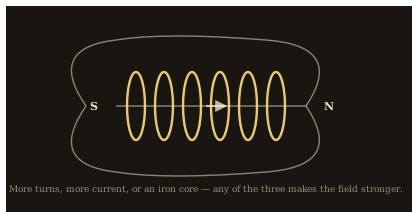
Building an electromagnet, and the three ways to make it stronger
- Take a length of insulated wire and wind it into a solenoid — a long coil of many turns.
- Place a core of magnetically SOFT iron inside the coil. The core is magnetised by induction and hugely increases the field, and it loses that magnetism the moment the current stops.
- Connect the ends to a power supply. The electromagnet is on, and switching the supply off switches the magnet off.
- TO STRENGTHEN IT — one: increase the CURRENT. Two: increase the NUMBER OF TURNS on the coil. Three: use a soft iron CORE, or a better one.
- TO REVERSE THE POLES — reverse the direction of the current. This is something no permanent magnet can do, and it is the whole reason electromagnets are used in motors, relays and loudspeakers.
The core is the part most often misunderstood, so it is worth being exact. The core does not create the field; the current does. What the core does is become an induced magnet in the coil's field and add its own much larger field to it. This is why the core must be magnetically SOFT: a steel core would keep its magnetism after the current stopped, and a scrapyard crane that cannot drop what it has picked up is not a crane.
There is a neat way to find the poles of a solenoid without any rule at all. Look at the end of the coil and ask which way the current is going round it. If it is going ANTICLOCKWISE as you look at that end, you are looking at a NORTH pole; if CLOCKWISE, a SOUTH pole. The letters help: an anticlockwise arrow can be closed into an N, a clockwise one into an S.
2 · Grade 9 Notes
A different job from the section above. You have already understood it; this is the precise set of things to LEARN — definitions to reproduce word for word, processes in order, equations with units, and the answers that score full marks.
Learn this definition · Electromagnet
A solenoid wound on a magnetically soft core, which becomes a magnet only while a current flows in the coil. Its strength can be varied and its poles reversed, and it can be switched off.
The three field patterns of statement 6.10
- STRAIGHT WIRE — concentric circles centred on the wire, in planes at right angles to it; closest together near the wire
- FLAT CIRCULAR COIL — the circles reinforce through the middle, giving a concentrated field through the centre of the loop
- SOLENOID — outside, the same shape as a bar magnet with a pole at each end; inside, a strong and very nearly UNIFORM field
- In every case, reversing the current reverses the whole field
The right-hand grip rule
- Point the THUMB of your RIGHT hand along the wire in the direction of the conventional current, from + to −.
- Curl your fingers round the wire.
- Your fingers now point the way round the circular field lines go.
- For a solenoid, curl your right-hand fingers the way the current goes round the coil; your thumb then points to the NORTH pole.
- Reverse the current and every arrow reverses with it.
Making an electromagnet stronger — the only three answers
- Increase the CURRENT through the coil
- Increase the NUMBER OF TURNS on the coil
- Add or improve a magnetically SOFT IRON CORE
- NOT on the list: making the wire thicker, or using a steel core — steel would keep its magnetism after switch-off
Electromagnet against permanent magnet
| Electromagnet | Permanent magnet | |
|---|---|---|
| Can be switched off | Yes — stop the current | No |
| Strength | Varied by changing the current or the turns | Fixed |
| Poles | Reversed by reversing the current | Fixed |
| Core material | Magnetically soft, so it lets go | Magnetically hard, so it keeps its magnetism |
Model answer [4 marks]
Describe the magnetic field produced around a long straight wire carrying a current, and state how its direction is found. [4]
The field lines form complete circles centred on the wire, lying in planes at right angles to the wire. The lines are closest together near the wire, showing the field is strongest there, and become further apart further away. The direction is found using the right-hand grip rule: point the thumb of the right hand along the wire in the direction of the conventional current and the curled fingers give the direction of the circular field lines. Reversing the current reverses the direction of the field.
Model answer [4 marks]
An electromagnet in a scrapyard crane is not lifting enough steel. Describe two changes that would increase its strength, and explain why its core must be soft iron. [4]
The strength can be increased by increasing the current through the coil, and by increasing the number of turns of wire on the coil. The core must be soft iron because a magnetically soft material is easy to magnetise, so the core becomes strongly magnetic by induction as soon as the current flows, and loses almost all of that magnetism as soon as the current is switched off. This allows the crane to release the steel. A steel core would be magnetically hard and would keep its magnetism, so the load could not be dropped.
Not this: The magnetic field around a current-carrying wire points along the wire, in the direction of the current.
This: The field forms CIRCLES around the wire, at right angles to it. This is precisely what surprised Ørsted: his compass needle set itself across the wire rather than along it, and reversed when the wire was moved to the other side of the needle.
Mark-losing trap. The field round a straight wire is CIRCULAR — not along the wire and not radially outwards.
Mark-losing trap. Use the RIGHT hand for the field around a current. The left hand is for the motor effect.
Mark-losing trap. The core does not make the field; the current does. The core is magnetised by it and adds to it.
Mark-losing trap. An electromagnet core must be SOFT iron — a steel core could never let go of the load.
3 · Prove it — the five questions
The five questions climb Grade 6 → Grade 7 → Grade 8 → Grade 9 → Grade 9 challenge, and are marked inside Incandio on your own device, by rule, with an authored diagnosis of the mistake you actually made. The mark schemes stay in the app so that the practice is worth doing; the questions themselves are here.
- Grade 6 · State [1 mark] — A compass is placed near a long straight wire. What is the shape of the magnetic field produced when a current flows in the wire?
- Grade 7 · State [3 marks] — State three changes that would increase the strength of an electromagnet.
- Grade 8 · Explain [3 marks] — The current through an electromagnet is reversed. Explain what happens to the magnetic field, and give one use that depends on this.
- Grade 9 · Describe [6 marks] — Select every statement that belongs in a full-mark description of how to construct an electromagnet and make it as strong as possible.
- 9+ · Analyse [6 marks] — A student builds an electromagnet that works but is far too weak. They double the number of turns by winding a second layer over the first, but wind the second layer in the OPPOSITE direction around the core. The electromagnet becomes weaker rather than stronger. Select every statement that belongs in a full-mark analysis.
The people behind this science
Two ways into the same idea — the one who saw it happen and refused to believe it for three months, and the one who built machines out of coils and fields rather than out of gears. Inside Incandio each of them answers knowing exactly which lesson you have just finished.
Hans Christian Ørsted — the one who saw it happen and refused to believe it for three months
Statement 6.8 is his discovery, made in front of a class in April 1820. What makes him worth asking is not the moment but what followed it: he did not publish for three months, because he distrusted the result and spent that time building stronger piles, larger needles and better wires, and turning the wire above the needle and then below it to see whether the effect would survive. It did, and the way it survived told him the force was circular. He is also the right person to ask about motivation, because he had been looking for a connection between electricity and magnetism for years on philosophical grounds before he found one.
- “What exactly did the needle do when you closed the circuit?”
- “Why does the needle turn ACROSS the wire instead of towards it?”
- “Why did you wait three months before publishing?”
- “What happened when you moved the wire to the other side of the needle?”
- “What made you look for a connection at all?”
Nikola Tesla — the one who built machines out of coils and fields rather than out of gears
An electromagnet is the first device on this course that can be switched, strengthened and reversed at will, and Tesla's whole career is an argument about what that makes possible. His induction motor works by arranging several coils so that their fields peak in turn, producing a magnetic field that rotates without anything mechanical rotating at all — no brushes, no commutator, nothing to wear out. He is the right second figure here because he shows the destination of this page: the point of a coil is not that it is a magnet but that it is a magnet you can command.
- “What can you build with a magnet you can switch off?”
- “How can a magnetic field rotate without anything moving?”
- “Why did you want to get rid of brushes and commutators?”
- “What does the number of turns on a coil really change?”
- “Why did alternating current suit your machines so well?”
Think you understand it?
Reading is the start. On Incandio a topic counts as mastered only once you have taught it and defended it — the two things a revision guide cannot ask of you.
Incandio this topic → Prove it. Teach it. Defend it. What does “Incandio it” mean?
- Prove it — five questions on electromagnets, marked on the spot, that tell you what was missing rather than just what was wrong.
- Teach it — Explain electromagnets in your own words to Ember, an AI pupil who does not have it yet and asks the awkward question. Understanding is credited; wording is not required.
- Defend it — Argue electromagnets against Hans Christian Ørsted — three rounds, marked against descriptors you can read before you begin.
- Then the exam — read all 11 authored exam-style questions on this unit, each with its command word and its tariff, then have them marked on Incandio with the mistake you actually made named.
Completely free. No subscriptions, no paywalls, no account needed to start.
Carry on through the course
- Previous lesson: Induced Magnetism and Field Patterns
- Next lesson: The Motor Effect
- Magnets and Magnetic Fields — Why only repulsion proves you are holding a magnet, and what a field line is actually a picture of.
- Induced Magnetism and Field Patterns — Why an iron nail sticks to a magnet at all, why it never pushes back, and how to plot a field you cannot see.
- The Motor Effect — Put a current in a magnetic field and something moves — the effect behind every electric motor and every loudspeaker.
- Electromagnetic Induction — Move a magnet near a coil and a voltage appears from nowhere — provided something is changing.
- Transformers — Two coils that never touch, the reason the National Grid runs at 400 000 volts, and why none of it works on a battery.
- All of Physics · Physics key terms · required practicals · equations · Incandio Science · The 4PH1 specification