Pearson Edexcel International GCSE in Physics · 4PH1 · Free · no account needed
Transformers
Two coils that never touch, the reason the National Grid runs at 400 000 volts, and why none of it works on a battery.
Topic 6 · Magnetism and electromagnetism — one of 6 lessons in this topic, and one of 65 in Physics.
This lesson ends with Michael Faraday. Learn transformers, teach it, then defend it against Michael Faraday.
The definition this lesson teaches, word for word — every Physics definition.
- Transformer
- Two coils wound on a soft iron core and not electrically connected. An alternating current in the primary produces a changing magnetic field in the core, which induces an alternating voltage in the secondary.
Its equation is on the Physics equations page with the other 37.
What this lesson covers in the specification
Incandio is aligned to this specification. It is not published by, endorsed by or affiliated with Pearson, and it reproduces none of Pearson's wording — the statement numbers are given so you can check every lesson against your own copy.
- 6.17 — The structure of a transformer and how turns change an alternating voltage (bold P statement — Paper 2 only)
- 6.18 — The use of step-up and step-down transformers in generation and transmission (bold P statement — Paper 2 only)
- 6.19 — Use the transformer turns-ratio relationship (bold P statement — Paper 2 only)
- 6.20 — Use input power = output power for a 100% efficient transformer (bold P statement — Paper 2 only)
1 · Understand it
No exam language yet. The only question this section answers is: do I actually understand what is happening?
A TRANSFORMER is two coils of wire wound on the same core of soft iron, not connected to each other electrically at all. An alternating current in the first coil — the PRIMARY — produces a magnetic field in the core that is constantly changing, because the current producing it is constantly changing. That changing field passes through the second coil — the SECONDARY — and induces an alternating voltage in it. No wire runs between the two, and no part of the device moves.
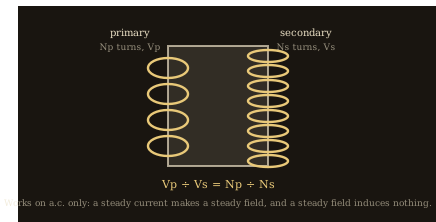
That last point is where most marks are won and lost, so take it now. A TRANSFORMER DOES NOT WORK ON DIRECT CURRENT. Connect a battery to the primary and a steady current flows, producing a steady magnetic field in the core — and a steady field induces nothing whatever in the secondary. The output is zero. This is not a limitation of the design; it is the previous page's rule applied. The only exception is the instant of switching on or off, when the field is briefly changing and the secondary gives a single momentary pulse.
Think of it like a swing being pushed rather than held
Two children on adjacent swings, with a rope between the swings. If the first child swings back and forth, the rope tugs rhythmically and the second swing is set going too — energy passes across without either child touching the other. Now suppose the first child instead sits perfectly still, leaning as hard as they can in one direction. The rope is under enormous tension, and the second swing does absolutely nothing, because a steady pull is not a push-and-release. A transformer is the rope. Alternating current is the child swinging; direct current is the child leaning. The steady pull can be as strong as you like and the second swing will not move.
The voltages depend on the numbers of turns, and the relationship is simple: the ratio of the voltages equals the ratio of the turns. Written the way the specification does, Vp ÷ Vs = Np ÷ Ns, where p is the primary and s the secondary. If the secondary has more turns than the primary the output voltage is higher — a STEP-UP transformer. If it has fewer, the output voltage is lower — a STEP-DOWN transformer.
Both directions, and the current that goes with them
(a) A transformer has 200 turns on the primary and 5000 on the secondary, with 230 V a.c. applied to the primary. Find the output voltage. (b) The transformer is 100% efficient and the primary current is 2.5 A. Find the secondary current.
- (a) Vp ÷ Vs = Np ÷ Ns, so 230 ÷ Vs = 200 ÷ 5000.
- Rearranging: Vs = 230 × 5000 ÷ 200 = 5750 V. The secondary has 25 times the turns, so the voltage is 25 times larger.
- (b) For a 100% efficient transformer, input power = output power: Vp × Ip = Vs × Is.
- 230 × 2.5 = 5750 × Is, so 575 = 5750 × Is.
- Is = 575 ÷ 5750 = 0.10 A.
- Notice the pattern: the voltage went UP by 25 times and the current came DOWN by 25 times. It has to, or the transformer would be creating energy.
Answer: 5750 V from the secondary, at 0.10 A.
That last observation is statement 6.20 and it is the heart of the topic. A transformer changes voltage; it does not create energy. For an ideal transformer the power in equals the power out, so Vp × Ip = Vs × Is. Step the voltage UP and the current necessarily comes DOWN in the same proportion, and the other way round. A transformer that increased both would be a free energy machine.
Why the National Grid uses hundreds of thousands of volts — statement 6.18
- Power stations generate at around 25 000 V. The energy has to travel hundreds of kilometres along cables.
- Any cable has resistance, so a current in it heats it, and that heat is energy wasted. The waste depends on the SQUARE of the current — double the current and you waste four times as much.
- So the way to cut the waste is to cut the CURRENT, not to improve the cable.
- A STEP-UP transformer raises the voltage to 400 000 V. Since the power carried is the same, raising the voltage sixteen-fold cuts the current sixteen-fold — and cuts the heating loss by a factor of over two hundred.
- At the other end, STEP-DOWN transformers reduce the voltage in stages, finally to 230 V, which is low enough to be safe in a house.
- The whole scheme depends on transformers, and transformers depend on alternating current. That is why mains electricity is a.c. rather than d.c.
A real transformer is not quite 100% efficient, and the losses are worth knowing because they explain the construction. Current in the coils heats them, which is why the windings are thick copper. The core is repeatedly magnetised and demagnetised, which wastes energy, so the core is made of magnetically SOFT iron that gives up its magnetism easily. And the changing field induces unwanted currents in the core itself, so the core is built from thin sheets separated by insulation rather than being a solid block. Even so, large grid transformers reach efficiencies above 99%.
2 · Grade 9 Notes
A different job from the section above. You have already understood it; this is the precise set of things to LEARN — definitions to reproduce word for word, processes in order, equations with units, and the answers that score full marks.
Vp ÷ Vs = Np ÷ Ns
Vp and Vs are the primary and secondary voltages in volts (V); Np and Ns are the numbers of turns on the primary and secondary coils
Units: V and V; turns are a pure number. Ns greater than Np gives a STEP-UP transformer; Ns less than Np gives a STEP-DOWN transformer.
Vp × Ip = Vs × Is
Vp and Vs are the primary and secondary voltages in volts (V); Ip and Is are the primary and secondary currents in amperes (A)
Units: V × A = W. This holds for a 100% efficient transformer: input power equals output power, so raising the voltage lowers the current in the same proportion.
Learn this definition · Transformer
Two coils wound on a soft iron core and not electrically connected. An alternating current in the primary produces a changing magnetic field in the core, which induces an alternating voltage in the secondary.
Step-up against step-down
| Step-up | Step-down | |
|---|---|---|
| Turns | More turns on the secondary than the primary | Fewer turns on the secondary than the primary |
| Voltage | Output voltage is higher | Output voltage is lower |
| Current | Output current is lower | Output current is higher |
| Used | At the power station, to raise voltage for transmission | Near the consumer, to bring voltage down to 230 V |
Working a transformer question
- Identify which coil is the primary (input) and which is the secondary (output).
- For a voltage or turns question, use Vp ÷ Vs = Np ÷ Ns and rearrange before substituting.
- Check the answer against the turns: more turns on the secondary MUST give a higher voltage.
- For a current question, use Vp × Ip = Vs × Is, which assumes 100% efficiency.
- Check again: if the voltage went up, the current must have come down by the same factor.
Why the grid transmits at high voltage
- Cables have resistance, so a current heats them and that heat is wasted energy
- The heating loss depends on the SQUARE of the current, so halving the current quarters the loss
- Transmitting the same power at a higher voltage requires a smaller current
- A STEP-UP transformer raises the voltage to 400 000 V for transmission
- STEP-DOWN transformers reduce it in stages to 230 V, which is safe for domestic use
- None of this is possible with d.c., which is why mains electricity is alternating
Model answer [3 marks]
A transformer has 800 turns on the primary and 40 turns on the secondary. An alternating supply of 240 V is connected to the primary. Calculate the secondary voltage. [3]
Using Vp ÷ Vs = Np ÷ Ns gives 240 ÷ Vs = 800 ÷ 40. Rearranging, Vs = 240 × 40 ÷ 800 = 12 V. The secondary has one twentieth of the turns, so the output voltage is one twentieth of the input, and this is a step-down transformer.
Model answer [5 marks]
Explain why electricity is transmitted across the National Grid at very high voltage. [5]
The cables of the grid have resistance, so the current flowing in them heats them and that energy is wasted. The energy wasted per second depends on the square of the current, so reducing the current reduces the waste very sharply. For a given amount of power being transmitted, the power is the voltage multiplied by the current, so transmitting at a higher voltage means a smaller current is needed to carry the same power. A step-up transformer at the power station therefore raises the voltage to about 400 000 V, which greatly reduces the current and hence the energy wasted as heat in the cables. Step-down transformers then reduce the voltage again near the consumer, to a value that is safe to use.
Not this: A step-up transformer increases the power available, because the output voltage is higher.
This: It increases the VOLTAGE and decreases the CURRENT in the same proportion, so the power is unchanged. A transformer that raised both would be creating energy from nothing.
Mark-losing trap. A transformer produces NOTHING on d.c. — a steady current gives a steady field, which induces nothing.
Mark-losing trap. Higher voltage means LOWER current for the same power. The two always move opposite ways.
Mark-losing trap. The grid uses high voltage to cut the CURRENT, because heating loss depends on the current squared.
Mark-losing trap. Check every answer against the turns: more secondary turns must give more volts.
3 · Prove it — the five questions
The five questions climb Grade 6 → Grade 7 → Grade 8 → Grade 9 → Grade 9 challenge, and are marked inside Incandio on your own device, by rule, with an authored diagnosis of the mistake you actually made. The mark schemes stay in the app so that the practice is worth doing; the questions themselves are here.
- Grade 6 · Calculate [2 marks] — A transformer has 100 turns on the primary and 400 turns on the secondary. An alternating supply of 12 V is connected to the primary. Calculate the secondary voltage.
- Grade 7 · Explain [3 marks] — A student connects a 12 V battery to the primary coil of a transformer and finds no voltage across the secondary. Explain why.
- Grade 8 · Calculate [3 marks] — A 100% efficient transformer has an input of 230 V at 4.0 A. The output voltage is 11 500 V. Calculate the output current.
- Grade 9 · Explain [6 marks] — Select every statement that belongs in a full-mark explanation of why electrical power is transmitted across the National Grid at very high voltage.
- 9+ · Analyse [6 marks] — A student claims that a step-up transformer with 10 times as many turns on the secondary as on the primary gives '10 times the electricity', and that connecting two such transformers in series would give 100 times as much. Select every statement that belongs in a full-mark analysis.
The people behind this science
Two ways into the same idea — the one who won the argument about which kind of current the world would use, and the one who built the first transformer without knowing what it was for. Inside Incandio each of them answers knowing exactly which lesson you have just finished.
Nikola Tesla — the one who won the argument about which kind of current the world would use
This page explains why mains electricity has to be a.c., and Tesla is the person who forced that outcome. In the 1880s Edison had built direct-current stations, which could not transform and so could not transmit power more than about a mile before the losses became hopeless. Tesla's alternating-current system, backed by Westinghouse, could be stepped up for transmission and down for use, and it won the contract to harness Niagara Falls in 1893. The dispute was fought partly with public demonstrations designed to make a.c. look lethal. He is the right person to ask what the choice actually turned on, and what it cost him.
- “Why can direct current not be transmitted very far?”
- “What could alternating current do that Edison's system could not?”
- “How did the argument over the two systems actually go?”
- “What did winning Niagara Falls prove?”
- “Was the dispute settled by physics or by publicity?”
Michael Faraday — the one who built the first transformer without knowing what it was for
The very apparatus that revealed induction was a transformer: an iron ring with two separate coils wound on opposite sides, connected to nothing in common. Faraday connected a battery to one coil and watched the needle on the other circuit twitch at the instant of connection and again at the instant of disconnection, and read nothing in between. That is this page's whole physics discovered before anyone had a use for it, and it is also the cleanest demonstration that d.c. gives you nothing but the switching instants. He is the person to ask what it is like to build the foundation of an industry as a laboratory curiosity.
- “What did you see when you connected the battery to the ring?”
- “Why did the needle move only at the moment of switching?”
- “Why does the second coil need no connection to the first?”
- “What made you wind two separate coils on one ring?”
- “Did it occur to you this could carry power across a country?”
Think you understand it?
Reading is the start. On Incandio a topic counts as mastered only once you have taught it and defended it — the two things a revision guide cannot ask of you.
Incandio this topic → Prove it. Teach it. Defend it. What does “Incandio it” mean?
- Prove it — five questions on transformers, marked on the spot, that tell you what was missing rather than just what was wrong.
- Teach it — Explain transformers in your own words to Ember, an AI pupil who does not have it yet and asks the awkward question. Understanding is credited; wording is not required.
- Defend it — Argue transformers against Michael Faraday — three rounds, marked against descriptors you can read before you begin.
- Then the exam — read all 10 authored exam-style questions on this unit, each with its command word and its tariff, then have them marked on Incandio with the mistake you actually made named.
Completely free. No subscriptions, no paywalls, no account needed to start.
Carry on through the course
- Previous lesson: Electromagnetic Induction
- Next lesson: Atomic Structure and Isotopes
- Magnets and Magnetic Fields — Why only repulsion proves you are holding a magnet, and what a field line is actually a picture of.
- Induced Magnetism and Field Patterns — Why an iron nail sticks to a magnet at all, why it never pushes back, and how to plot a field you cannot see.
- Electromagnets — The four pages of Latin that showed a current makes a field — and why that field goes round the wire rather than along it.
- The Motor Effect — Put a current in a magnetic field and something moves — the effect behind every electric motor and every loudspeaker.
- Electromagnetic Induction — Move a magnet near a coil and a voltage appears from nowhere — provided something is changing.
- All of Physics · Physics key terms · required practicals · equations · Incandio Science · The 4PH1 specification