Pearson Edexcel International GCSE in Physics · 4PH1 · Free · no account needed
Magnets and Magnetic Fields
Why only repulsion proves you are holding a magnet, and what a field line is actually a picture of.
Topic 6 · Magnetism and electromagnetism — one of 6 lessons in this topic, and one of 65 in Physics.
This lesson ends with William Gilbert. Learn Magnets and Magnetic Fields, teach it, then defend it against William Gilbert.
The definition this lesson teaches, word for word — every Physics definition.
- Magnetic field line
- The path that a free north pole would follow if placed in the field. Outside a magnet the lines run from the north pole to the south pole, and they never cross.
What this lesson covers in the specification
Incandio is aligned to this specification. It is not published by, endorsed by or affiliated with Pearson, and it reproduces none of Pearson's wording — the statement numbers are given so you can check every lesson against your own copy.
- 6.1 — Use the units ampere, volt and watt
- 6.2 — Magnets repel and attract other magnets and attract magnetic substances
- 6.3 — The properties of magnetically hard and soft materials
- 6.4 — The term magnetic field line
1 · Understand it
No exam language yet. The only question this section answers is: do I actually understand what is happening?
A magnet has two ends that behave differently, and we call them the NORTH POLE and the SOUTH POLE. Bring two magnets together and the rule is the one everybody half-remembers: like poles REPEL and unlike poles ATTRACT. North pushes north away; north pulls south towards it. The force acts at a distance, through air, through a table, through your hand — nothing has to touch.
Now the sentence that this whole topic depends on, and it is the one most learners never get told. A magnet also attracts things that are not magnets at all — iron, steel, nickel and cobalt, the MAGNETIC MATERIALS. So if you hold something against a magnet and it is pulled towards it, you have learned almost nothing: it might be another magnet turned the right way round, or it might be an ordinary iron nail. Attraction is ambiguous. REPULSION IS NOT. Nothing except another magnet can be pushed away, so repulsion is the only test that proves you are holding two magnets.
Think of it like proving someone is awake
If you speak to someone and they do not move, you have learned nothing — they might be asleep, or awake and ignoring you. If you speak and they answer, that settles it. Attraction is the non-answer: an iron nail is dragged towards a magnet and so is the south pole of a second magnet, and from outside the two look identical. Repulsion is the answer. An iron nail can never push back, because a magnet magnetises it in whatever way brings the two together — the nail is not free to disagree. Only something with its own fixed poles can be forced apart, so a push is a confession.
That leads straight to the difference between the two kinds of magnetic material, statement 6.3. A MAGNETICALLY SOFT material — pure iron is the standard example — is easy to magnetise and just as easy to demagnetise. Take the field away and it loses almost all its magnetism at once. A MAGNETICALLY HARD material — steel, and the alloys used for permanent magnets — is harder to magnetise in the first place and then keeps its magnetism when the field is removed.
Choosing the material, which is what the examiner actually asks
- Ask one question first: does this object need to STAY magnetic, or does it need to STOP being magnetic the moment it is switched off?
- A fridge magnet, a compass needle, a loudspeaker magnet — these must keep their magnetism indefinitely, so they are made of a magnetically HARD material such as steel.
- An electromagnet's core must lose its magnetism the instant the current stops, or a crane could never drop the scrap it has just picked up. So the core is magnetically SOFT iron.
- A transformer core reverses its magnetism fifty times a second, so it must be effortless to magnetise and demagnetise — soft iron again.
- Nothing here is about strength. A soft material can produce a very strong field while the current flows; it simply does not keep it.
The space around a magnet where it can exert a force is its MAGNETIC FIELD, and we draw it with FIELD LINES. A magnetic field line is defined as the path a free north pole would follow if it were placed in the field — which is why the lines are drawn with arrows and why, outside the magnet, they always run from NORTH to SOUTH. There is a real object that does this: a plotting compass is a tiny magnet free to turn, and its north end points along the field line at every point you set it down.
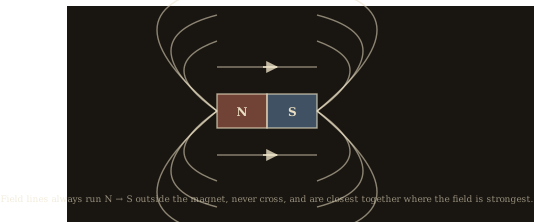
Field lines carry two pieces of information at once, and marks are lost by reading only one. The DIRECTION of the line is the direction of the force on a north pole. The SPACING of the lines is the strength: closely spaced lines mean a strong field, widely spaced lines a weak one. It follows that field lines can never cross, because a crossing point would be a place where a compass needle was being told to point in two directions at the same time, and it cannot.
Finally the units, statement 6.1, which look like a footnote and are the vocabulary of the next four pages. Current is measured in AMPERES, one ampere being one coulomb of charge passing a point every second. Potential difference is measured in VOLTS, one volt being one joule of energy transferred per coulomb. Power is measured in WATTS, one watt being one joule per second — and for an electrical device, power in watts is current in amperes multiplied by potential difference in volts.
2 · Grade 9 Notes
A different job from the section above. You have already understood it; this is the precise set of things to LEARN — definitions to reproduce word for word, processes in order, equations with units, and the answers that score full marks.
Learn this definition · Magnetic field line
The path that a free north pole would follow if placed in the field. Outside a magnet the lines run from the north pole to the south pole, and they never cross.
Statement 6.1 — the units of this topic
- A (ampere)
- Current. One ampere is one coulomb of charge passing a point each second.
- V (volt)
- Potential difference. One volt is one joule of energy transferred per coulomb.
- W (watt)
- Power. One watt is one joule per second; for a device, watts = amperes × volts.
The magnetic materials
- IRON, STEEL, NICKEL and COBALT are attracted by a magnet
- Copper, aluminium, brass, plastic, wood and glass are NOT — being a metal is not enough
- A magnet attracts an unmagnetised magnetic material AND attracts the opposite pole of another magnet
- Only another MAGNET can be repelled
Magnetically hard against magnetically soft
| Magnetically hard (e.g. steel) | Magnetically soft (e.g. iron) | |
|---|---|---|
| Magnetising it | Harder to magnetise | Easy to magnetise |
| When the field is removed | Keeps its magnetism | Loses almost all its magnetism |
| Used for | Permanent magnets, compass needles, loudspeakers | Electromagnet cores, transformer cores, relays |
| Why that use | The object must stay magnetic with nothing switched on | The object must stop being magnetic the moment the current stops |
Reading a field diagram — what the lines tell you
- The ARROW gives the direction of the force on a north pole; outside the magnet it points N → S
- The SPACING gives the strength: close together is strong, far apart is weak
- The field is therefore strongest AT THE POLES, where the lines are most crowded
- Lines NEVER cross — a compass cannot point two ways at one point
- A plotting compass is the physical version of a field line: its north end lies along the line
Deciding whether an object is a magnet
- Bring the unknown object near one pole of a known magnet.
- If it is REPELLED, it is a magnet — nothing else can be pushed away.
- If it is attracted, turn it round and try the other end against the same pole.
- Attracted both ways round: it is an unmagnetised magnetic material, such as an iron nail.
- Attracted one way and repelled the other: it is a magnet.
Model answer [4 marks]
Explain why attraction alone does not prove that an object is a magnet, and state the test that does. [4]
A magnet attracts unmagnetised magnetic materials such as iron and steel as well as attracting the opposite pole of another magnet, so an object that is attracted could be either. Repulsion, however, only occurs between two like poles, so only a magnet can be repelled by a magnet. The test is therefore to bring the object near one pole of a known magnet and look for repulsion: if it is pushed away it must be a magnet.
Model answer [3 marks]
A crane in a scrapyard uses an electromagnet to lift steel. Explain why its core is made of soft iron rather than steel. [3]
Soft iron is magnetically soft, so it is easy to magnetise and loses almost all of its magnetism as soon as the current is switched off. This means the crane can release the load when required. If the core were made of steel it would be magnetically hard and would keep its magnetism after the current stopped, so the scrap would remain stuck to the crane.
Not this: A magnet attracts all metals.
This: Only IRON, STEEL, NICKEL and COBALT are attracted. Copper, aluminium and brass are metals and are not attracted at all — which is precisely how a scrapyard separates steel from aluminium.
Mark-losing trap. ATTRACTION proves nothing; only REPULSION proves that both objects are magnets.
Mark-losing trap. Field lines run N → S OUTSIDE the magnet, and they can never cross.
Mark-losing trap. Hard and soft describe how easily magnetism is KEPT, not how strong the magnet is.
Mark-losing trap. Close-together field lines mean a STRONG field — the spacing is information, not decoration.
3 · Prove it — the five questions
The five questions climb Grade 6 → Grade 7 → Grade 8 → Grade 9 → Grade 9 challenge, and are marked inside Incandio on your own device, by rule, with an authored diagnosis of the mistake you actually made. The mark schemes stay in the app so that the practice is worth doing; the questions themselves are here.
- Grade 6 · State [1 mark] — A student holds the north pole of one bar magnet near the north pole of another. What happens?
- Grade 7 · Explain [3 marks] — A steel bar is attracted to the north pole of a magnet. A student concludes that the steel bar must be a magnet. Is the student correct, and why?
- Grade 8 · Explain [3 marks] — A relay switch contains a coil wound on a core. The core must become magnetic when a current flows and must stop being magnetic the instant the current stops. State the type of magnetic material required and explain why.
- Grade 9 · Describe [5 marks] — A student is given two identical-looking steel bars. One is a magnet and one is not. Select every statement that belongs in a full-mark description of how to find out which is which, using no other equipment.
- 9+ · Evaluate [6 marks] — A student draws a field diagram for a bar magnet in which two field lines cross at a point beyond the north pole, and labels the crossing point 'where the field is strongest'. Select every statement that belongs in a full-mark evaluation.
The people behind this science
Two ways into the same idea — the one who invented the field line in the first place, and the one who turned the picture into mathematics without throwing it away. Inside Incandio each of them answers knowing exactly which lesson you have just finished.
Michael Faraday — the one who invented the field line in the first place
Statement 6.4 is his invention. Faraday had almost no mathematics, and he thought about magnetism by scattering iron filings on card and watching the curves they made — then arguing that those curves are not a drawing aid but a real physical thing filling the space, which he called lines of force. Every physicist of standing thought this was naive, because the accepted view was that magnets act on each other across empty space at a distance, with nothing in between. He is the right person to ask why a picture in the head can be a scientific claim, and how someone with no equations at all persuaded physics to change its mind about what space contains.
- “What is a line of force actually made of?”
- “Why did you not believe in action across empty space?”
- “What do iron filings on a card really show you?”
- “How did you do physics without mathematics?”
- “Why can two field lines never cross?”
James Clerk Maxwell — the one who turned the picture into mathematics without throwing it away
Maxwell read Faraday's papers as a young man and did something nobody expected: instead of dismissing the lines of force as the untutored picture-making of a bookbinder's apprentice, he took them literally and looked for the equations they implied. He said later that Faraday was in reality a mathematician of a very high order, one from whom the mathematicians of the future might derive valuable methods. He is the second angle on this page because he shows what happens to a good picture when someone tests whether it can be made exact — and the answer, eventually, was that light itself is a disturbance in these fields.
- “Why did you take Faraday's lines seriously when others did not?”
- “Can a picture in the head really be turned into equations?”
- “What is a field, if it is not just a way of drawing?”
- “What did you find that Faraday could not have?”
- “Was Faraday a mathematician without knowing it?”
Think you understand it?
Reading is the start. On Incandio a topic counts as mastered only once you have taught it and defended it — the two things a revision guide cannot ask of you.
Incandio this topic → Prove it. Teach it. Defend it. What does “Incandio it” mean?
- Prove it — five questions on Magnets and Magnetic Fields, marked on the spot, that tell you what was missing rather than just what was wrong.
- Teach it — Explain Magnets and Magnetic Fields in your own words to Ember, an AI pupil who does not have it yet and asks the awkward question. Understanding is credited; wording is not required.
- Defend it — Argue Magnets and Magnetic Fields against William Gilbert — three rounds, marked against descriptors you can read before you begin.
- Then the exam — read all 11 authored exam-style questions on this unit, each with its command word and its tariff, then have them marked on Incandio with the mistake you actually made named.
Completely free. No subscriptions, no paywalls, no account needed to start.
Carry on through the course
- Previous lesson: The Gas Laws
- Next lesson: Induced Magnetism and Field Patterns
- Induced Magnetism and Field Patterns — Why an iron nail sticks to a magnet at all, why it never pushes back, and how to plot a field you cannot see.
- Electromagnets — The four pages of Latin that showed a current makes a field — and why that field goes round the wire rather than along it.
- The Motor Effect — Put a current in a magnetic field and something moves — the effect behind every electric motor and every loudspeaker.
- Electromagnetic Induction — Move a magnet near a coil and a voltage appears from nowhere — provided something is changing.
- Transformers — Two coils that never touch, the reason the National Grid runs at 400 000 volts, and why none of it works on a battery.
- All of Physics · Physics key terms · required practicals · equations · Incandio Science · The 4PH1 specification