Pearson Edexcel International GCSE in Biology · 4BI1 · Free · no account needed
Synapses and the Reflex Arc
Neurones do not touch. What crosses the gap between them, why the gap is there at all, and how a hand leaves a hot pan before you know it was hot.
On the specification this is role of neurotransmitters at synapses — 4BI1 statements 2.89 · 2.90.
Topic 2 · Structures and functions in living organisms — one of 34 lessons in this topic, and one of 68 in Biology.
This lesson ends with Santiago Ramón y Cajal. Learn Synapses and the Reflex Arc, teach it, then defend it against Santiago Ramón y Cajal.
The 3 definitions this lesson teaches, word for word — every Biology definition.
- Synapse
- The junction between two neurones, where a small gap separates the ending of one from the membrane of the next.
- Neurotransmitter
- A chemical released from vesicles at the ending of a neurone, which diffuses across the synapse and binds to receptor molecules on the next neurone, generating a new impulse in it.
- Reflex action
- A rapid, automatic response to a stimulus that does not involve conscious control by the brain, usually protective in function.
What this lesson covers in the specification
Incandio is aligned to this specification. It is not published by, endorsed by or affiliated with Pearson, and it reproduces none of Pearson's wording — the statement numbers are given so you can check every lesson against your own copy.
- 2.89 — The role of neurotransmitters at synapses
- 2.90 — The structure and functioning of a simple reflex arc
Specification section 2(j) Co-ordination and response — also taught in ADH and the Water Balance of the Blood, Homeostasis and the Control of Body Temperature, Plant Responses, Tropisms and Auxin, The Nervous System, and the Two Ways a Body Sends a Message.
1 · Understand it
No exam language yet. The only question this section answers is: do I actually understand what is happening?
Here is a fact that ought to be a problem. Neurones do not join up. Where one ends and the next begins there is a gap — far too small to see with an ordinary microscope, but a real gap, with fluid in it. An electrical impulse cannot jump a gap. So every message your nervous system sends has to stop at least once on the way and be turned into something else.
That junction is called a SYNAPSE, and what crosses it is not electricity but a chemical. When the impulse reaches the end of the first neurone it causes tiny sacs there to release a chemical called a NEUROTRANSMITTER into the gap. The neurotransmitter diffuses across — and diffusion is quick here for exactly the reason the diffusion lesson gave, because the distance is minute. On the far side it binds to receptor molecules in the membrane of the next neurone, and if enough of them are occupied a new electrical impulse begins in that second neurone. The message continues, in the same form it started in, having briefly been something else.
Think of it like a relay race with a river in the middle
A runner cannot cross the river, so at the bank they throw a package across to the next runner, who catches it and runs on. Three things follow immediately, and they are the three things the specification wants you to notice. The crossing takes a moment, so it is the slowest part of the whole race. It only works one way, because only the first runner has anything to throw and only the second is standing there to catch. And if you interfere with the package — or with the catcher's hands — the race stops at the river, even though both runners are perfectly fit.
Crossing a synapse, step by step
- An electrical impulse travels along the first neurone and arrives at its ending.
- This causes vesicles — small sacs in the ending — to release a neurotransmitter into the gap.
- The neurotransmitter diffuses across the gap. The gap is extremely narrow, so this takes well under a millisecond.
- The neurotransmitter binds to receptor molecules on the membrane of the next neurone.
- If enough receptors are occupied, a new electrical impulse is generated in the next neurone and travels on.
- The neurotransmitter is then broken down or taken back up, so the synapse is cleared and ready for the next impulse rather than firing continuously.
It is worth asking why a body would build in a gap that slows everything down. Crossing one costs roughly 0.7 of a millisecond, which is far longer than the impulse would take to cover the same distance along a neurone. The answer is that the gap buys something conduction cannot. It makes transmission ONE-WAY: only the first neurone has the vesicles and only the second has the receptors, so an impulse can never run backwards and the whole system has a direction. It also makes junctions possible — many neurones can feed into one, or one into many — so a synapse is where the nervous system does anything more interesting than carrying a message in a straight line. And, unavoidably, it is the point where a chemical from outside the body can interfere.
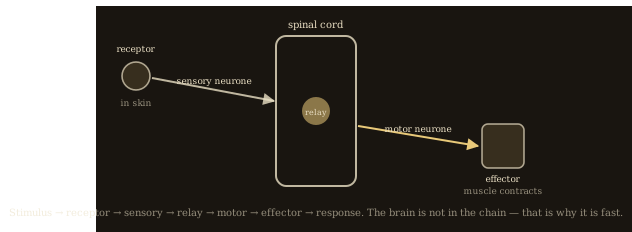
Now the reflex. Put your hand on something unexpectedly hot and it is off again before you have decided anything — in fact before you have even felt the pain. That is a REFLEX ACTION: rapid, automatic, and not under conscious control. The reason it is so fast is what the pathway leaves out. The impulse does not go to the brain and wait for a decision. It runs into the spinal cord, crosses to a relay neurone there, crosses again onto a motor neurone, and comes straight back out to the muscle.
The reflex arc — the path taken by a hand leaving a hot pan
- STIMULUS: the high temperature of the pan.
- RECEPTOR: temperature and pain receptors in the skin of the hand detect it and convert it into an electrical impulse.
- SENSORY NEURONE: carries the impulse into the spinal cord.
- SYNAPSE, then RELAY NEURONE: inside the spinal cord, the impulse crosses to a relay neurone.
- SYNAPSE, then MOTOR NEURONE: it crosses again onto a motor neurone leaving the spinal cord.
- EFFECTOR: the biceps muscle of the arm contracts.
- RESPONSE: the hand is pulled away from the pan.
The brain is not left out of the story entirely — an impulse does travel up the spinal cord to it, which is how you come to be aware of what happened. But the response did not wait for that, which is why the order of events feels strange when you pay attention to it: the hand moves first and the pain arrives afterwards. Most people assume they pulled their hand away because it hurt. They pulled it away instead of waiting to find out that it hurt, and the fraction of a second saved is the difference between a fright and a burn.
Reflexes are not only for danger, though the protective ones are the easiest to notice: blinking when something moves towards the eye, the pupil narrowing in bright light, coughing, the knee jerking when the tendon below it is tapped. What they share is the shape of the pathway rather than the purpose — a fixed route from receptor to effector that produces the same response every time, without deciding anything.
2 · Grade 9 Notes
A different job from the section above. You have already understood it; this is the precise set of things to LEARN — definitions to reproduce word for word, processes in order, equations with units, and the answers that score full marks.
Learn this definition · Synapse
The junction between two neurones, where a small gap separates the ending of one from the membrane of the next.
Learn this definition · Neurotransmitter
A chemical released from vesicles at the ending of a neurone, which diffuses across the synapse and binds to receptor molecules on the next neurone, generating a new impulse in it.
Learn this definition · Reflex action
A rapid, automatic response to a stimulus that does not involve conscious control by the brain, usually protective in function.
Transmission across a synapse — the six marking points
- An electrical impulse arrives at the ending of the first neurone.
- Vesicles release a neurotransmitter into the gap.
- The neurotransmitter diffuses across the gap.
- It binds to receptor molecules on the membrane of the next neurone.
- A new electrical impulse is generated in the next neurone.
- The neurotransmitter is broken down or reabsorbed, so the synapse is cleared for the next impulse.
The reflex arc — the pathway, in the order marks are awarded
- Stimulus.
- Receptor, in a sense organ, converts it to an electrical impulse.
- Sensory neurone carries the impulse to the central nervous system.
- Relay neurone, within the spinal cord, connects sensory to motor — with a synapse on each side of it.
- Motor neurone carries the impulse out to the effector.
- Effector — a muscle or gland — produces the response.
The features of a reflex action — the phrases that earn the marks
- Rapid
- The impulse takes the shortest available route, through the spinal cord rather than via the brain.
- Automatic / involuntary
- It happens without any decision, and cannot be prevented by deciding not to.
- Protective
- Most reflexes prevent damage — withdrawal from heat, blinking, the pupil reflex in bright light.
- The same every time
- The pathway is fixed, so the same stimulus produces the same response in everyone.
- The brain is informed, not consulted
- An impulse does travel to the brain, which is why you become aware of it — but the response has already happened.
Why the gap makes transmission one-way — a favourite six-mark discriminator
A. Only the FIRST neurone has vesicles containing neurotransmitter, so only it can send anything across the gap.
B. Only the SECOND neurone has the receptor molecules that the neurotransmitter binds to, so only it can be stimulated. An impulse therefore cannot travel backwards through a synapse.
Not this: The electrical impulse jumps across the synapse.
This: Nothing electrical crosses the gap. The impulse causes a chemical to be released, the chemical diffuses across, and a NEW impulse begins on the other side.
Model answer [5 marks]
Describe how an impulse is transmitted from one neurone to the next at a synapse. [5]
The electrical impulse arrives at the ending of the first neurone, causing vesicles to release a neurotransmitter into the gap. The neurotransmitter diffuses across the gap and binds to receptor molecules on the membrane of the next neurone. This generates a new electrical impulse in that neurone. The neurotransmitter is then broken down or reabsorbed so that the synapse is ready for the next impulse.
Model answer [3 marks]
Explain why a reflex action is faster than a voluntary response to the same stimulus. [3]
In a reflex the impulse passes from the sensory neurone to a relay neurone in the spinal cord and straight out along a motor neurone, so the pathway is short. It does not travel to the brain and no decision has to be made, so no time is lost in processing. Fewer synapses are crossed, and each synapse adds a delay because the neurotransmitter has to be released and diffuse across.
Model answer [2 marks]
Explain why transmission at a synapse can occur in only one direction. [2]
The vesicles containing the neurotransmitter are present only in the ending of the first neurone, so only that neurone can release it. The receptor molecules that the neurotransmitter binds to are present only on the membrane of the second neurone, so only that neurone can be stimulated.
Mark-losing trap. Nothing electrical crosses a synapse. A chemical diffuses across, and a NEW impulse starts on the other side.
Mark-losing trap. A relay neurone lies inside the CNS. There are two synapses in a simple reflex arc — one on each side of it.
Mark-losing trap. The brain is not part of a reflex arc. It is informed afterwards, which is why the pain arrives after the movement.
Mark-losing trap. Name the effector as a muscle or a gland, and say what it does — contracts, or secretes.
Mark-losing trap. Say the neurotransmitter BINDS TO RECEPTORS. 'Goes into the next neurone' is not what happens and is not credited.
3 · Prove it — the five questions
The five questions climb Grade 6 → Grade 7 → Grade 8 → Grade 9 → Grade 9 challenge, and are marked inside Incandio on your own device, by rule, with an authored diagnosis of the mistake you actually made. The mark schemes stay in the app so that the practice is worth doing; the questions themselves are here.
- Grade 6 · State [1 mark] — What is a synapse?
- Grade 7 · Identify [1 mark] — A person treads on a sharp stone and lifts their foot immediately. Which structure in this reflex arc lies entirely within the spinal cord?
- Grade 8 · Describe [5 marks] — Describe how an impulse is transmitted from one neurone to the next across a synapse. Select every statement that belongs in a full-mark answer.
- Grade 9 · Calculate [4 marks] — In a withdrawal reflex the impulse travels a total of 1.5 m along neurones at a speed of 60 m/s, and crosses two synapses, each of which adds a delay of 0.70 ms. Calculate the total time for the reflex, in milliseconds.
- 9+ · Analyse [5 marks] — An arrow poison is injected into an animal's leg. Tests show that impulses still travel normally along its motor neurones, that neurotransmitter is still released in normal amounts, and that the muscle still contracts when stimulated directly by an electric current — yet the animal cannot move that leg. Select every statement that these results justify.
The people behind this science
Two ways into the same idea — the one who argued for a gap he could not see, and the one who proved the junction is a separate place. Inside Incandio each of them answers knowing exactly which lesson you have just finished.
Santiago Ramón y Cajal — the one who argued for a gap he could not see
The gap this lesson is built on was, in Cajal's lifetime, an inference rather than an observation — his microscope could not resolve it, and it was not directly seen until electron microscopes were turned on nervous tissue in the 1950s, twenty years after he died. What he could show was that each stained cell was complete in itself and ended near the next without merging into it, and that impulses ran one way through a cell. Arguing successfully for something you cannot see, against a theory everyone accepts, is the interesting part of his story, and it is precisely what a synapse required.
- “How do you argue for something your instrument cannot show you?”
- “What did you see at the point where one cell ended and another began?”
- “Why does it matter whether the cells are joined or merely close?”
- “How did you work out which way the impulse travels through a cell?”
- “What would you say to Golgi, who never accepted it?”
Claude Bernard — the one who proved the junction is a separate place
Bernard took an arrow poison and used it as an instrument. He showed that curare leaves the nerve able to carry its impulse and leaves the muscle able to contract when stimulated directly — yet the animal cannot move. The only place left for the poison to be acting is the junction between the two, which is exactly the interference this lesson's last question describes. It is one of the cleanest demonstrations in physiology that a thing can be located by finding out precisely what it is not.
- “How did you show curare acts on neither the nerve nor the muscle?”
- “What does it mean to use a poison as a scientific instrument?”
- “What did you conclude about the junction between nerve and muscle?”
- “Why is it useful to find out what a substance does NOT affect?”
Think you understand it?
Reading is the start. On Incandio a topic counts as mastered only once you have taught it and defended it — the two things a revision guide cannot ask of you.
Incandio this topic → Prove it. Teach it. Defend it. What does “Incandio it” mean?
- Prove it — five questions on Synapses and the Reflex Arc, marked on the spot, that tell you what was missing rather than just what was wrong.
- Teach it — Explain Synapses and the Reflex Arc in your own words to Ember, an AI pupil who does not have it yet and asks the awkward question. Understanding is credited; wording is not required.
- Defend it — Argue Synapses and the Reflex Arc against Santiago Ramón y Cajal — three rounds, marked against descriptors you can read before you begin.
- Then the exam — read all 9 authored exam-style questions on this unit, each with its command word and its tariff, then have them marked on Incandio with the mistake you actually made named.
Completely free. No subscriptions, no paywalls, no account needed to start.
Carry on through the course
- Previous lesson: The Nervous System, and the Two Ways a Body Sends a Message
- Next lesson: The Eye — Focusing, and the Pupil Reflex
- Levels of Organisation — From organelle to organism — the five-step ladder that every later topic in biology is built on.
- Comparing Cells, and Stem Cells — What plant and animal cells share and where they differ — then why a cell specialising is one of the most powerful ideas in biology.
- Carbohydrates, Proteins and Lipids — The three big food molecules — what they are made of, what they are built from, and how to test for them.
- Enzymes: Catalysts With a Shape — Why a protein with a hole in it speeds up a reaction, and why heat destroys that ability permanently.
- Enzymes and pH — Why acid ruins one enzyme and is the only condition another will work in — and how to find an enzyme's best pH by experiment.
- All of Biology · Biology key terms · required practicals · Incandio Science · The 4BI1 specification