Pearson Edexcel International GCSE in Physics · 4PH1 · Free · no account needed
Hooke's Law and Elasticity
Why a spring stretches in proportion to the force — until, quite suddenly, it does not.
Topic 1 · Forces and motion — one of 10 lessons in this topic, and one of 65 in Physics.
This lesson ends with Robert Hooke. Learn Hooke's Law and Elasticity, teach it, then defend it against Robert Hooke.
The definition this lesson teaches, word for word — every Physics definition.
- Hooke's law
- The extension of a spring is directly proportional to the force applied to it, provided the limit of proportionality is not exceeded.
One of the 17 Physics required practicals · Its equation is on the Physics equations page with the other 37.
What this lesson covers in the specification
Incandio is aligned to this specification. It is not published by, endorsed by or affiliated with Pearson, and it reproduces none of Pearson's wording — the statement numbers are given so you can check every lesson against your own copy.
- 1.22 — Practical: investigate how extension varies with applied force for springs, wires and rubber bands (required practical)
- 1.23 — The initial linear region of a force–extension graph and Hooke's law
- 1.24 — Elastic behaviour as recovery of original shape after the deforming force is removed
Specification section 1(c) Forces, movement, shape and momentum — also taught in Forces, Vectors and Scalars, Resultant Force, Friction and F = ma, Weight and Terminal Velocity, Stopping Distance.
1 · Understand it
No exam language yet. The only question this section answers is: do I actually understand what is happening?
Hang a mass on a spring and it gets longer. Hang a second identical mass on it and it gets longer by the same amount again. That second sentence is not obvious and it is not guaranteed — it is a discovery, made by Robert Hooke and published in 1676 as an anagram, because he wanted to claim it without yet revealing it. Decoded, it reads: ut tensio, sic vis. As the extension, so the force.
First, the word that costs most marks. EXTENSION is not the length of the spring. It is the INCREASE in length: the stretched length minus the original unstretched length. A spring 4.0 cm long unloaded and 6.5 cm long with a mass on it has an extension of 2.5 cm, not 6.5 cm. Every question on this topic is written to find out whether you subtract, and a graph of force against LENGTH does not go through the origin while a graph of force against EXTENSION does.
Think of it like a queue of identical people holding hands
Picture a spring as a long line of people holding hands, each pair of hands stretching a little when pulled. Pull with a certain force and every pair of hands stretches by the same small amount, so the whole line lengthens by the sum of those. Double the pull and every pair stretches twice as much, so the line lengthens by twice as much — which is the proportionality, and it comes from every part of the spring behaving identically. Now pull far too hard. One pair of hands slips into a new grip and does not return; the line is permanently longer even after you let go, and adding more force no longer has the tidy effect it had. That is the elastic limit, and it explains why the law works up to a point and then stops working rather than gradually fading.
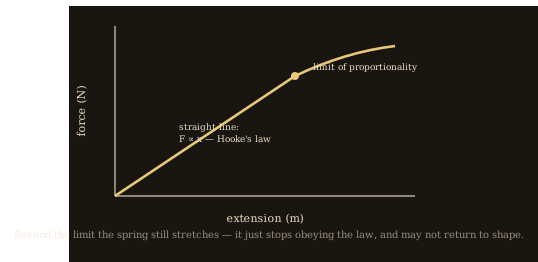
Reading the force–extension graph — what each feature means
- The graph is a STRAIGHT LINE THROUGH THE ORIGIN at first. Through the origin, because no force means no extension; straight, because doubling the force doubles the extension.
- That straight region is where HOOKE'S LAW applies: force is directly proportional to extension, F = k × x.
- The GRADIENT of that straight line is the spring constant k, in newtons per metre. A steep line means a stiff spring — a large force is needed for a small extension.
- At the LIMIT OF PROPORTIONALITY the line stops being straight. Beyond it the extension grows faster than the force, so the same extra newton produces more extension than it did before.
- Beyond the ELASTIC LIMIT the deformation is no longer elastic: remove the force and the spring does not return to its original length. It has been permanently stretched.
That last point is what statement 1.24 is about, and the definition is worth being precise about. ELASTIC deformation means the object returns to its original shape and size once the deforming force is removed. INELASTIC — often called plastic — deformation means it does not. The distinction is not about how far something stretched but about what happens when you let go. A spring stretched a long way but within its elastic limit is behaving elastically; a paperclip bent slightly past its limit is not.
Springs are the tidy case. Two other materials on this specification behave differently and are worth knowing as contrasts. A METAL WIRE obeys Hooke's law over a small extension and then yields, stretching a great deal for little extra force before it breaks. A RUBBER BAND does not obey Hooke's law at all over most of its range: its force–extension graph is a curve, not a straight line, and it also follows a different path being unloaded than it did being loaded. Hooke's law is a description of how some materials behave over part of their range — not a law of nature that everything obeys.
Finding a spring constant, and then using it
A spring is 4.0 cm long. When a force of 6.0 N is applied it is 10.0 cm long. Find the spring constant, then find the length when a force of 9.0 N is applied, assuming the limit of proportionality is not reached.
- Extension = stretched length − original length = 10.0 − 4.0 = 6.0 cm = 0.060 m. (Convert to metres, or k will not be in N/m.)
- k = F ÷ x = 6.0 ÷ 0.060 = 100 N/m.
- For 9.0 N: x = F ÷ k = 9.0 ÷ 100 = 0.090 m = 9.0 cm. That is the EXTENSION.
- Length = original length + extension = 4.0 + 9.0 = 13.0 cm.
Answer: k = 100 N/m, and the new length is 13.0 cm — an extension of 9.0 cm added to the original 4.0 cm.
2 · Grade 9 Notes
A different job from the section above. You have already understood it; this is the precise set of things to LEARN — definitions to reproduce word for word, processes in order, equations with units, and the answers that score full marks.
F = k × x
F is the force applied in newtons (N), k is the spring constant in newtons per metre (N/m), x is the EXTENSION in metres (m) — not the length
Units: N, N/m, m. Rearranged: k = F ÷ x and x = F ÷ k. The equation holds only up to the limit of proportionality.
Learn this definition · Hooke's law
The extension of a spring is directly proportional to the force applied to it, provided the limit of proportionality is not exceeded.
The four words this topic is marked on
- Extension
- The increase in length: stretched length minus original unstretched length.
- Spring constant
- The force needed per metre of extension, in N/m; the gradient of the straight part of a force–extension graph.
- Limit of proportionality
- The point beyond which the force–extension graph is no longer a straight line.
- Elastic limit
- The point beyond which the object no longer returns to its original shape when the force is removed.
Elastic against inelastic deformation
A. ELASTIC: the object returns to its original shape and size when the deforming force is removed. Nothing is permanently changed.
B. INELASTIC (plastic): the object does not return to its original shape. It stays permanently deformed after the force is removed.
Required practical 1.22 — how extension varies with applied force
- Clamp the spring vertically from a stand, with the stand weighted or clamped to the bench so it cannot topple.
- Measure the original length of the spring with a millimetre rule, with the rule vertical and the eye level with the marker.
- Hang a mass hanger from the spring and record the force in newtons, taking the weight of each 100 g slotted mass as approximately 1 N.
- Measure the new length and calculate the extension by subtracting the original length from it.
- Add masses one at a time, recording the force and the new length each time, for at least six values.
- Remove the masses one at a time and re-measure, to check whether the spring returns to its original length.
- Plot force on the vertical axis against extension on the horizontal axis, and draw a line of best fit through the straight region.
Variables
Independent (changed) — The force applied to the spring, in newtons
Dependent (measured) — The extension of the spring, in metres
| Control variable | Why it must be held constant |
|---|---|
| The same spring | different springs have different spring constants |
| Temperature | warming a spring changes its stiffness |
| Position of the rule | moving it between readings adds a false change in length |
| Time before reading | the spring must stop oscillating or the length is not steady |
Sources of error
| Type | What goes wrong | What to do |
|---|---|---|
| Systematic | The original length is measured with the mass hanger already attached, so every extension is too small. | Measure the unloaded length before attaching anything. |
| Judgement | Reading the rule from above or below the marker gives a parallax error in the length. | Read the rule with the eye level with the marker. |
| Random | The spring is still oscillating when the length is read, so readings scatter. | Wait until the spring is completely still. |
Reading the force–extension graph
- STRAIGHT LINE THROUGH THE ORIGIN — Hooke's law applies in this region
- GRADIENT of that line = the spring constant k, in N/m; a steeper line means a stiffer spring
- WHERE THE LINE CURVES = the limit of proportionality; beyond it, extension grows faster than force
- BEYOND THE ELASTIC LIMIT the spring does not return to its original length when unloaded
- A graph of force against LENGTH is also a straight line, but it does NOT pass through the origin
How three materials behave — the contrast examiners use
| Spring | Metal wire | Rubber band | |
|---|---|---|---|
| Obeys Hooke's law? | yes, up to the limit of proportionality | yes, over a small extension | no — the graph is a curve over most of its range |
| Shape of the graph | straight, then curving and becoming less steep beyond the limit of proportionality | straight, then a long yield before breaking | curved throughout, and S-shaped |
| Unloading | retraces the same path within the elastic limit | does not return once it has yielded | follows a different path from loading |
Model answer [4 marks]
A spring is 3.0 cm long. A force of 4.0 N stretches it to 7.0 cm. Calculate the spring constant, and state the assumption you have made. [4]
The extension is the increase in length, so x = 7.0 − 3.0 = 4.0 cm = 0.040 m. Using F = k × x, the spring constant k = F ÷ x = 4.0 ÷ 0.040 = 100 N/m. The assumption is that the limit of proportionality has not been exceeded, since Hooke's law and therefore this calculation apply only in the region where force is proportional to extension.
Not this: The extension is how long the spring is once the force is applied.
This: Extension is the INCREASE in length — the stretched length minus the original length. Using the full length instead gives the wrong spring constant, and a force–length graph does not pass through the origin.
Mark-losing trap. SUBTRACT the original length. Extension is the increase, never the total length.
Mark-losing trap. Convert centimetres to metres before finding k, or the units will not be N/m.
Mark-losing trap. Quote the condition: Hooke's law holds only up to the limit of proportionality.
Mark-losing trap. Elastic means it RETURNS to its original shape — the test is what happens when you let go, not how far it stretched.
3 · Prove it — the five questions
The five questions climb Grade 6 → Grade 7 → Grade 8 → Grade 9 → Grade 9 challenge, and are marked inside Incandio on your own device, by rule, with an authored diagnosis of the mistake you actually made. The mark schemes stay in the app so that the practice is worth doing; the questions themselves are here.
- Grade 6 · State [1 mark] — A spring is 5.0 cm long. When a mass is hung on it, it becomes 8.0 cm long. What is the extension?
- Grade 7 · State [2 marks] — A metal paperclip is bent slightly and springs back to its original shape. It is then bent much further and stays bent. Which statement describes this correctly?
- Grade 8 · Calculate [3 marks] — A spring of original length 6.0 cm is stretched to 14.0 cm by a force of 20 N. Calculate the spring constant in N/m.
- Grade 9 · Describe [6 marks] — A student investigates how the extension of a spring varies with the force applied. Select every statement that belongs in a full-mark description of a valid method.
- 9+ · Analyse [6 marks] — A student loads a spring far beyond its elastic limit, then removes all the masses and finds the spring is 2 cm longer than it started. They conclude: 'This proves Hooke's law is wrong.' Select every statement that belongs in a full-mark analysis.
The people behind this science
Two ways into the same idea — the one whose law this is, published as an anagram to hide it, and the one who first asked why materials fail rather than how they bend. Inside Incandio each of them answers knowing exactly which lesson you have just finished.
Robert Hooke — the one whose law this is, published as an anagram to hide it
Statement 1.23 is his result, found while he was Curator of Experiments at the Royal Society and obliged to demonstrate several new experiments every week. He announced it in 1676 not in words but as the anagram ceiiinosssttuv, so that he could prove priority later without revealing the finding — and two years afterwards unscrambled it as ut tensio, sic vis. He had good reason to be careful: he spent his life watching ideas he had proposed get credited to other people, most famously the inverse-square law of gravitation.
- “Why did you publish your law of the spring as an anagram first?”
- “What did you actually hang from a spring to find this?”
- “Does every material stretch in proportion to the force on it?”
- “What happens to a spring you have pulled too far?”
- “How did being Curator of Experiments shape what you worked on?”
Galileo Galilei — the one who first asked why materials fail rather than how they bend
Galileo's last book, the Two New Sciences of 1638, opens not with motion but with the strength of materials — how much a beam can carry, why a longer beam of the same shape is proportionally weaker, and why an animal or a ship cannot simply be scaled up without its bones or timbers failing. That is the other half of the question this page opens: Hooke describes how a material deforms under a force, and Galileo asks how much force it can take before it gives way. He also worked it out by hanging weights on things and looking.
- “Why can a structure not simply be built twice the size?”
- “What did you find out by hanging weights on beams?”
- “Why is a thick short rope stronger than a thin long one?”
- “What did you mean by calling the strength of materials a new science?”
- “How much can you learn about a material by loading it until it breaks?”
Think you understand it?
Reading is the start. On Incandio a topic counts as mastered only once you have taught it and defended it — the two things a revision guide cannot ask of you.
Incandio this topic → Prove it. Teach it. Defend it. What does “Incandio it” mean?
- Prove it — five questions on Hooke's Law and Elasticity, marked on the spot, that tell you what was missing rather than just what was wrong.
- Teach it — Explain Hooke's Law and Elasticity in your own words to Ember, an AI pupil who does not have it yet and asks the awkward question. Understanding is credited; wording is not required.
- Defend it — Argue Hooke's Law and Elasticity against Robert Hooke — three rounds, marked against descriptors you can read before you begin.
- Then the exam — read all 12 authored exam-style questions on this unit, each with its command word and its tariff, then have them marked on Incandio with the mistake you actually made named.
Completely free. No subscriptions, no paywalls, no account needed to start.
Carry on through the course
- Previous lesson: Stopping Distance
- Next lesson: Momentum
- Speed, and What a Distance–Time Graph Is Telling You — Speed as a rate, the units physics insists on, and how to read a journey straight off a graph.
- Acceleration and the Velocity–Time Graph — What acceleration actually measures, why its unit looks strange, and how one graph gives you both acceleration and distance.
- Forces, Vectors and Scalars — What a force actually does, why some quantities need a direction to mean anything, and why that makes a force one of them.
- Resultant Force, Friction and F = ma — Why a moving object stops, what really happens when you add forces up, and the one equation that connects force to motion.
- Weight and Terminal Velocity — What weight actually is, why it is not the same as mass, and what happens to a falling object once the air starts pushing back.
- All of Physics · Physics key terms · required practicals · equations · Incandio Science · The 4PH1 specification