Pearson Edexcel International GCSE in Biology · 4BI1 · Free · no account needed
Cloning Mammals
How a lamb was built from an udder cell, what that proved about every cell in your body, and what such animals are now used for.
Topic 5 · Use of biological resources — one of 8 lessons in this topic, and one of 68 in Biology.
This lesson ends with Ian Wilmut. Learn Cloning Mammals, teach it, then defend it against Ian Wilmut.
The definition this lesson teaches, word for word — every Biology definition.
- Nuclear transfer
- Placing the nucleus of a body cell into an egg cell whose own nucleus has been removed, so that the egg develops into an animal genetically identical to the nucleus donor.
What this lesson covers in the specification
Incandio is aligned to this specification. It is not published by, endorsed by or affiliated with Pearson, and it reproduces none of Pearson's wording — the statement numbers are given so you can check every lesson against your own copy.
- 5.19 — The stages in producing cloned mammals, illustrated by Dolly the sheep (bold B statement — Paper 2 only)
- 5.20 — How cloned transgenic animals can produce human proteins (bold B statement — Paper 2 only)
Specification section 5(d) Cloning — also taught in Micropropagation.
1 · Understand it
No exam language yet. The only question this section answers is: do I actually understand what is happening?
Every cell in your body came from one fertilised egg by mitosis, so every cell should contain the same genes. But a cell in your pancreas makes insulin and a cell in your eye does not, and for most of the twentieth century nobody could say why. There were two possible answers and they are very different. Either the specialised cell still holds the entire instruction set and simply keeps most of it switched off — or, as it specialised, it discarded what it would never need again. Hans Spemann set out the experiment that would decide it in 1938: take the nucleus out of a cell that has already become something, put it into an egg whose own nucleus has been removed, and see whether an animal can be built. He had no way of doing it. It took fifty-eight years.
In July 1996 a lamb was born at the Roslin Institute near Edinburgh whose nucleus had come from the mammary gland of a six-year-old ewe. A cell that had spent its life making milk protein built an entire sheep. That settled the question: the nucleus of a fully specialised adult cell still contains every gene the organism has, and the cytoplasm of an egg can switch the silent ones back on.
The stages of nuclear transfer, as they were done for Dolly
- A BODY CELL is taken from the sheep to be cloned — for Dolly, a cell from the mammary gland of an adult Finn Dorset ewe — and its NUCLEUS is kept.
- An unfertilised EGG CELL is taken from a second, different ewe, and its own nucleus is REMOVED, leaving the cytoplasm and nothing to direct it.
- The body-cell nucleus is placed into the emptied egg, and the two are FUSED with a brief electric pulse — which also stimulates the egg to begin dividing, the job normally done by fertilisation.
- The reconstructed cell divides by MITOSIS in culture to form an EMBRYO.
- The embryo is IMPLANTED into the uterus of a third ewe, a surrogate mother, which carries the pregnancy.
- The lamb born is genetically identical to the sheep that supplied the NUCLEUS — not to the ewe that supplied the egg, and not to the ewe that carried her.
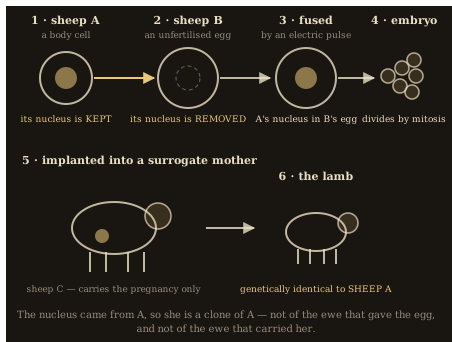
One qualification, because 'genetically identical' is very slightly too strong. Almost all of an animal's DNA is in the nucleus, and that came from the first ewe — but mitochondria have a small amount of their own DNA, and the mitochondria came with the egg. So the lamb is identical to the nucleus donor in every gene that matters for this specification, and carries a trace of the egg donor as well.
The other thing worth knowing is how badly it worked. Two hundred and seventy-seven reconstructed eggs were made. Twenty-nine developed far enough to be transferred to surrogate ewes. One lamb was born. That is roughly one success in every three hundred attempts, and the failure rate is not a detail — it is the honest answer to almost every question about whether this should be done to anything else. Dolly herself lived six and a half years and had six lambs, developed arthritis, and was put down after a lung infection that is common in sheep kept indoors. Whether cloning shortened her life is disputed; a later study of other sheep cloned from the same cell line found them ageing normally.
Now the reason anyone does this commercially, which is the second statement. Bacteria are excellent at making small human proteins like insulin, and for those the previous page is the whole story. But many human proteins are large, and a working molecule needs more than the right sequence of amino acids: it must be folded correctly and have particular chemical groups attached afterwards, and a bacterium cannot perform those finishing steps. A mammal can. So for those proteins the producer has to be a mammal, and the problem becomes how to get a human gene into one and then how to collect what it makes.
How a cloned transgenic animal produces a human protein
- The HUMAN GENE for the protein is inserted into the DNA of a sheep or goat cell, alongside a control sequence that switches the gene on only in the mammary gland.
- The nucleus of that TRANSGENIC cell is used for nuclear transfer, exactly as above, so an animal develops carrying the human gene in every one of its cells.
- The animal grows up, and when it produces MILK, the mammary gland reads the human gene and secretes the human protein into the milk.
- The protein is EXTRACTED from the milk and purified. The animal is milked repeatedly for years and is not harmed by it.
- Because making a transgenic animal succeeds so rarely, the one that works is CLONED — producing a flock of identical animals all secreting the same protein, rather than starting the whole process again.
Think of it like a hand-built prototype that finally works
Imagine an engineer who has spent two years hand-building a machine, failing hundreds of times, and at last has one that works properly. Nobody would respond by starting again from raw materials to build the second one. They would copy the working machine exactly, and go on copying it. That is the relationship between the two statements on this page. Producing an animal that secretes a human protein correctly is the two years of failure; cloning is the copying. It is also why the low success rate of nuclear transfer is tolerable here in a way it would not be otherwise — you only have to succeed once, and then you copy that success.
The objections are real and are worth stating precisely rather than generally. Most reconstructed embryos never develop, so a great many are made and lost for each animal born. Cloned animals are more likely than others to be born with abnormalities or to die soon after birth, which is a welfare cost that falls on the animals rather than the patients. A flock of clones has no genetic variation between its members, so a disease that one animal cannot resist, none of them can resist — and if the flock is the only source of the medicine, losing it stops the supply to the patients who depend on it. And some people object to modifying an animal so that it produces a substance for human use at all, which is a question about what animals are for rather than about whether the biology works. Set against that is a specific gain: proteins that cannot practically be made any other way, for patients who would otherwise have nothing.
2 · Grade 9 Notes
A different job from the section above. You have already understood it; this is the precise set of things to LEARN — definitions to reproduce word for word, processes in order, equations with units, and the answers that score full marks.
Learn this definition · Nuclear transfer
Placing the nucleus of a body cell into an egg cell whose own nucleus has been removed, so that the egg develops into an animal genetically identical to the nucleus donor.
The words this statement is marked on
- Clone
- An organism genetically identical to another because it developed from that organism's cells without fertilisation.
- Body cell
- Any cell of the organism other than a gamete — the source of the nucleus that is transferred.
- Enucleated egg
- An unfertilised egg cell whose own nucleus has been removed, leaving the cytoplasm to direct development.
- Electric pulse
- The brief current used to fuse the nucleus into the egg and to stimulate the egg to start dividing.
- Surrogate mother
- The female into whose uterus the embryo is implanted, which carries the pregnancy but contributes no nuclear DNA.
- Transgenic animal
- An animal carrying a gene transferred to it from a different species, such as a human gene for a protein.
Statement 5.19 — the stages to write, in order
- Take a body cell from the animal to be cloned and keep its nucleus.
- Take an unfertilised egg cell from a second animal and remove its nucleus.
- Place the body-cell nucleus into the emptied egg and fuse them with an electric pulse, which also stimulates division.
- Let the reconstructed cell divide by mitosis in culture to form an embryo.
- Implant the embryo into the uterus of a third animal, the surrogate mother.
- The offspring is genetically identical to the animal that supplied the nucleus.
Which sheep is Dolly a copy of
A. SHEEP A supplied the NUCLEUS, from a mammary-gland cell. Almost all the DNA came from here, so Dolly is genetically identical to sheep A.
B. SHEEP B supplied the EGG and sheep C carried the pregnancy. Neither contributed nuclear DNA, so Dolly resembles neither of them.
What Dolly actually proved
- The nucleus of a FULLY SPECIALISED adult cell still contains every gene the organism has
- Specialisation switches genes off; it does not throw them away
- The cytoplasm of an egg can switch those silent genes back on, so development starts again from the beginning
- An egg can be made to divide by an electric pulse instead of by fertilisation
- The success rate is very low: 277 reconstructed eggs, 29 embryos transferred, one live lamb
Statement 5.20 — making a human protein in bacteria or in an animal
| Transgenic bacteria | Cloned transgenic animals | |
|---|---|---|
| Suits which proteins | small, simple proteins such as insulin | large proteins needing correct folding and added chemical groups |
| Where it is made | in a fermenter, in any quantity | in the mammary gland, secreted into the milk |
| How it is collected | extracted from the culture and purified | extracted from the milk and purified, repeatedly for years |
| Speed of scaling up | hours — the bacteria divide every twenty minutes | years — an animal must be born and reach maturity |
| The main objection | few; the process is contained and uses no animals | most embryos are lost, abnormalities are commoner, and animal welfare is at stake |
Model answer [3 marks]
Explain why the lamb produced by nuclear transfer is genetically identical to the sheep that supplied the body cell. [3]
Almost all of an animal's DNA is contained in the nucleus, and the nucleus placed into the egg came from a body cell of that sheep, so it carries that sheep's alleles. The egg's own nucleus had been removed, so the egg contributed no nuclear DNA of its own. All the divisions that follow are mitosis, which produces cells with identical chromosomes, and no fertilisation takes place, so no alleles are contributed by a second parent and none are recombined.
Model answer [3 marks]
Explain why a company that has produced one transgenic goat secreting a human protein would then clone it. [3]
Inserting a human gene into an animal so that it is expressed correctly in the mammary gland succeeds only rarely, so producing another animal the same way would be slow, expensive and uncertain. Cloning the animal that already works produces offspring genetically identical to it, so every one of them carries the human gene and secretes the protein in the same way. The company therefore obtains a whole flock of reliable producers from a single success, rather than repeating a process that mostly fails.
Not this: A clone is the same individual as the animal it was made from, so it will have the same personality and the same life.
This: A clone has the same alleles, in the way identical twins do. Everything the environment affects — size, health, behaviour, how long it lives — can still differ, and identical twins are a closer copy of each other than a clone is of an animal born six years earlier.
Mark-losing trap. Say the egg's nucleus is REMOVED. An answer that leaves the egg's nucleus in has described fertilisation.
Mark-losing trap. Three animals, one copy: the NUCLEUS donor is the one the offspring matches.
Mark-losing trap. The electric pulse does two jobs — fuses the cells and starts the egg dividing. Both are worth saying.
Mark-losing trap. For 5.20, name the milk. The protein is secreted, so it can be collected without harming the animal.
3 · Prove it — the five questions
The five questions climb Grade 6 → Grade 7 → Grade 8 → Grade 9 → Grade 9 challenge, and are marked inside Incandio on your own device, by rule, with an authored diagnosis of the mistake you actually made. The mark schemes stay in the app so that the practice is worth doing; the questions themselves are here.
- Grade 6 · State [1 mark] — In nuclear transfer, what is done to the egg cell before the body-cell nucleus is put into it?
- Grade 7 · Explain [2 marks] — Dolly was made using a body cell from a white-faced Finn Dorset ewe, an egg from a black-faced ewe, and a black-faced surrogate mother. Dolly had a white face. Explain why.
- Grade 8 · Describe [5 marks] — Select every statement that belongs in a full-mark description of the stages used to produce a cloned mammal such as Dolly.
- Grade 9 · Calculate [3 marks] — Producing Dolly required 277 reconstructed egg cells, of which 29 developed far enough to be transferred to surrogate ewes, and one live lamb was born. Calculate the percentage of the reconstructed egg cells that produced a live lamb. Give your answer to two significant figures.
- 9+ · Evaluate [6 marks] — A company proposes to produce a human blood-clotting protein in the milk of a flock of cloned transgenic goats, for patients whose own protein is missing. Select every statement that belongs in a full-mark evaluation.
The people behind this science
Two ways into the same idea — the one who led the team that finally did it, and the one who described the experiment sixty years before it could be done. Inside Incandio each of them answers knowing exactly which lesson you have just finished.
Ian Wilmut — the one who led the team that finally did it
Wilmut led the Roslin group that produced Dolly in 1996, and he is the best possible corrective to how this lesson is usually remembered. He gives the arithmetic rather than the headline; he insisted publicly and under oath that the decisive idea was Keith Campbell's, not his — that the donor cell had to be starved into a resting state so its cycle matched the egg's; he opposed human cloning from the first day; and in 2007 he abandoned his own famous technique for reprogrammed stem cells, which achieve the same thing without an embryo.
- “How many attempts did it take before you had one live lamb?”
- “What was Keith Campbell's idea, and why was it the one that mattered?”
- “Is a clone the same animal as the one it was made from?”
- “Why did you give up nuclear transfer for stem cells?”
- “What did the newspapers get most wrong about Dolly?”
Hans Spemann — the one who described the experiment sixty years before it could be done
The procedure on this page was written down in 1938, in a book by a man who had no means of attempting it. Spemann had already shown, using a noose of hair from his infant son's head to constrict a newt embryo, that early cells have not yet been assigned their fates — and with Hilde Mangold he had found the small region of tissue that instructs the rest of an embryo what to become. The obvious next question was whether a cell that had already become something still held the whole instruction set. He proposed moving its nucleus into an emptied egg to find out, and called it fantastical because it was beyond any instrument then existing.
- “What made you think a nucleus could be moved into an emptied egg?”
- “How did a hair from a baby's head let you take an embryo apart?”
- “What did the organiser experiment show about how cells decide what to become?”
- “What part did Hilde Mangold play in the work that won the prize?”
- “Did you expect anyone would ever perform the experiment you described?”
Think you understand it?
Reading is the start. On Incandio a topic counts as mastered only once you have taught it and defended it — the two things a revision guide cannot ask of you.
Incandio this topic → Prove it. Teach it. Defend it. What does “Incandio it” mean?
- Prove it — five questions on Cloning Mammals, marked on the spot, that tell you what was missing rather than just what was wrong.
- Teach it — Explain Cloning Mammals in your own words to Ember, an AI pupil who does not have it yet and asks the awkward question. Understanding is credited; wording is not required.
- Defend it — Argue Cloning Mammals against Ian Wilmut — three rounds, marked against descriptors you can read before you begin.
- Then the exam — read all 10 authored exam-style questions on this unit, each with its command word and its tariff, then have them marked on Incandio with the mistake you actually made named.
Completely free. No subscriptions, no paywalls, no account needed to start.
Carry on through the course
- Previous lesson: Micropropagation
- Increasing Crop Yield — Everything a grower does is one of two things — remove whatever is limiting the crop, or remove whatever is competing with it.
- Yeast, Bread and Fermentation — One organism respiring without oxygen — and two industries built on the two different products it makes.
- Yoghurt and the Industrial Fermenter — Bacteria turned into a manufacturing process — and the vessel built to give them the best conditions they will ever have.
- Fish Farming and Selective Breeding — Growing food by controlling every loss of energy — and by doing deliberately what the environment does by accident.
- Genetic Engineering — Cutting a gene out of one organism and making another organism read it — and the reason that works at all.
- All of Biology · Biology key terms · required practicals · Incandio Science · The 4BI1 specification